Search This Blog

Sunday, 28 December 2025

Recognizing a lifetime of achievement

 Recognizing a lifetime of achievement

The Pindar Lifetime Achievement Award for 2025, presented by the International Association of Cape Horners, goes to Sir Robin Knox-Johnston KB CBE RD. Sir Robin, who lives in Portsmouth UK, has been inspiring sailors the world over since becoming the first person to sail solo non-stop around the world aboard his treasured 32ft 6in traditional wooden yacht Suhaili back in 1968-69.

He is still inspiring newcomers. The Clipper Round the World yacht race has introduced some 20,000 amateur crews to the sport since he co-founded the event in 1996. And this year, at the age of 86, he led old friends on a cruise to Greenland and back.

One circumnavigation was never going to be enough. Sir Robin has completed three, and also competed in the 1977-78 Whitbread Round the World Race, skippering the British maxi yacht Heath’s Condor to elapsed time victories on legs 2 and 4. - Full report

Thursday, 25 December 2025

Extraordinary boats: Ragtime – The 60-year-old yacht that launched a genre is back on the water

Extraordinary boats: Ragtime – The 60-year-old yacht that launched a genre is back on the water

Extraordinary boats: Ragtime – The 60-year-old yacht that launched a genre is back on the water

Yachting World
November 27, 2025
0shares


The painstaking two-year refit of Ragtime is complete, securing the legacy of the ultra-light displacement boat that stunned the racing world

TAGS:


The restoration of an iconic racer, one that was so ground-breaking it helped create a whole genre of yachts, is no small undertaking. But that’s exactly what inadvertent owner Tina Roberts ploughed into headfirst with the two-year refit of Ragtime, the original ultra-light displacement boat from the land of the long white cloud.

Designed and built single-handedly by New Zealander John Spencer for industrialist and racing driver Sir Tom Clark in 1963/64, Ragtime was launched as Infidel and was reputedly the largest hard chine plywood keelboat in the world.

Infidel immediately upset the racing establishment, beating the Tercel brothers’ 60-footer Ranger, which had won nearly every race it sailed over three decades. So comprehensive were Infidel’s victories that it was reportedly banned from competing in regattas in New Zealand. It was also barred from entering the 1967 Sydney-Hobart Race because it was deemed too light and not seaworthy enough for the notoriously treacherous 630-mile race.


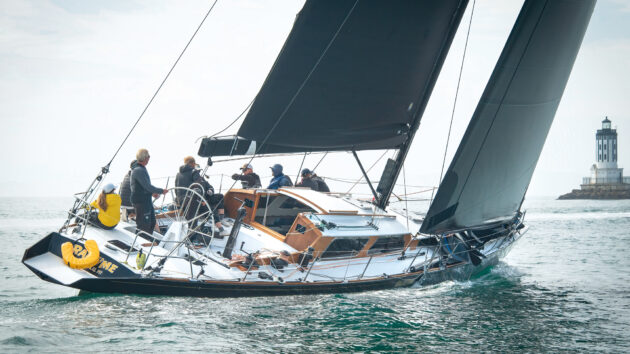
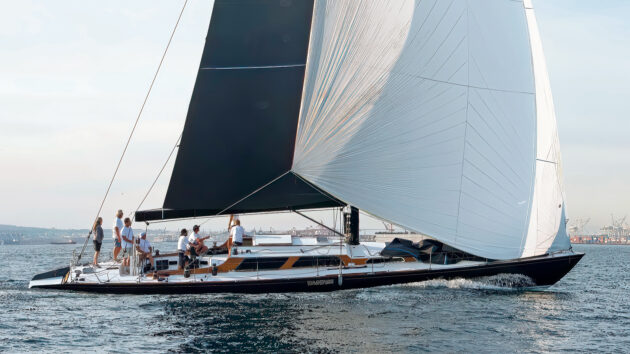
Under spinnaker, Ragtime’s low freeboard becomes evident. Photo: Steve Jost Photography
California dreaming

With nowhere to turn Infidel wound up where many wayward souls are welcomed: California. A pair of businessmen in Newport Beach purchased the yacht for $25,000 in 1969 and renamed it Ragtime.

The yacht changed owners again in 1971 and, 10 years after her launch, benchmarked the performance of the ultra-light displacement genre by defeating the 73-footer Windward Passage in the epic 1973 Transpac Race, winning the Barn Door Trophy for first-to-finish by a mere 4m 31s over the 2,225-mile course. “I remember thinking, ‘Wow, that’s an interesting boat. That’s cool,’” recalls California yacht designer Alan Andrews of his first sighting of Ragtime in the early 1970s.

“Ragtime was a big boat, most of the racing at the time was in 30- to 40-footers. She was clearly very fast, at least downwind, with the hard chines as well.”


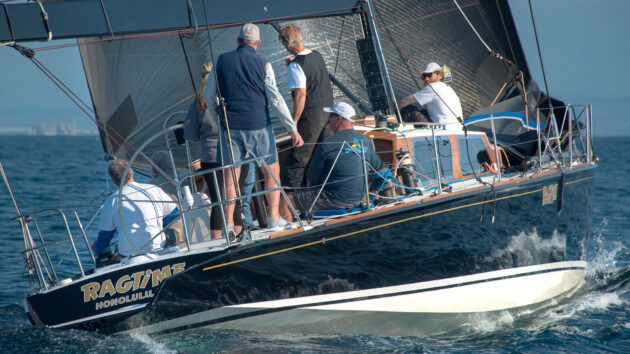
The plywood-built hull features hard chines that run its entire length. Photo: Steve Jost Photography

Ragtime is a simple but eye-catching yacht design, with a sheerline that drops noticeably from bow to stern. The hull is constructed from marine plywood; the cabin house, which stands tall of the sheerline, of kauri wood, and when launched it displaced 10 tons. The original LOA of 61ft 8in was determined in large part because that was the amount of floor space in Spencer’s shop, yet still the bow and stern hung outside the sliding doors on either end of the shed.

The boat hull features hard chines running the waterline length of 50ft 8in. In its original form Ragtime lacked an engine and was tiller steered, two features that were changed after she reached American shores.

Article continues below…

Demanding first night for Sydney Hobart >> Scuttlebutt Sailing News: Providing sailing news for sailors

Demanding first night for Sydney Hobart >> Scuttlebutt Sailing News: Providing sailing news for sailors

Demanding first night for Sydney Hobart

Published on December 24th, 2025

Strong southerlies and big ocean swell are shaping as the defining features of the opening stages of the 2025 Rolex Sydney Hobart Yacht Race which starts December 26. Given that the 628nm course is to the south, this equats to a demanding first night at sea.

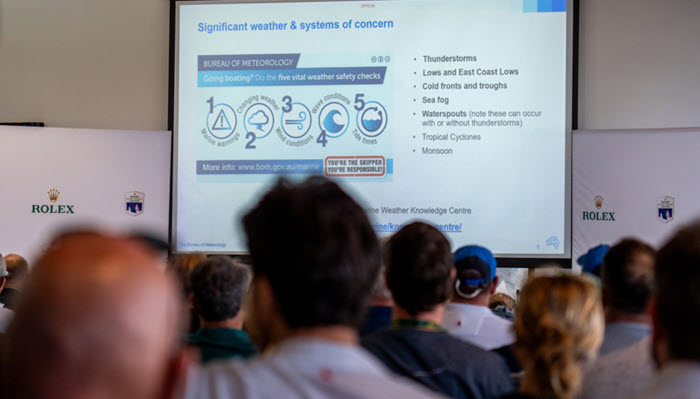
The Bureau of Meteorology (BOM) has warned crews to prepare for a sharp transition from Sydney Harbour sailing to full ocean conditions almost immediately after the start.

BOM meteorologist Edward Townsend-Medlock outlined a forecast dominated by a slow-moving high-pressure system sitting over Tasmania. While the system brings settled weather overall, its positioning puts the fleet on its eastern flank for the opening phase of the race — a scenario that delivers firm southerly winds and a long, mature swell rolling straight up the New South Wales coast.

At the start cannon, conditions inside Sydney Harbour are expected to be relatively orderly but brisk. Southerly winds in the 15–20 knot range will funnel through the harbor, enough to keep crews alert during the congested spinnaker start without creating the chaotic conditions seen in some recent editions.

Tuesday, 23 December 2025

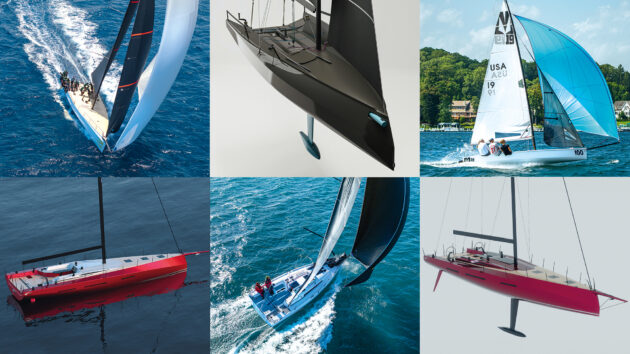
6 race-ready new yachts: Performance designs built for speed

6 race-ready new yachts: Performance designs built for speed

6 race-ready new yachts: Performance designs built for speed

Toby Hodges
November 26, 2025
0shares


Got a need for speed? The last year has delivered an explosive fleet of new performance yachts designed for one thing: getting there first.

TAGS:


Got a need for speed? The last year has delivered an explosive fleet of new performance yachts designed for one thing: getting there first.

Designers are leveraging every ounce of technology, from prepreg carbon fiber construction to optimised IRC/ORC configurations, resulting in some of the most dynamic and competitive yachts we’ve seen in years.

Whether you’re looking for a double-handed weapon or a grand-prix dominating maxi, the options are faster and sharper than ever before.

We dive into the cutting edge: Discover the Neo 620 Roma, a carbon-fiber mini-maxi built for fast cruising with the weight of a pure racer, and its lighter, competition-focused cousin, the 460 Competizione.

See how the radical Wallyrocket 71 stepped onto the global stage and instantly redefined the Maxi 72 class by taking the Rolex IMA Grand Prix World Championship.

Plus, check out the new wave of sportsboats, from the featherlight, trailable Melges 19 to the pure one-design thrill of the KiSS 25.

These yachts aren’t just built to sail—they’re built to win.


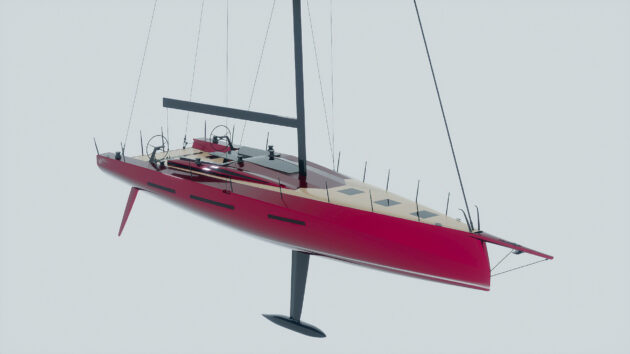
Neo 620 Roma (& 460 Competizione)

This rocketship is the second Carkeek design for Italian carbon cognoscenti Neo Yachts.

The Neo 620 is its new flagship, which will muscle into the competitive mini-maxi arena.

It’s an evolution of the 570 we featured a couple of years ago (check out the video tour), and continues to sport Carkeek’s distinctive chamfered topsides, which run into a reverse sheerline, a stealth bomber-style shape first seen on racing machines such as Ràn.

The 620 has various layout options, primarily adding a third heads compartment compared to its smaller sister, and providing the option for a convertible fourth cabin space, which can be used as a nav station, for dining or sleeping – all while keeping weight to a mere 13.5 tonnes (nearly half of which is ballast in a deep keel).

Neo manages this wizardry by building the 620 in prepreg carbon fibre, fitted with a high-modulus carbon rig.

Cariboni hydraulics aid high-speed control, while it can sport a single or twin rudders, has space for a 3m tender, and includes 400lt tanks for both fuel and water.

Founded by competitive sailor and sailmaker Paolo Semeraro, Neo has now built 30 custom or semi-custom high-performance yachts since 2018.

The ‘Roma’ branding is Neo’s fast cruising line, which reflects the possibility for the wood veneered interior to be removable.

So these yachts suit those wanting to compete at high-level events with the lightest-weight boat, yet do so while protecting the timber finish and maintaining resale value.

Sunday, 21 December 2025

Port And Starboard: How To Remember The Difference | Dictionary.com

Port And Starboard: How To Remember The Difference | Dictionary.com

Port and Starboard: How to Remember the Difference

top down image of boat, blue filter

🛳️ Quick summary

Port and starboard refer to directions on nautical vessels and aircraft. When facing the front of the vehicle, port refers to the left side, and starboard refers to the right side. 

Ahoy, matey! Because they don’t want to walk the plank, sailors use the words port and starboard to make sure they know which direction the captain is talking about. However, it’s easy for landlubbers to get turned around by these words.

In this article, we will define the words port and starboard as they are used in the context of nautical vessels and aircraft, explain why they are used, and give a quick tip on how to remember which word is which. 

port vs. starboard

Port and starboard are terms used on nautical vessels and aircraft to refer to directions. When facing the front of the vessel, port refers to the left side, and starboard refers to the right side. 

Sailors use port and starboard rather than left and right to avoid confusion. People riding cars, trains, and buses usually all face toward the front of the vehicle, so they all have the same “left” and “right.” However, a sailor on a boat can face in any direction, so “left” and “right” will mean something different, depending on where the sailor is. The left and right sides of the boat itself don’t change, though, so port and starboard will refer to the same direction, no matter which direction you’re facing on a boat. The nautical terms bow and fore (front) and stern and aft (back) are used for the same reasons. 

To keep port and starboard straight, remember that port has the same number of letters as left, so they mean the same thing.

A common myth says that the word posh originated as an acronym of “port out, starboard home,” referring to the traveling habits of the wealthy. As fun as that story is, the evidence doesn’t support it.

Saturday, 20 December 2025

Scuttlebutt Sailing News


Friday, December 19, 2025 - Issue 6493

Rockport Marine’s R-37 ‘Lobster Yacht.’ Photo: Pim Van Hemmen.

This newsletter is provided through the support of its sponsors, delivering a digest of major sailing news, commentary, opinions, features and dock talk…with a North American focus.

Today's sponsors:
Quantum Sails - Rockport Marine


And to all a good night

The 28th year of Scuttlebutt Sailing News is coming to a close, with this to be the final newsletter for 2025. The past couple months have been hectic as we line up advertising for next year, with only 13 newsletter ad slots remaining (click here if interested). Now our focus turns to holiday cheer, and we wish you all Merry Christmas and Happy New Year, with the newsletter to return on January 6, 2026.

Crisis in American Youth Sports

It was in the 1980s when youth sailing was modeled after other youth sports, and this paved the way for age-based boats and focused coaching. It also created a bubble of youth events which impacted the transition into adult sailing.

The shift increased the focus on improvement while limiting exposure to other sailing opportunities, and for a lot of kids, they never found the fun in the sport. This was not a unique problem to sailing, and is the basis for why John O’Sullivan founded the Changing the Game Project.

He wanted to put the ‘play’ back in ‘play ball’ and recently testified before the United States House of Representatives Subcommittee on Early Childhood, Elementary, and Secondary Education.

The hearing was titled “The Crisis in American Youth Sports and Its Cost to Our Future.” And that title says everything. This conversation was about burnout. Dropout. Rising costs. Pressure. And the millions of kids walking away from sports that were supposed to help them grow.

John shared what has been seen for years through coaches, parents, and athletes across every level of sport. When competition outweighs connection, kids leave. When adults lose perspective, kids pay the price.

Youth sports should be a place where children build confidence, character, and community. Instead, too many environments are pushing kids out before they ever get the chance to fall in love with the game.

This update from Changing the Game Project was posted on Facebook which prompted significant commentary.

Friday, 19 December 2025

Losing interest in America’s Cup


Scuttlebutt Sailing Club, the official club of Scuttlebutt Sailing News, officially sanctioned by US Sailing since 2001, and officially available to all Scuttlebutt readers. SSC fulfills the racing rule which requires club membership. For details, click here.

Losing interest in America’s Cup

by Roger Marshall
Interesting story on the America’s Cup, but I wonder who is deluding who (whom?). To quote, “it’s the last great sporting event that hasn’t been commercialized.” The America’s Cup was commercialized in the 1930’s when Sir Thomas Lipton (he of Lipton Tea), entered the fray.

The America’s Cup used to be interesting in that hull shapes somewhat resembled the boats that everyday sailors sailed. Gear such as winch design, headstay foils, sail development directly trickled down to the guy who goes out for an afternoon sail. The America’s Cup was the World Series of day sailing. The Admiral’s Cup was the Superbowl of offshore sailing. The boats of the time were similar to boats the average sailor owned and could easily relate to.

In those days, there were challenger trials and defender trials, all with a path to the finals. The buildup may have been slow, out of sight of most spectators, but it lasted all summer and crested in September. It was closely followed by sailors all over the world. I remember being called by a friend from Sweden during the Australia-Freedom series. He was in a restaurant and put me on speaker for all to hear. I heard the roar when I told him Australia was ahead. None of that would happen today.

Today the America’s Cup caters to spectators by going around a short course that is, frankly, boring as all hell. As soon as one boat gets in front, it’s over. The boats have little trickle down for the average guy except for, maybe electronics. The America’s Cup sailors wear helmets, talk on radios, cycle or wind handlebars to charge the batteries. Where does that relate to today’s sailor? Do you put grandma on a bicycle to fuel your Sunday afternoon cruise? Do you ask your wife and kids to wear helmets and talk into microphones while eating Oreos?

I can see the need for speed, after all, every America’s Cup sailor tries to make the boat go faster, be it a J Class, a 12-meter or any of the other AC boats, but frankly the spectacle has become very narrow and very boring with absolutely no buildup. Even SailGP does better, in that it has a series, a gradual build up, and a final event. But even that has become a highly specialized, made-for-TV event.

That is why the America’s Cup is dying.

Wednesday, 17 December 2025

Italy SailGP Team restructures roster >> Scuttlebutt Sailing News: Providing sailing news for sailors

Italy SailGP Team restructures roster >> Scuttlebutt Sailing News: Providing sailing news for sailors


Italy SailGP Team restructures roster


Scuttlebutt Sailing News: Providing sailing news for sailors · 21 hours ago
by Assoc Editor · Feature


Red Bull Italy SailGP Team have confirmed a major restructuring of its roster for the 2026 season, unveiling Phil Robertson as the team’s new driver and welcoming Jana Germani as strategist. The move is part of a deliberate performance strategy designed to boost the Italian outfit’s chances of achieving their ultimate goal: to win the SailGP Championship.

New Zealander Robertson is among SailGP’s most experienced athletes, and returns to the driver’s seat having led the Chinese, Spanish and Canadian teams in Seasons 1, 2 & 3 and 4. Italy’s Germani joins SailGP off the back of a glittering career on the Olympic dinghy circuit, during which she won five national titles, three World and European medals and represented her country at the Paris 2024 Olympics.

Both Robertson and Germani will join the team early, making their debuts at the Mubadala Abu Dhabi Sail Grand Prix 2025 Season Grand Final, presented by Abu Dhabi Sports Council. Their early integration is aimed at sharpening onboard communication and coordination before the 2026 Season begins in Perth in January.

Two-time Olympic champion Ruggero Tita will remain an essential part of the program as an alternate driver, while Maelle Frascari will also continue to be part of the Italian roster.

Red Bull Italy SailGP Team CEO Jimmy Spithill said: “Anytime you can add Olympic, SailGP and World Championship-level talent, it’s a great day for the team. Having both Jana and Phil join Ruggi and Maelle on our roster really puts the team in a strong position looking at the seasons ahead.”

The news comes after SailGP announced its new Athlete Transfer framework, designed to bring new clarity, structure and long-term stability to athlete movement.

Sunday, 14 December 2025

Ainslie getting ready to show the money >> Scuttlebutt Sailing News: Providing sailing news for sailors

Ainslie getting ready to show the money >> Scuttlebutt Sailing News: Providing sailing news for sailors

Ainslie getting ready to show the money

Published on November 14th, 2025

Britain’s Ben Ainslie leads Athena Racing, representing Royal Yacht Squadron Racing Ltd as the America’s Cup Challenger of Record. This is Ainslie’s fourth effort as team leader, but after losing INEOS as sponsor after the 2024 edition, funding questions lingered for the 2027 campaign.

Ainslie hopes to provide the answers within weeks about who will bankroll his next America’s Cup team,

The most successful Olympic sailor lifted the “Auld Mug” in 2013 with Oracle Team USA, but has made it his goal to “bring the Cup home” to Britain, where it was first contested off the south coast in 1851.

“It’s coming very soon … within the next two to four weeks, we’ll have more to say on that,” Ainslie told Reuters. “Watch this space.”

Thursday, 11 December 2025

Is the Olympic Sailing medal becoming just a participation trophy? – Matt Sheahan

Is the Olympic Sailing medal becoming just a participation trophy? – Matt Sheahan

Is the Olympic Sailing medal becoming just a participation trophy? – Matt Sheahan

Matthew Sheahan
November 14, 2025
0shares


If a new Olympic Sailing format is needed, how do we make it fair? It surely can’t be TV that calls the shots

TAGS:


What should an Olympic medal represent? Is it still sport’s ultimate accolade? Is it a demonstration that you’re the best in the world and have dedicated your entire life to proving it? Or is it more of a blue Peter badge, a confirmation that you took part in a piece of sporting media entertainment that you should be proud of?

As we head towards the next Olympic Games regatta in San Diego there are a growing number of sailors who are extremely worried that the medals in 2028 will represent more of a memento for turning up rather than a celebration of being the world’s best.

It’s no secret that Olympic Sailing has had the sword of Damocles hanging over it for decades. An expensive, complicated sport that still isn’t as inclusive as the modern age requires has been a hard sell for a long time.

For years the sport has resisted a class cull to rationalise the overall fleet and bring the numbers down to more economically viable proportions. You could argue that it should have led the way and merged the genders for all of the double-handers to keep classes and disciplines while reducing the head count. And though this has happened in the 470s and Nacra cats, the sport has introduced the equivalent of BMX bike and skateboard categories in the foilers, in the hope these more street-style classes will draw in a huge new audience.


Paris 2024 Olympic Sailing in Marseille, France on 1 August, 2024. Photo: World Sailing / Sander van der Borch

I have nothing against foiling boards or kite foils – they’re exciting – but these new classes have not brought spectators and supporters in the kind of numbers that will turn around the economic fortunes of Olympic Sailing. And neither will changing the medal racing format by reducing it to a single, short, winner-take-all final race between the top four.

Apparently, this is what could be on the cards for Los Angeles. I’m told there are plans to reduce the fleet racing stages beforehand to just three days with no reserve or lay days – which surely doesn’t help to even out the spikes in weather and fortune that often influence our sport. And all in the name of creating a greater sense of jeopardy to make our sport more exciting.

Really? More of a lottery by the sounds of it. Imagine if you turned up at your national championships where you’d worked hard at consistently delivering the points during the week only to be told that the points buffer you’d accumulated counted for nothing when it came to a shot at the trophy.

That’s effectively what happened to British iQFoil sailor Emma Wilson, who was 31 points ahead in the games last year. We know how that played out for her… a bronze.

Wednesday, 10 December 2025

In pursuit of the Jules Verne Trophy >> Scuttlebutt Sailing News: Providing sailing news for sailors

In pursuit of the Jules Verne Trophy >> Scuttlebutt Sailing News: Providing sailing news for sailors

In pursuit of the Jules Verne Trophy

Alexia Barrier and seven female crew of The Famous Project CIC began their pursuit of the Jules Verne Trophy at 13:40 UTC on November 29, sailing the 103-foot trimaran IDEC SPORT in hopes of claiming the prize for the fastest crewed, non-stop, unassisted circumnavigation of the globe.

Tuesday, 9 December 2025

New leadership for Sail Canada >> Scuttlebutt Sailing News: Providing sailing news for sailors

New leadership for Sail Canada >> Scuttlebutt Sailing News: Providing sailing news for sailors

“I am delighted to be taking on the role as Chair for Sail Canada after serving the past two years on the Board of Directors,” said Cochrane. “I am looking forward to working with my fellow Board members, our Chief Executive Officer, Sail Canada staff, and our Member Organizations over the next two years.

“I would like to welcome Dan and Jennifer to the Board. As well, thank you to Kate MacLennan, who has devoted numerous hours over her tenure as a member of the Board of Directors for seven years, and then as our Chair for the past years. We will continue to benefit from her prior leadership going forward.

Sunday, 7 December 2025

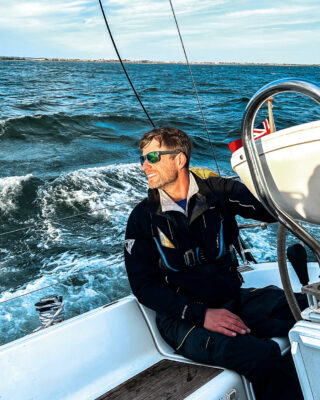
RYA Yachtmaster Exam: A day-by-day account


RYA Yachtmaster Exam: A day-by-day account of the Preparation you need to pass


Yachting World · 14 days ago
by Theo Stocker · Special reports


Theo Stocker knew he was a competent sailor, but not having an RYA Yachtmaster ticket was a gap he needed to fill. Here's how he handled the intense week of preparation and the one-day exam

Any very competent and highly experienced yachtsmen and women don’t have any qualifications at all and are content to keep it that way, but not being a Yachtmaster bothered me.

I was pretty sure I was up to the standard, but I didn’t know. Becoming an RYA Yachtmaster is something I’ve wanted to do for years.

Unlike RYA Day Skipper etc, the Yachtmaster is not an attendance-based course, but a one-day exam in which an examiner will form an objective opinion of your abilities, and recommend you to the RYA/MCA Yachtmaster Qualification Panel to become a Yachtmaster… or not.

Technically, no instruction is required beforehand and the theory course is not compulsory. However, you will certainly need theory knowledge of the level of the RYA Yachtmaster Offshore shorebased course, with practical experience and skills to match, to stand any chance of passing.

It is strongly recommended to have a few days’ preparation, ideally immediately before the exam, with the same boat and crew. Many sailing schools offer a Yachtmaster preparation course, normally of five days, with your examination at the end of it.

I completed my preparation course and exam, together with my friend, Andrew, at the Hamble School of Yachting.

During the pre-exam training it was made abundantly clear this was not a course on which we could be taught what we needed to know; this should have been gained over our years of experience.

The week’s aim instead was to run through the Yachtmaster syllabus to reveal our weaknesses and bad habits.


Traditional and modern navigation tools are used
Swatting Up

Andrew and I spent five days swatting up. The preparation course, led by instructor Matt Sillars, included Collision Regulations (I quickly found that I’d had significant ‘skills fade’ in my detailed knowledge of the IRPCS).

We practised safety briefings and engine checks; marina boat handling; navigation and pilotage; safety drills; manoeuvres, including downwind sail handling and rigging a preventer; and some of the softer skills involved in skippering a crew.

Thoroughly prepared, the exam was looming…

Article continues below…

Exam Day

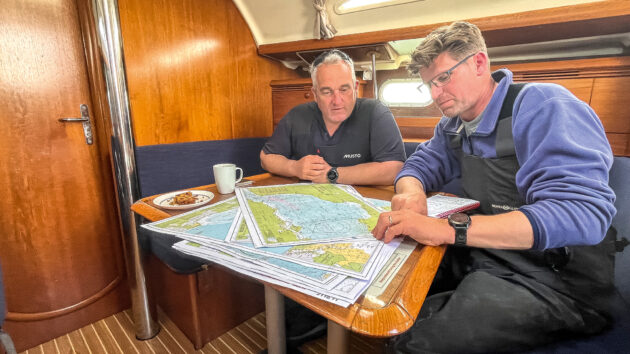
The exam starts a day or two before the examiner turns up, as they may want to see a passage plan you’ve prepared in advance. It’s best to do this two or three days before to avoid a last-minute panic, but not too far in advance that you’ve forgotten the sums you’ve done and why you made the choices you did.

I was set a passage from Bembridge to St Vaast, giving me a potentially fiddly drying harbour at either end. After completing our plans, we did some last-minute swatting up on lights, shapes and sounds.

Exam day dawned bright and breezy with a forecasted good Force 5 from the south-west. Matt reassured us that making mistakes wasn’t the end of the world, if we showed competence in getting ourselves back on track.


Theo takes the helm

The only sorts of errors that would probably be an outright fail, other than flunking lights and shapes, are safety-critical things such as a collision, running aground, an inability to navigate and pilot, or an uncontrolled gybe.

We were joined at 0900 by our examiner Andy Wright, RYA Yachtmaster instructor trainer, examiner and centre inspector, and an MCA Master 200 who also works as an RNLI area lifesaving manager.

There’d be no ‘getting away with it’ here. We began the day with a coffee and chat, while Andy spent some time asking about our reasons for taking the exam, before laying out what he would be looking for: “I’m not going to be trying to catch anyone out, but what I want to see you demonstrate is that you can skipper the boat, navigate the boat, handle the boat under power and handle the boat under sail.”


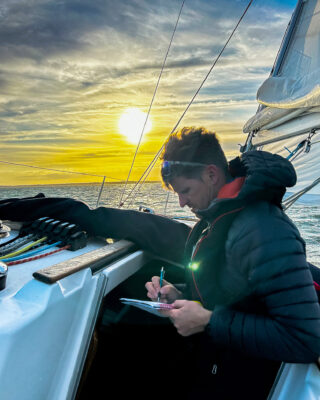
Preparing for night nav
Safety First

We began, as we had during our prep week, with safety briefings. With the engine bay open, our examiner took time to probe our knowledge of troubleshooting, various parts of the engine, the significance of blue, black or white smoke from the exhaust (incomplete combustion, burning oil and overheating), how to change filters, impellers and belts and how to bleed the fuel.

On deck, we were asked to explain when and why each kind of flare would be used. None of it felt overly pressured, but it was certainly an in-depth examination of our knowledge.

During the day these conversations continued on areas that were not being practically demonstrated on the day – including 20 minutes on lights, shapes, sounds and collision avoidance, and how we’d handle different scenarios in traffic separation schemes.

We were asked to talk through our passage plans, and our examiner went further to see whether we knew what the administrative and immigration requirements would be on either side of the Channel – a tricky one these days.


Passage planning skills are thoroughly tested
Getting Underway

We began with marina manoeuvres in and out of a selection of increasingly tricky berths, putting the boat into positions that we might not have chosen, including a berth two spaces into a gulley with a yacht moored either side and another boat opposite.

Ferry gliding in bows-first wasn’t too tricky, but with wind and tide pushing us on, getting out again was harder. I opted to use prop walk to pull the stern out against a bow line – slightly unconventional, and it needed a bit of oomph, but I got away without a collision.

We then had half an hour or so to each prepare a short passage plan and pilotage, this time from Hamble to Portsmouth and back.

I was asked to explain the route I’d chosen. While I had the route in the chartplotter, I’d picked waypoints near easy-to-find buoys so I could see I was in the right place from the cockpit.

Underway, and with our fourth crewmember on the wheel (it’s recommended to have crew so you can demonstrate leadership and also help handle the yacht), I had decisions to make about how many reefs to put in, and was torn between sailing the boat properly and being overly cautious.


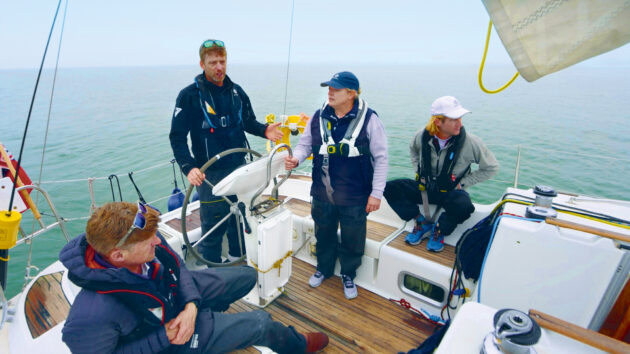
Working with crew

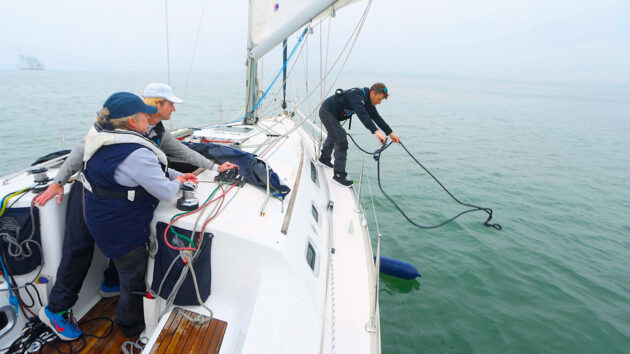
Next we were tested on our MOB recovery with a fender overboard. We went through our recovery drill and I was relieved to get back to the MOB first go.

Andrew and crew looked at me to see if we were doing ‘the whole thing’ and, as our examiner hadn’t flinched, we continued rigging the handy billy, attached the fender to the sling and hauled away until it was safely aboard, just as we had in our preparation week – it’s a complex process that really does need practice.

Once in Portsmouth Harbour, it was my turn to find and pick up a mooring buoy under sail. Handing over skippering duty to Andrew for his turn in the hot seat, I felt a wave of relief that my passage, pilotage and handling seemed to have gone okay.

However, we wouldn’t be finished until we’d each done our night navigation.


Engine checks
Night Navigation

Back on a mooring inside Calshot Spit it was time for dinner and a brief respite, before plunging on with night nav exercises.

We were asked to navigate to unmarked locations and given a bit of time to prepare these. Our examiner also checked our knowledge of how the radar worked for collision avoidance and for navigation, and how to extract relevant information from both the chartplotter and the AIS.

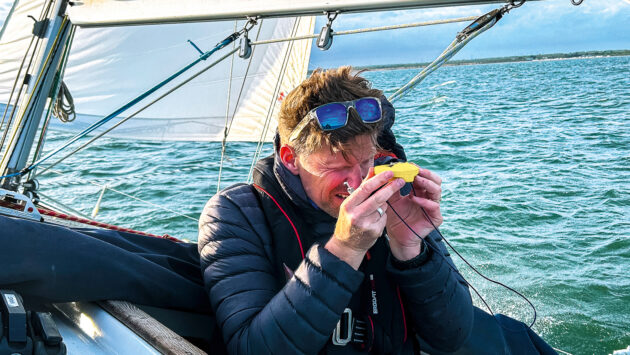
My night nav began well, using multiple sources of position information as requested, and just about making sense of my hastily drawn sketch and notes, looking for the characteristics of particular lights (you’ll need to know how quick VQ compared to just Q really is) and using the radar to plot our course.


Manoeuvres under sail are tested, including downwind sail handling and preventers

As it was top of the tide, however, every ship in Southampton seemed to set sail, including the maiden voyage of the Queen Mary cruise liner with attendant tugs, police launches and party boats.

My plan was thrown into disarray as we were blinded by disco balls and oil terminal lights alike. Luckily, Navionics is by no means banned, and a quick range and bearing in the palm of my hand gave me a course and distance to my imaginary point. Another step closer.

Next Andrew needed to pilot us up the Hamble River, where Hamble Point’s sector lights can be easily lost in the welter of shore lights, and I was asked to bring the boat alongside, stern first at the end of a long gulley, giving me another last-minute chance to mess things up.


MOB recovery techniques have been updated
Pass Or Fail

With the boat put to bed, we each headed off for a quick chat. Fortunately, our examiner told us we’d both passed. Phew!

Both Andrew and I had found the week intense, all-absorbing and demanding. We’d been forced to up our game, and our skills had been updated by a decade or two. There were lots of learnings to take back to our own boats and both of us felt we were now much better-rounded skippers than before.
If you enjoyed this….
Yachting World is the world’s leading magazine for bluewater cruisers and offshore sailors. Every month we have inspirational adventures and practical features to help you realise your sailing dreams.

Build your knowledge with a subscription delivered to your door. See our latest offers and save at least 30% off the cover price.

Friday, 5 December 2025

The Psychology Behind Why Outdoor Sports Are So Much Fun


The Psychology Behind Why Outdoor Sports Are So Much Fun
feed favicon
Outside Online · 5 hours ago
by awise · Exploration & Survival
The Psychology Behind Why Outdoor Sports Are So Much Fun

To surf Dessert, a standing wave in the middle of the Ottawa River, one must paddle a quarter mile from shore, drift down to a set of rapids, line up the approach perfectly, pivot at just the right moment, and with a burst of power strokes either slide onto the shoulder or catch the foam pile. If you miss the wave, wipe out, or get flushed, it can take half an hour to try again, starting with a cross-current slog back to shore and a long hike upstream—in my case, lugging a SUP and stewing over what went wrong. Which I did dozens of times over the past few years. Which kind of sucks.

Proficient at riding a much more accessible but short-lived wave that only works when the river is surging with snowmelt, I sought the same feeling on Dessert. With absolutely zero success. This made me wonder why some of us spend countless hours learning how to ski or bike down mountains, or scrambling back onto paddleboards while dodging rocks in the rapids. Outdoor enthusiasts tend to be meticulous planners, not daredevils, according to Australian adventure psychologist Eric Brymer. So, what exactly are we craving?

Our Brains Like the Challenge

As exasperating as those attempts at Dessert were, the effort itself was probably part of the appeal. Evolutionarily, we’re programmed to follow the path of least resistance, but in modern urban lives, easy often begets boredom. If it’s a struggle to do something, the outcome can be more rewarding. “Outdoor adventure can feel good precisely because it’s hard,” says psychology researcher Michael Inzlicht, who runs the University of Toronto’s Work and Play Lab. “Despite these oversized brains, we’re still embodied creatures.”

Yet what if there doesn’t seem to be much ROI from all that floundering? So many swims at Dessert, a couple seconds of surfing. My progress may have been imperceptible, but each wipeout made me slightly less bad, suggests Inzlicht. To him, this is an example of “effortful leisure,” which can be a source of deeper meaning and purpose—or what he calls “eudaimonic wellbeing”—that hobbies such as binge-watching Naked and Afraid don’t deliver.

“Outdoor adventure can feel good precisely because it’s hard.”

Inzlicht was right, because this past summer, I finally began to figure out the wave. I locked in during the approach, kept my balance while turning, and committed to digging in with my blade. My rides were fleeting and butterflies set up camp in my stomach, but I had an inexorable urge to drive through rush-hour traffic to the put-in every day after work.

Unfragmented Consciousness

To understand what was brewing inside my head, as a water-logged proxy for what extreme athletes feel, I contacted Susan Houge Mackenzie, who moved to New Zealand from California in her early twenties and became a wilderness guide, leading clients on river surfing trips with bodyboards and fins. (Or as she describes it: rafting without the raft.) “There’s a tension between anxiety and excitement when you’re getting close to the wave,” says Mackenzie, now a sport psychology researcher at New Zealand’s University of Otago. “During activities like this, we’re almost always flipping back and forth.”

Fluctuating between these telic and paratelic states is common in whitewater. In the former, people are serious, goal-oriented, and arousal avoidant; in the latter, we’re playful, spontaneous, and game for a thrill. Individual personalities differ, but the multiphasic nature of these types of pursuits, plus a dash of fear, could be “a precursor to optimal experiences,” says Mackenzie. What’s more, the trajectory of emotions people typically go through while river surfing, from nervous anticipation to stimulation, relief, confidence, peace, and a sense of accomplishment, is derived from the ability to display expertise in a challenging situation and the creativity we feel while immersed in the activity—a buzz that persists long after we’re off the water.

“The skills required to navigate rapids,” Mackenzie says, “help you tune out other aspects of your life and focus on what’s right in front of you.” Circa 2025, this “unfragmented consciousness” is rare and precious.

man surfing riverA man surfing on the Kananaskis River (Photo: Aaron Black/Getty)

Even though she’s 9,000 miles away, it’s like Mackenzie is peering into my skull. In mid-August, on my birthday, I picked up an oversized sandwich at an Italian deli and spent the day at Dessert (named thusly, I’ve been told, because it’s a treat to be consumed after Ottawa’s spring surfing season is finished). On my second attempt, I paddled out, pivoted, and slid into a supersensory harmony. I was in synch with the wave, shifting my weight slightly and stepping back and forth to carve and glide on its short, steep face. My body seemed to move on its own—flying, floating—as if powered by the river, roaring over a limestone shelf toward the sea.

Later, sitting in the shade to eat that sandwich, all of my worries had evaporated. Problems morphed into possibilities. Small stuff was not sweated.

Flow State

Researcher Eric Bryner, from Australia’s Southern Cross University, tells me this wasn’t a cognitive leap. Looking at outdoor sports through the lens of ecological psychology, which revolves around the relationship between humans and the physical environment, he says that when we’re “dancing with nature,” we’re scanning and exploring with our bodies, trying to make sense of the world. Surfing is not necessarily an augmented process in the brain; distance and time might be directly perceived, catalyzing our rapid-fire actions. In this context, emotions we label as fear or anxiety are not negative, simply information to absorb as our bodies wobble and bounce and settle into energized focus. Basically: flow.

We’re on top of the world during and après surf, Bryner suggests, because activities like this, surrendering to the moment, failing and grinding, playing at the edge of our comfort zones in dynamic outdoor environments, are “a fundamental way to be human.” They shut down cognitive chatter, our haptic senses fully alive.

I confess to Byrner that I can’t stop thinking about river surfing. “Tiger in a cage,” he replies.

Confined in an artificial space, a tiger feels suppressed, unwell. Bogged down in cities and cubicles, that’s us. “Essentially, we’re locking ourselves in a cage,” Bryner says. “Some of us don’t realize there’s a door, and even if we see it, a lot of us are afraid to open it. But if you open it and step outside, you’re where human beings feel most at home.

“We call this adventure,” he continues, “but really, it should be considered normal.”

The post The Psychology Behind Why Outdoor Sports Are So Much Fun appeared first on Outside Online.

Thursday, 4 December 2025

Great Britain wins SailGP Season 5 - Scuttlebutt

Great Britain wins SailGP Season 5 >> Scuttlebutt Sailing News: Providing sailing news for sailors 

Great Britain wins SailGP Season 5

The fifth season of SailGP finished as it should with Great Britain taking the title. They had been the form team, winning the most events (3 of 12), but still had to overcome the final stage on November 29-30 in Abu Dhabi, UAE.

The season began and ended with events in the Middle East, and while the United Arab Emirates oil money must be good for the league, the meager shoreside fan action was matched by the light winds on the Persian Gulf. A league built on high adrenaline instead strolled.

However, the top three teams on the season leaderboard - Great Britain, New Zealand, and Australia - survived the six fleet races to advance to the winner-take-all $2 million Grand Final. As this was the lone event decided on the fleet races alone, their focus was to keep defender Spain out, which made for odd optics as the best teams did poorly.

Wednesday, 3 December 2025

New Wallyrocket 71: The Next Generation Racing Yacht

New Wallyrocket 71: The Next Generation Racing Yacht

New Wallyrocket 71: The Next Generation Racing Yacht

Yachting World
November 13, 2025
0shares


The new Wallyrocket 71 is the latest evolution in performance racing from Wally to rival other maxis on the market

TAGS:


Wally launches a second Rocket. If the name and look seem familiar, it’s because we ran plenty of coverage of the first Wallyrocket 51 earlier this year, following its eagerly awaited launch and build-up to the Admiral’s Cup and Rolex Fastnet Race.

Yet just as we began featuring the first Rocket, Wally announced this larger sistership, with both yachts launching in the same season. Both are Botin Partners designs, and where the 51 is conceived to take on the TP52s and smash races on handicap, the 71 has the equally herculean task of becoming the ‘world’s most successful maxi’.


Wallyrocket 71 Django 7X became a world champ at its first major regatta. Photo: Gilles Martin-Raget

Compared with its main Maxi 72 rivals then (most of which have been extended), the Wallyrocket 71 is two tonnes lighter, with over 30% more water ballast (2.7 tonnes of it) for the same sail area, which brings advantages both in the light and going downwind. It can clock upwind speeds of 10.5-11 knots, while matching or exceeding true winds going the other way.

“We started from a blank sheet of paper, asking how we could beat the most competitive Maxi 72s on corrected time,” Botin’s Adolfo Carrau explains. “When they were designed, it was to a box rule, so many parameters were already set. Now, as everyone is optimising their boats under IRC rules, there is a lot more freedom.”


Clean, Spartan carbon interior – it’s a racing yacht after all. Photo: Gilles Martin-Raget

Giovanni Lombardi Stronati commissioned the build of the first 71, Django 7x, at King Marine in Valencia. It is already being campaigned by his Italian Django team, which represented the Yacht Club Costa Smeralda (YCCS) at the Admiral’s Cup with the first 51. Once again, this team is galvanised by the affable Vasco Vascotto, who holds more world titles than any other sailor.


Django 7x’s first major regatta was the Rolex Maxi Yacht Cup in September, hosted by the team’s club YCCS, where it took on the likes of seasoned competitors such as Bella Mente, Vesper, Jolt and Jethou – and beat them all, to claim the first Rolex IMA Grand Prix World Championship. Quite the proof of concept!

Article continues below…


World’s Coolest Yachts: Wallygator II


“This was the boat that represented the style of Wally and was the first large yacht really able to sail…


Wallyrocket 51 review: Is this the world’s fastest new raceboat (on handicap)?


You have to admire the ambition. A goal to create the fastest race boat in the world (on corrected time)…
Wallyrocket 71 Specifications:

LOA: 21.44m 70ft 4in
Beam: 5.55m 18ft 3in
Draught: 4.90m 16ft 1in
Displacement: 12,500kg 27,558lb
Sail area (upwind): 305m2 3,283ft2
Sail area (downwind): 630m2 6,781ft2
Contact details: wally.com

RG Richardson City Guides

RG Richardson City Guides
Interactive City and Finance Guides

RG Richardson City Guides

RG Richardson City Guide has over 300 guides let our interactive search city guides do the searching, no more typing and they never go out of date. With over 13,900 preset searches, you only have to click on the preset icon. Search for restaurants, hotels, hostels, Airbnb, pubs, clubs, fast food, coffee shops, real estate, historical sites and facts all just by clicking on the icon. Even how to pack is all there.

Recognizing a lifetime of achievement

  Recognizing a lifetime of achievement The Pindar Lifetime Ac...