Search This Blog

Friday, 19 December 2025

Losing interest in America’s Cup


Scuttlebutt Sailing Club, the official club of Scuttlebutt Sailing News, officially sanctioned by US Sailing since 2001, and officially available to all Scuttlebutt readers. SSC fulfills the racing rule which requires club membership. For details, click here.

Losing interest in America’s Cup

by Roger Marshall
Interesting story on the America’s Cup, but I wonder who is deluding who (whom?). To quote, “it’s the last great sporting event that hasn’t been commercialized.” The America’s Cup was commercialized in the 1930’s when Sir Thomas Lipton (he of Lipton Tea), entered the fray.

The America’s Cup used to be interesting in that hull shapes somewhat resembled the boats that everyday sailors sailed. Gear such as winch design, headstay foils, sail development directly trickled down to the guy who goes out for an afternoon sail. The America’s Cup was the World Series of day sailing. The Admiral’s Cup was the Superbowl of offshore sailing. The boats of the time were similar to boats the average sailor owned and could easily relate to.

In those days, there were challenger trials and defender trials, all with a path to the finals. The buildup may have been slow, out of sight of most spectators, but it lasted all summer and crested in September. It was closely followed by sailors all over the world. I remember being called by a friend from Sweden during the Australia-Freedom series. He was in a restaurant and put me on speaker for all to hear. I heard the roar when I told him Australia was ahead. None of that would happen today.

Today the America’s Cup caters to spectators by going around a short course that is, frankly, boring as all hell. As soon as one boat gets in front, it’s over. The boats have little trickle down for the average guy except for, maybe electronics. The America’s Cup sailors wear helmets, talk on radios, cycle or wind handlebars to charge the batteries. Where does that relate to today’s sailor? Do you put grandma on a bicycle to fuel your Sunday afternoon cruise? Do you ask your wife and kids to wear helmets and talk into microphones while eating Oreos?

I can see the need for speed, after all, every America’s Cup sailor tries to make the boat go faster, be it a J Class, a 12-meter or any of the other AC boats, but frankly the spectacle has become very narrow and very boring with absolutely no buildup. Even SailGP does better, in that it has a series, a gradual build up, and a final event. But even that has become a highly specialized, made-for-TV event.

That is why the America’s Cup is dying.

Wednesday, 17 December 2025

Italy SailGP Team restructures roster >> Scuttlebutt Sailing News: Providing sailing news for sailors

Italy SailGP Team restructures roster >> Scuttlebutt Sailing News: Providing sailing news for sailors


Italy SailGP Team restructures roster


Scuttlebutt Sailing News: Providing sailing news for sailors · 21 hours ago
by Assoc Editor · Feature


Red Bull Italy SailGP Team have confirmed a major restructuring of its roster for the 2026 season, unveiling Phil Robertson as the team’s new driver and welcoming Jana Germani as strategist. The move is part of a deliberate performance strategy designed to boost the Italian outfit’s chances of achieving their ultimate goal: to win the SailGP Championship.

New Zealander Robertson is among SailGP’s most experienced athletes, and returns to the driver’s seat having led the Chinese, Spanish and Canadian teams in Seasons 1, 2 & 3 and 4. Italy’s Germani joins SailGP off the back of a glittering career on the Olympic dinghy circuit, during which she won five national titles, three World and European medals and represented her country at the Paris 2024 Olympics.

Both Robertson and Germani will join the team early, making their debuts at the Mubadala Abu Dhabi Sail Grand Prix 2025 Season Grand Final, presented by Abu Dhabi Sports Council. Their early integration is aimed at sharpening onboard communication and coordination before the 2026 Season begins in Perth in January.

Two-time Olympic champion Ruggero Tita will remain an essential part of the program as an alternate driver, while Maelle Frascari will also continue to be part of the Italian roster.

Red Bull Italy SailGP Team CEO Jimmy Spithill said: “Anytime you can add Olympic, SailGP and World Championship-level talent, it’s a great day for the team. Having both Jana and Phil join Ruggi and Maelle on our roster really puts the team in a strong position looking at the seasons ahead.”

The news comes after SailGP announced its new Athlete Transfer framework, designed to bring new clarity, structure and long-term stability to athlete movement.

Sunday, 14 December 2025

Ainslie getting ready to show the money >> Scuttlebutt Sailing News: Providing sailing news for sailors

Ainslie getting ready to show the money >> Scuttlebutt Sailing News: Providing sailing news for sailors

Ainslie getting ready to show the money

Published on November 14th, 2025

Britain’s Ben Ainslie leads Athena Racing, representing Royal Yacht Squadron Racing Ltd as the America’s Cup Challenger of Record. This is Ainslie’s fourth effort as team leader, but after losing INEOS as sponsor after the 2024 edition, funding questions lingered for the 2027 campaign.

Ainslie hopes to provide the answers within weeks about who will bankroll his next America’s Cup team,

The most successful Olympic sailor lifted the “Auld Mug” in 2013 with Oracle Team USA, but has made it his goal to “bring the Cup home” to Britain, where it was first contested off the south coast in 1851.

“It’s coming very soon … within the next two to four weeks, we’ll have more to say on that,” Ainslie told Reuters. “Watch this space.”

Thursday, 11 December 2025

Is the Olympic Sailing medal becoming just a participation trophy? – Matt Sheahan

Is the Olympic Sailing medal becoming just a participation trophy? – Matt Sheahan

Is the Olympic Sailing medal becoming just a participation trophy? – Matt Sheahan

Matthew Sheahan
November 14, 2025
0shares


If a new Olympic Sailing format is needed, how do we make it fair? It surely can’t be TV that calls the shots

TAGS:


What should an Olympic medal represent? Is it still sport’s ultimate accolade? Is it a demonstration that you’re the best in the world and have dedicated your entire life to proving it? Or is it more of a blue Peter badge, a confirmation that you took part in a piece of sporting media entertainment that you should be proud of?

As we head towards the next Olympic Games regatta in San Diego there are a growing number of sailors who are extremely worried that the medals in 2028 will represent more of a memento for turning up rather than a celebration of being the world’s best.

It’s no secret that Olympic Sailing has had the sword of Damocles hanging over it for decades. An expensive, complicated sport that still isn’t as inclusive as the modern age requires has been a hard sell for a long time.

For years the sport has resisted a class cull to rationalise the overall fleet and bring the numbers down to more economically viable proportions. You could argue that it should have led the way and merged the genders for all of the double-handers to keep classes and disciplines while reducing the head count. And though this has happened in the 470s and Nacra cats, the sport has introduced the equivalent of BMX bike and skateboard categories in the foilers, in the hope these more street-style classes will draw in a huge new audience.


Paris 2024 Olympic Sailing in Marseille, France on 1 August, 2024. Photo: World Sailing / Sander van der Borch

I have nothing against foiling boards or kite foils – they’re exciting – but these new classes have not brought spectators and supporters in the kind of numbers that will turn around the economic fortunes of Olympic Sailing. And neither will changing the medal racing format by reducing it to a single, short, winner-take-all final race between the top four.

Apparently, this is what could be on the cards for Los Angeles. I’m told there are plans to reduce the fleet racing stages beforehand to just three days with no reserve or lay days – which surely doesn’t help to even out the spikes in weather and fortune that often influence our sport. And all in the name of creating a greater sense of jeopardy to make our sport more exciting.

Really? More of a lottery by the sounds of it. Imagine if you turned up at your national championships where you’d worked hard at consistently delivering the points during the week only to be told that the points buffer you’d accumulated counted for nothing when it came to a shot at the trophy.

That’s effectively what happened to British iQFoil sailor Emma Wilson, who was 31 points ahead in the games last year. We know how that played out for her… a bronze.

Wednesday, 10 December 2025

In pursuit of the Jules Verne Trophy >> Scuttlebutt Sailing News: Providing sailing news for sailors

In pursuit of the Jules Verne Trophy >> Scuttlebutt Sailing News: Providing sailing news for sailors

In pursuit of the Jules Verne Trophy

Alexia Barrier and seven female crew of The Famous Project CIC began their pursuit of the Jules Verne Trophy at 13:40 UTC on November 29, sailing the 103-foot trimaran IDEC SPORT in hopes of claiming the prize for the fastest crewed, non-stop, unassisted circumnavigation of the globe.

Tuesday, 9 December 2025

New leadership for Sail Canada >> Scuttlebutt Sailing News: Providing sailing news for sailors

New leadership for Sail Canada >> Scuttlebutt Sailing News: Providing sailing news for sailors

“I am delighted to be taking on the role as Chair for Sail Canada after serving the past two years on the Board of Directors,” said Cochrane. “I am looking forward to working with my fellow Board members, our Chief Executive Officer, Sail Canada staff, and our Member Organizations over the next two years.

“I would like to welcome Dan and Jennifer to the Board. As well, thank you to Kate MacLennan, who has devoted numerous hours over her tenure as a member of the Board of Directors for seven years, and then as our Chair for the past years. We will continue to benefit from her prior leadership going forward.

Sunday, 7 December 2025

RYA Yachtmaster Exam: A day-by-day account


RYA Yachtmaster Exam: A day-by-day account of the Preparation you need to pass


Yachting World · 14 days ago
by Theo Stocker · Special reports


Theo Stocker knew he was a competent sailor, but not having an RYA Yachtmaster ticket was a gap he needed to fill. Here's how he handled the intense week of preparation and the one-day exam
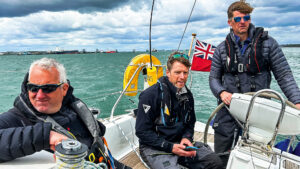
Any very competent and highly experienced yachtsmen and women don’t have any qualifications at all and are content to keep it that way, but not being a Yachtmaster bothered me.

I was pretty sure I was up to the standard, but I didn’t know. Becoming an RYA Yachtmaster is something I’ve wanted to do for years.

Unlike RYA Day Skipper etc, the Yachtmaster is not an attendance-based course, but a one-day exam in which an examiner will form an objective opinion of your abilities, and recommend you to the RYA/MCA Yachtmaster Qualification Panel to become a Yachtmaster… or not.

Technically, no instruction is required beforehand and the theory course is not compulsory. However, you will certainly need theory knowledge of the level of the RYA Yachtmaster Offshore shorebased course, with practical experience and skills to match, to stand any chance of passing.

It is strongly recommended to have a few days’ preparation, ideally immediately before the exam, with the same boat and crew. Many sailing schools offer a Yachtmaster preparation course, normally of five days, with your examination at the end of it.

I completed my preparation course and exam, together with my friend, Andrew, at the Hamble School of Yachting.

During the pre-exam training it was made abundantly clear this was not a course on which we could be taught what we needed to know; this should have been gained over our years of experience.

The week’s aim instead was to run through the Yachtmaster syllabus to reveal our weaknesses and bad habits.
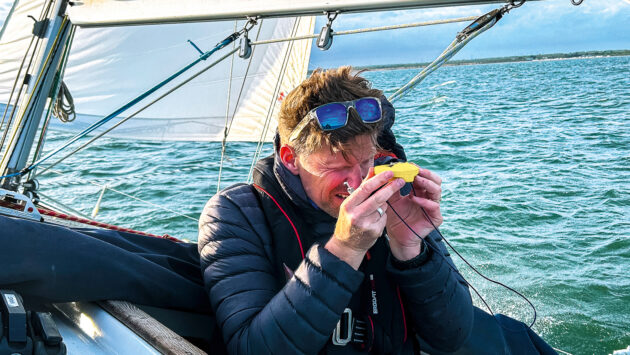

Traditional and modern navigation tools are used
Swatting Up

Andrew and I spent five days swatting up. The preparation course, led by instructor Matt Sillars, included Collision Regulations (I quickly found that I’d had significant ‘skills fade’ in my detailed knowledge of the IRPCS).

We practised safety briefings and engine checks; marina boat handling; navigation and pilotage; safety drills; manoeuvres, including downwind sail handling and rigging a preventer; and some of the softer skills involved in skippering a crew.

Thoroughly prepared, the exam was looming…

Article continues below…

Exam Day

The exam starts a day or two before the examiner turns up, as they may want to see a passage plan you’ve prepared in advance. It’s best to do this two or three days before to avoid a last-minute panic, but not too far in advance that you’ve forgotten the sums you’ve done and why you made the choices you did.

I was set a passage from Bembridge to St Vaast, giving me a potentially fiddly drying harbour at either end. After completing our plans, we did some last-minute swatting up on lights, shapes and sounds.

Exam day dawned bright and breezy with a forecasted good Force 5 from the south-west. Matt reassured us that making mistakes wasn’t the end of the world, if we showed competence in getting ourselves back on track.
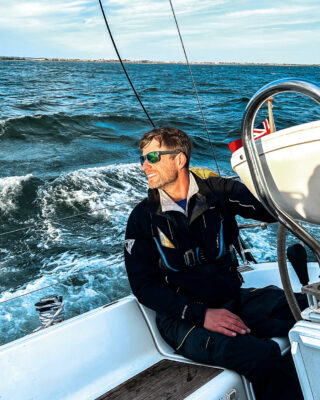

Theo takes the helm

The only sorts of errors that would probably be an outright fail, other than flunking lights and shapes, are safety-critical things such as a collision, running aground, an inability to navigate and pilot, or an uncontrolled gybe.

We were joined at 0900 by our examiner Andy Wright, RYA Yachtmaster instructor trainer, examiner and centre inspector, and an MCA Master 200 who also works as an RNLI area lifesaving manager.

There’d be no ‘getting away with it’ here. We began the day with a coffee and chat, while Andy spent some time asking about our reasons for taking the exam, before laying out what he would be looking for: “I’m not going to be trying to catch anyone out, but what I want to see you demonstrate is that you can skipper the boat, navigate the boat, handle the boat under power and handle the boat under sail.”
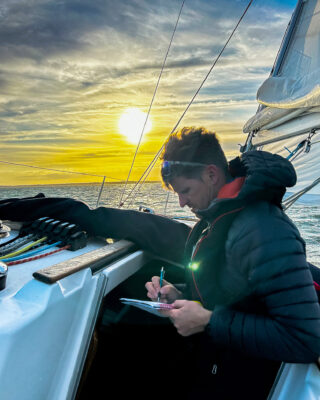

Preparing for night nav
Safety First

We began, as we had during our prep week, with safety briefings. With the engine bay open, our examiner took time to probe our knowledge of troubleshooting, various parts of the engine, the significance of blue, black or white smoke from the exhaust (incomplete combustion, burning oil and overheating), how to change filters, impellers and belts and how to bleed the fuel.

On deck, we were asked to explain when and why each kind of flare would be used. None of it felt overly pressured, but it was certainly an in-depth examination of our knowledge.

During the day these conversations continued on areas that were not being practically demonstrated on the day – including 20 minutes on lights, shapes, sounds and collision avoidance, and how we’d handle different scenarios in traffic separation schemes.

We were asked to talk through our passage plans, and our examiner went further to see whether we knew what the administrative and immigration requirements would be on either side of the Channel – a tricky one these days.
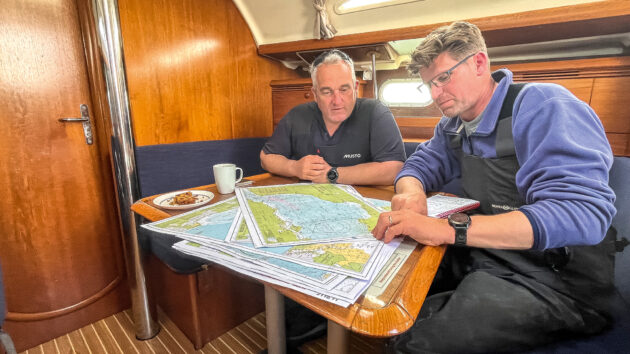

Passage planning skills are thoroughly tested
Getting Underway

We began with marina manoeuvres in and out of a selection of increasingly tricky berths, putting the boat into positions that we might not have chosen, including a berth two spaces into a gulley with a yacht moored either side and another boat opposite.

Ferry gliding in bows-first wasn’t too tricky, but with wind and tide pushing us on, getting out again was harder. I opted to use prop walk to pull the stern out against a bow line – slightly unconventional, and it needed a bit of oomph, but I got away without a collision.

We then had half an hour or so to each prepare a short passage plan and pilotage, this time from Hamble to Portsmouth and back.

I was asked to explain the route I’d chosen. While I had the route in the chartplotter, I’d picked waypoints near easy-to-find buoys so I could see I was in the right place from the cockpit.

Underway, and with our fourth crewmember on the wheel (it’s recommended to have crew so you can demonstrate leadership and also help handle the yacht), I had decisions to make about how many reefs to put in, and was torn between sailing the boat properly and being overly cautious.
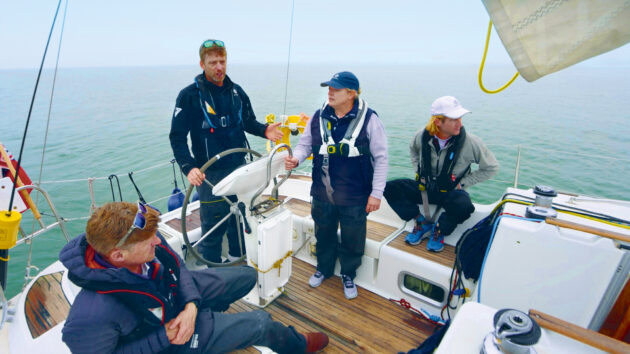

Working with crew

Next we were tested on our MOB recovery with a fender overboard. We went through our recovery drill and I was relieved to get back to the MOB first go.

Andrew and crew looked at me to see if we were doing ‘the whole thing’ and, as our examiner hadn’t flinched, we continued rigging the handy billy, attached the fender to the sling and hauled away until it was safely aboard, just as we had in our preparation week – it’s a complex process that really does need practice.

Once in Portsmouth Harbour, it was my turn to find and pick up a mooring buoy under sail. Handing over skippering duty to Andrew for his turn in the hot seat, I felt a wave of relief that my passage, pilotage and handling seemed to have gone okay.

However, we wouldn’t be finished until we’d each done our night navigation.
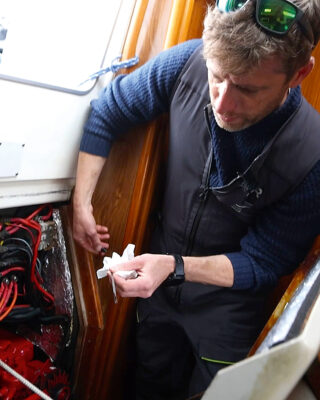

Engine checks
Night Navigation

Back on a mooring inside Calshot Spit it was time for dinner and a brief respite, before plunging on with night nav exercises.

We were asked to navigate to unmarked locations and given a bit of time to prepare these. Our examiner also checked our knowledge of how the radar worked for collision avoidance and for navigation, and how to extract relevant information from both the chartplotter and the AIS.

My night nav began well, using multiple sources of position information as requested, and just about making sense of my hastily drawn sketch and notes, looking for the characteristics of particular lights (you’ll need to know how quick VQ compared to just Q really is) and using the radar to plot our course.
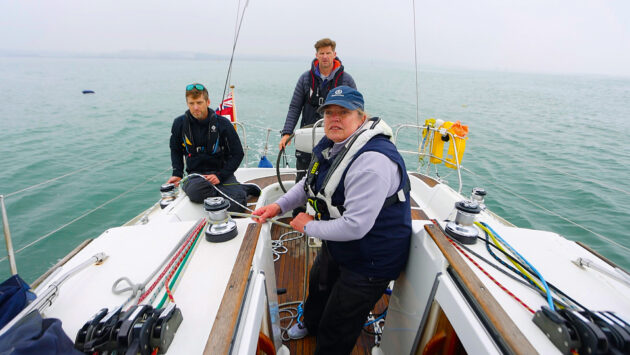

Manoeuvres under sail are tested, including downwind sail handling and preventers

As it was top of the tide, however, every ship in Southampton seemed to set sail, including the maiden voyage of the Queen Mary cruise liner with attendant tugs, police launches and party boats.

My plan was thrown into disarray as we were blinded by disco balls and oil terminal lights alike. Luckily, Navionics is by no means banned, and a quick range and bearing in the palm of my hand gave me a course and distance to my imaginary point. Another step closer.

Next Andrew needed to pilot us up the Hamble River, where Hamble Point’s sector lights can be easily lost in the welter of shore lights, and I was asked to bring the boat alongside, stern first at the end of a long gulley, giving me another last-minute chance to mess things up.
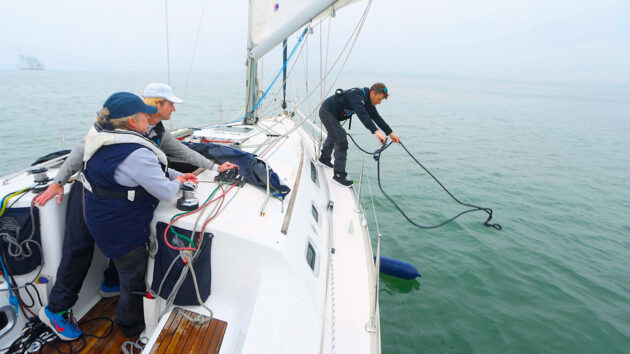

MOB recovery techniques have been updated
Pass Or Fail

With the boat put to bed, we each headed off for a quick chat. Fortunately, our examiner told us we’d both passed. Phew!

Both Andrew and I had found the week intense, all-absorbing and demanding. We’d been forced to up our game, and our skills had been updated by a decade or two. There were lots of learnings to take back to our own boats and both of us felt we were now much better-rounded skippers than before.
If you enjoyed this….
Yachting World is the world’s leading magazine for bluewater cruisers and offshore sailors. Every month we have inspirational adventures and practical features to help you realise your sailing dreams.

Build your knowledge with a subscription delivered to your door. See our latest offers and save at least 30% off the cover price.

RG Richardson City Guides

RG Richardson City Guides
Interactive City and Finance Guides

RG Richardson City Guides

RG Richardson City Guide has over 300 guides let our interactive search city guides do the searching, no more typing and they never go out of date. With over 13,900 preset searches, you only have to click on the preset icon. Search for restaurants, hotels, hostels, Airbnb, pubs, clubs, fast food, coffee shops, real estate, historical sites and facts all just by clicking on the icon. Even how to pack is all there.

Mikaela Shiffrin keeps World Cup slalom streak going but slams course conditions in night race | CBC Sports

Mikaela Shiffrin keeps World Cup slalom streak going but slams course conditions in night race | CBC Sports Mikaela Shiffrin keeps World Cup...