
Prospector’s ‘Doomsday’ Mansion
Vernon Pick was an American millionaire who left behind a unique property in Lillooet, BC.

Tyler Olsen TodayThe Tyee
Tyler Olsen is a senior editor at The Tyee.Our journalism is supported by readers like you. Click here to support The Tyee.
7 Comments
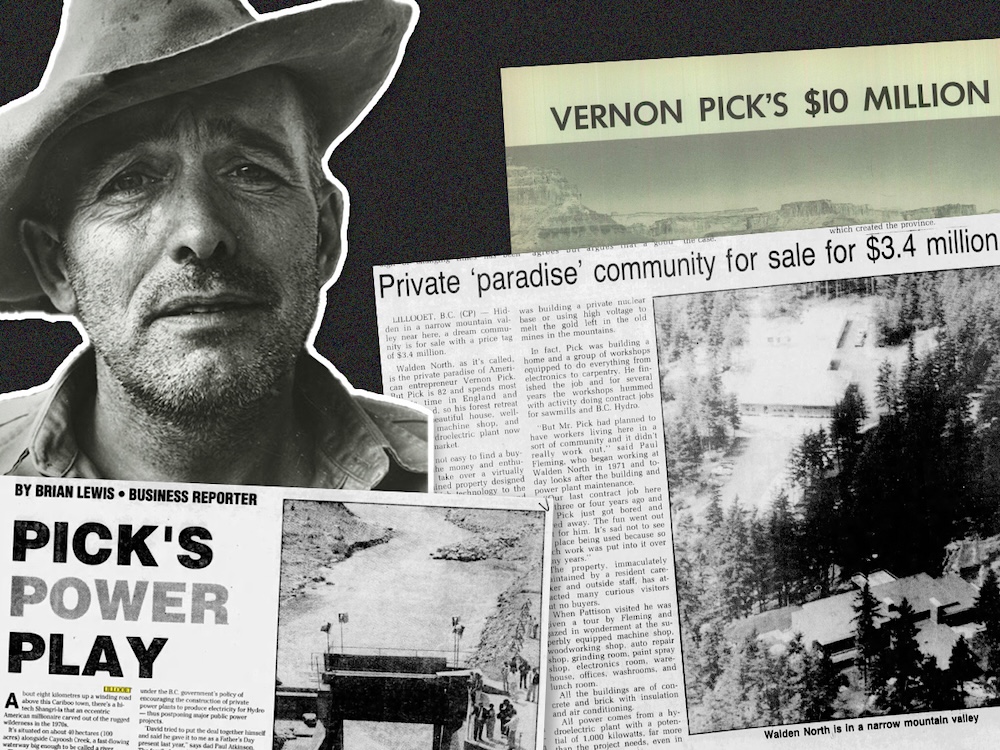 Vernon Pick struck it rich after discovering a uranium deposit in Colorado in the 1950s. The self-taught engineer and inventor later created a unique home powered by its own dam near Lillooet, BC. Photo illustration by The Tyee. Images via Newspapers.com.
“To be a philosopher is not merely to have subtle thoughts, nor even to found a school, but so to love wisdom as to live according to its dictates, a life of simplicity, independence, magnanimity, and trust. It is to solve some of the problems of life, not only theoretically, but practically.” — Henry Thoreau, Walden
Announcements, Events & more from Tyee and select partners
Youth Homelessness Is a Call to Action

In Vancouver, there are more unhoused youth than there are shelter beds. Family Services of Greater Vancouver is working to change that.
Word gets around fast when a uranium tycoon moves to a small town and starts building his own dam to power an off-the-grid high-tech research facility.
Was Vernon Pick building a nuclear base? Or seeking his own Armageddon hideout? Surely, some thought, there was something nefarious going on at a property with a home accessible only by an electric-powered railway.
North America’s “Uranium King” has been gone from Lillooet for decades now, but his dream-fuelled canyon estate continues to energize hikers, historians — and maybe even your own home. In recent years, the legend of Vernon Pick has inspired a mini-industry of YouTube videographers, many of whom have caricaturized him as an eccentric prospector trying to hide away from a potential nuclear holocaust.
The real Pick was much more interesting. His story is one of curiosity, boredom, ambition, fear, optimism and hope. Uranium might have made Pick rich. But it was Henry David Thoreau, in part, who made him a legend.
The Tyee is supported by readers like you Join us and grow independent media in Canada
‘Where’s a good area to look for uranium?’
“They have got to live a man’s life, pushing all these things before them, and get on as well as they can.” — Henry Thoreau, Walden
Vernon Pick was 51 years old when he became famous. But he had already packed several lifetimes into his first half-century on this planet.
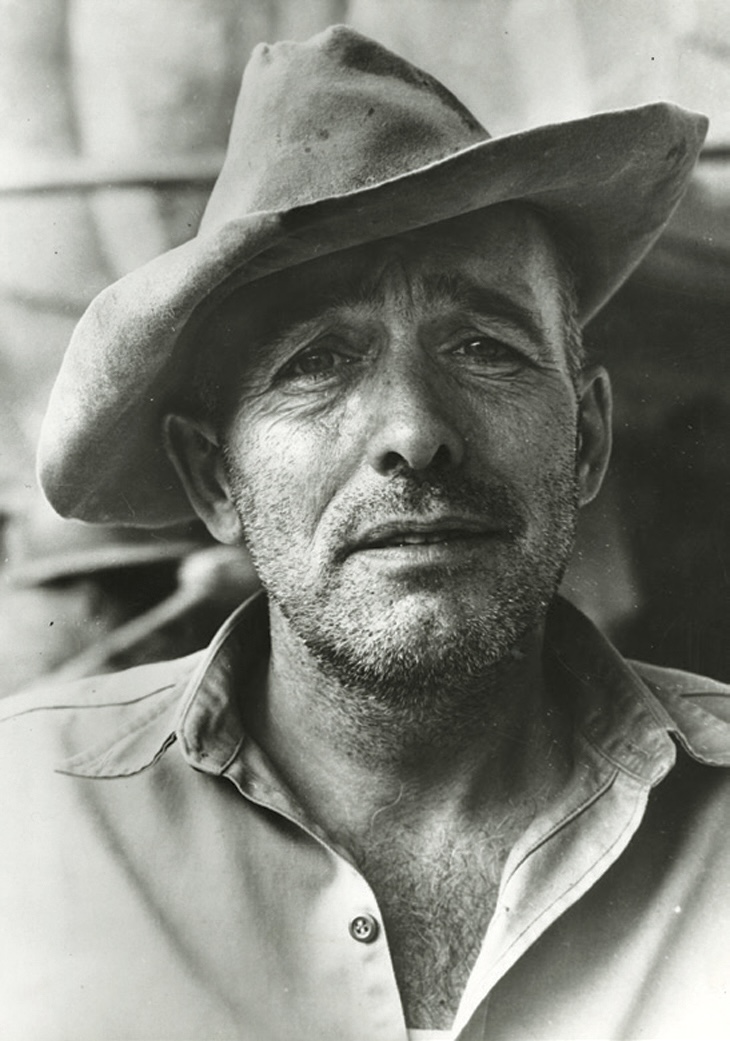 A portrait of Vernon Pick from the 1950s. Photo public domain.
Born in 1903 in Wisconsin, Pick grew up in the U.S. Midwest, joined the Marines, was discharged for being of “bad” character, worked in a Manitoba mine, learned to fly airplanes and became a self-taught electrical engineer. He ran an electric company for 17 years, then a printing press. He built his wife her own loom, repaired electric motors and took all sorts of university courses, including a writing class apparently taught by Sinclair Lewis.
And he dreamed of the type of personal independence that his idol, Henry Thoreau, wrote about in Walden, his enduring memoir about self-sufficient living.
By 1940, Pick had made enough money to buy a large plot of land in Minnesota where he imagined he could create something of a self-sustaining community. Crucially, the land had its own rundown hydro dam that could power the site. Pick rebuilt the dam, fixed up one of three houses and moved in with his wife in 1946.
But five years later, the mill burned down. Pick received $13,500 in insurance money, but it wasn’t enough to rebuild. And in a sign of restlessness to come, Pick seemed ready to move on. So he and his wife bought a truck and a trailer and headed south, toward the sunnier skies of Mexico.
They got only as far as Colorado Springs, where everyone seemed to be talking about the search for uranium. Between the nuclear arms race and the growing potential for atomic energy, a resource with a previously niche set of uses was suddenly in high demand. Pick bought a book about uranium prospecting, decided Mexico could wait and instead drove to Grand Junction, Colorado, a hub of uranium refining. According to a 1954 article published in the Buffalo Evening News Magazine, Pick walked into the offices of the Atomic Energy Commission, met its mining head and asked him: “Where’s a good area to look for uranium?”
Pick was told to head west, to a remote area in nearby Utah. And it was there, instead of lounging on a beach in Mexico, that the 48-year-old Pick went exploring. He would drive into a promising area as far as possible, load a backpack with 55 pounds of gear and start hiking. Pick would carry a heavy “scintillometer,” a device that can pick up radioactive material from a hundred metres or so away.
For months, he found little of value.
“He would drag himself in, hungry and dehydrated and tired,” his wife Ruth told a reporter. “For a couple days he just ate and slept, and then he was ready to go out again.”
Having started his prospecting with around $6,000, he was down to about $300 when he walked four days into the wilderness, stopped to rest under a cottonwood tree, spotted a promising strata of rocks on a cliff face and started climbing. When he got to the site, he turned on his scintillometer and watched its needle go wild.


No comments:
Post a Comment