Search This Blog

Thursday, 4 December 2025

Great Britain wins SailGP Season 5 - Scuttlebutt

Great Britain wins SailGP Season 5 >> Scuttlebutt Sailing News: Providing sailing news for sailors 

Great Britain wins SailGP Season 5

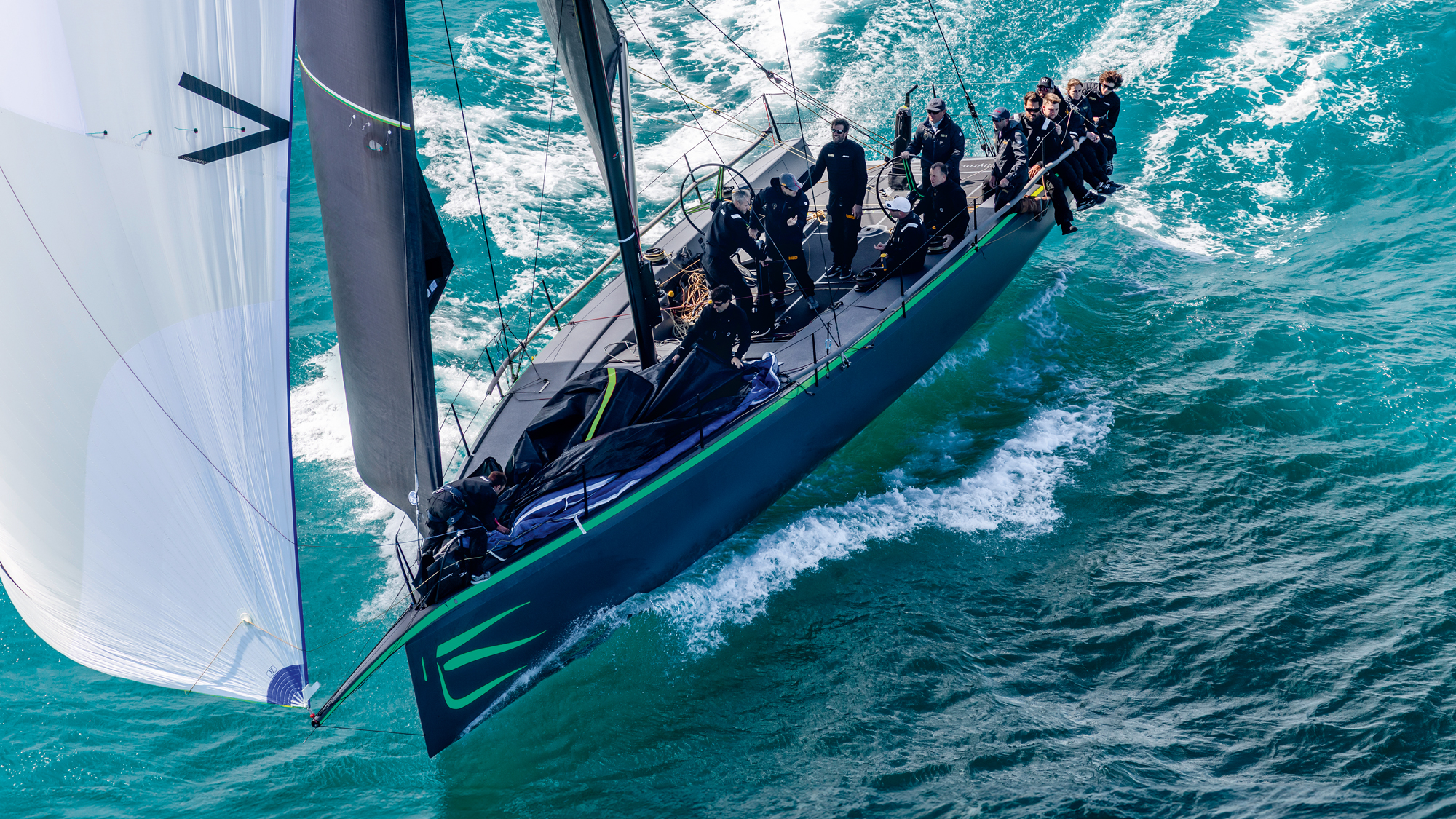
The fifth season of SailGP finished as it should with Great Britain taking the title. They had been the form team, winning the most events (3 of 12), but still had to overcome the final stage on November 29-30 in Abu Dhabi, UAE.

The season began and ended with events in the Middle East, and while the United Arab Emirates oil money must be good for the league, the meager shoreside fan action was matched by the light winds on the Persian Gulf. A league built on high adrenaline instead strolled.

However, the top three teams on the season leaderboard - Great Britain, New Zealand, and Australia - survived the six fleet races to advance to the winner-take-all $2 million Grand Final. As this was the lone event decided on the fleet races alone, their focus was to keep defender Spain out, which made for odd optics as the best teams did poorly.

Wednesday, 3 December 2025

New Wallyrocket 71: The Next Generation Racing Yacht

New Wallyrocket 71: The Next Generation Racing Yacht

New Wallyrocket 71: The Next Generation Racing Yacht

Yachting World
November 13, 2025
0shares


The new Wallyrocket 71 is the latest evolution in performance racing from Wally to rival other maxis on the market

TAGS:


Wally launches a second Rocket. If the name and look seem familiar, it’s because we ran plenty of coverage of the first Wallyrocket 51 earlier this year, following its eagerly awaited launch and build-up to the Admiral’s Cup and Rolex Fastnet Race.

Yet just as we began featuring the first Rocket, Wally announced this larger sistership, with both yachts launching in the same season. Both are Botin Partners designs, and where the 51 is conceived to take on the TP52s and smash races on handicap, the 71 has the equally herculean task of becoming the ‘world’s most successful maxi’.


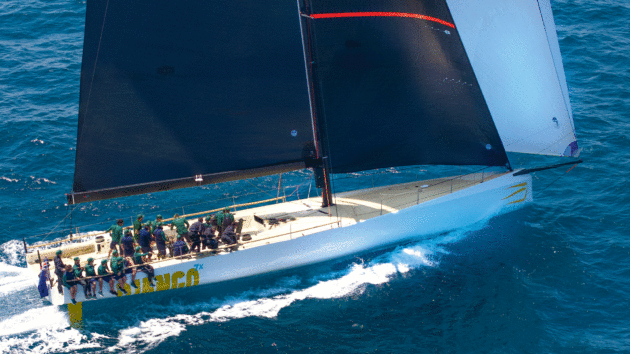
Wallyrocket 71 Django 7X became a world champ at its first major regatta. Photo: Gilles Martin-Raget

Compared with its main Maxi 72 rivals then (most of which have been extended), the Wallyrocket 71 is two tonnes lighter, with over 30% more water ballast (2.7 tonnes of it) for the same sail area, which brings advantages both in the light and going downwind. It can clock upwind speeds of 10.5-11 knots, while matching or exceeding true winds going the other way.

“We started from a blank sheet of paper, asking how we could beat the most competitive Maxi 72s on corrected time,” Botin’s Adolfo Carrau explains. “When they were designed, it was to a box rule, so many parameters were already set. Now, as everyone is optimising their boats under IRC rules, there is a lot more freedom.”


Clean, Spartan carbon interior – it’s a racing yacht after all. Photo: Gilles Martin-Raget

Giovanni Lombardi Stronati commissioned the build of the first 71, Django 7x, at King Marine in Valencia. It is already being campaigned by his Italian Django team, which represented the Yacht Club Costa Smeralda (YCCS) at the Admiral’s Cup with the first 51. Once again, this team is galvanised by the affable Vasco Vascotto, who holds more world titles than any other sailor.


Django 7x’s first major regatta was the Rolex Maxi Yacht Cup in September, hosted by the team’s club YCCS, where it took on the likes of seasoned competitors such as Bella Mente, Vesper, Jolt and Jethou – and beat them all, to claim the first Rolex IMA Grand Prix World Championship. Quite the proof of concept!

Article continues below…


World’s Coolest Yachts: Wallygator II


“This was the boat that represented the style of Wally and was the first large yacht really able to sail…


Wallyrocket 51 review: Is this the world’s fastest new raceboat (on handicap)?


You have to admire the ambition. A goal to create the fastest race boat in the world (on corrected time)…
Wallyrocket 71 Specifications:

LOA: 21.44m 70ft 4in
Beam: 5.55m 18ft 3in
Draught: 4.90m 16ft 1in
Displacement: 12,500kg 27,558lb
Sail area (upwind): 305m2 3,283ft2
Sail area (downwind): 630m2 6,781ft2
Contact details: wally.com

Sunday, 30 November 2025

Greg Norman on LIV Golf tenure: 'Don't judge me'

Greg Norman on LIV Golf tenure: 'Don't judge me'

Greg Norman on LIV Golf tenure: 'Don't judge me'

Aug 16, 2024; Greenbrier, West Virginia, USA; LIV Golf CEO Greg Norman at The Old White at the Greenbrier. Mandatory Credit: Bob Donnan-Imagn Images (Bob Donnan-Imagn Images)

Greg Norman said he is proud of what he accomplished as the CEO of LIV Golf and that PGA Tour players have benefitted from the Saudi-backed league.

Norman, who stepped down from LIV Golf last month, called his time with the league "mission accomplished" in an interview with Australian Golf Digest.

"When you look back on the past 12 months, there's been a realization that all those investment dollars have done great things for the institutions as well as the players, in all parts of the world. Even with the PGA Tour (boosting its prize money with elevated events), I was quietly happy when I saw that, because the players benefited from it.

"Are they going to recognize LIV for doing that? No, but I do know that was a significant uptick for them. For them to be able to play for more money, even play in less competitive fields - they reduced the size of the fields -- I just said, 'Well, there you go.' The adoption, to some degree, of what we implemented has been accepted."

Norman, 70, acknowledged the time commitment along with the intense criticism he endured as one of the primary faces of the breakaway league did take a toll. But he also said that he would do it all again "in a heartbeat."

"It was very draining on me," he said. "I was working 100-hour weeks. I'm not going to say all the abuse was anything (of consequence), but what hurt me the most was the lack of understanding of why people would judge me and give the abuse they did.

"That was the thing that bothered me the most, because I'm the type of guy who will happily sit down and talk about things. And if I'm wrong, I'll admit I'm wrong. But don't judge me. Don't judge what LIV was truly all about."

Norman was the original CEO of LIV Golf when the league launched in 2021 and held the role until being replaced in January by Scott O'Neil, who serves as the commissioner. Norman stayed on in an unnamed position until his contract expired in August, according to Golf Digest.

Norman's comments came during a significant news week during LIV Golf's offseason. Cleeks team captain Martin Kaymer said 'several' high profile players on the DP World Tour are interested in joining the league, while The Athletic reported that LIV's losses have hit $1.4 billion during the first three-plus years of its existence.

Norman is now spending the majority of his time in Florida while refocusing his efforts on his golf course design business and a significant role on the organizing committee for the 2032 Olympics in Brisbane.

"I'd do it a little differently. But, yes, I'd do it again in a heartbeat," Norman said when asked if he would put himself through the LIV Golf experience again. "Like anything, you look back at losing a golf tournament and ask yourself, Why did you lose that golf tournament? Did I hit a bad 5-iron? Or did I not concentrate? So, you sit back and you analyze it, and of course you would do that. And, like any CEO, you have to learn by your successes just as much as by your failures.

"So, yes, absolutely I'd do it again."

Thursday, 27 November 2025

SailGP: Four teams seek $2million payday


 SailGP: Four teams seek $2million payday

The SailGP sports league will conclude its fifth season on the Persian Gulf when 12 teams compete at the final event win but also the overall season title on November 29-30 in Abu Dhabi, UAE.

The schedule begins with six fleet races split over two days to determine the event 12 winner, with the top three teams on the season leaderboard then advancing to the Grand Final to go head-to-head in a single winner-takes-all race.

The rules are simple: the first across the finish line takes the Season 5 title and the $2 million prize. Mathematically, only four teams can make it to the three-boat Grand Final race this Season: Great Britain, New Zealand, Australia, and Spain.

Will Spain defend its Season 4 crown? Can Australia get its third title? Does overall leader Great Britain retain form for final victory? Race times each day are 14:00-15:30 GST (05:00-06:30 EST)

Wednesday, 26 November 2025

Davis Cup Finals: Italy beat Spain to win historic third successive title - BBC Sport

Davis Cup Finals: Italy beat Spain to win historic third successive title - BBC Sport

'Brotherhood' inspires Italy to third Davis Cup title

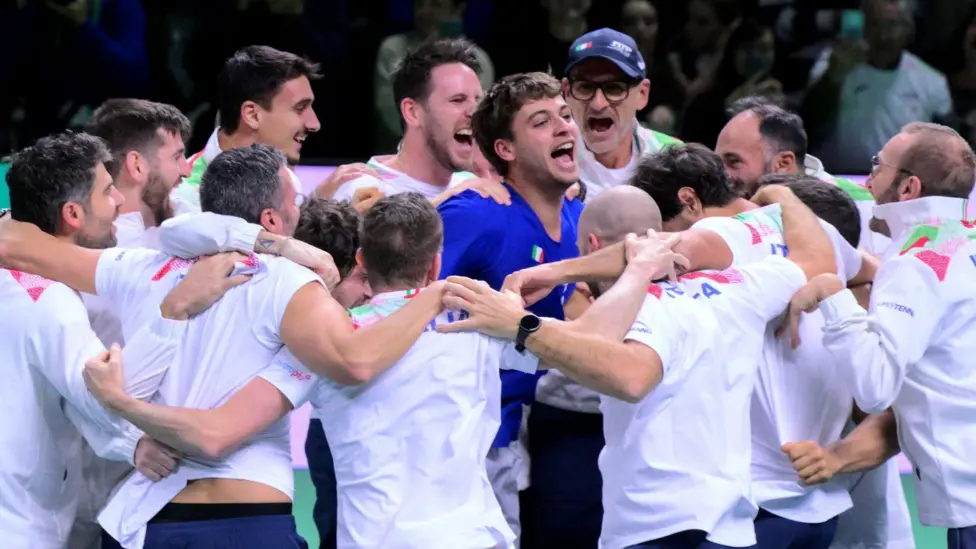
Flavio Cobolli celebrates with his team-mates after confirming Italy's Davis Cup triumphImage source,Getty Images
Image caption,

Flavio Cobolli won the the sixth-longest tie-break in Davis Cup history to beat Belgium's Zizou Bergs on Friday

  • Published

"At the end, I looked at my bench and found something in my heart."

For Flavio Cobolli, the faces cheering for him from the sidelines provided the extra impetus he needed as he fought to realise his dream of becoming a world champion.

The 23-year-old secured a historic third successive Davis Cup title for Italy by battling back from a set and a break down against Spain's Jaume Munar to seal a 2-0 triumph in front of an jubilant home crowd in Bologna.

Cobolli's gritty 1-6 7-6 (7-5) 7-5 victory, achieved two days after he confirmed Italy's place in Sunday's showpiece by winning an epic 32-point tie-break, followed Matteo Berrettini's 6-3 6-4 win over Pablo Carreno Busta.

It was an Italian double act long in the making.

Berrettini worked with Cobolli's father, former player Stefano, as a youngster. He would often be called upon to babysit Cobolli - six years his junior - and kept him occupied by playing tennis with him.

A video shared on social media by Italian outlet Spazio Tennis, external shows Berrettini towering above Cobolli as they walk off a tennis court after practising together in 2011.

Fourteen years later, Cobolli and the team-mate he describes as being "like a brother" to me were walking off the court in Italy as Davis Cup champions, having gone unbeaten in singles in the tournament.

"It's impossible to describe this feeling. I dreamed a lot for this night," Cobolli said.

"We cannot lose for our country. Sometimes you learn, but you never lose.

"I don't know what I did today. I don't know where I am. The only thing I know is that I am a world champion."

How 'brotherhood' inspired Italy to victory

It was a fourth Davis Cup title overall for Italy, who are the first nation to win three straight titles since defending champions stopped receiving automatic qualification to the final 53 years ago.

Both Italy and Spain reached the final despite missing key players. Spain were without the injured world number one Carlos Alcaraz, while second-ranked Jannik Sinner and 10th-ranked Lorenzo Musetti were missing for Italy.

But Cobolli and Berrettini owned their moments in the spotlight with three wins from three singles matches apiece.

The vast majority of the sell-out, 10,000-strong crowd chanted Cobolli's name as he kept his composure to serve out his comeback victory to love, having forced the breakthrough in the 11th game of a tense deciding set.

That was no mean feat, given the emotional and physical fatigue from his heroics in the semi-finals two days earlier.

World number 22 Cobolli paid the price for a slow start as he conceded a one-sided opening set.

But he launched a necessary, immediate response after falling a break down at the start of the second, before once again delivering in a crucial tie-break and then finding the inspiration to complete his memorable win.

"We tried to recreate the spirit of the Italy team that won the [football] World Cup in 2006," Cobolli said.

"Our brilliant fans are also part of this team. I've been repeating for three days but it's the best day of my life."

Flavio Cobolli and Matteo Berrettini celebrate at the Davis Cup FinalsImage source,Getty Images
Image caption,

Italy are the first nation to win three straight Davis Cup titles since the United States in 1972

Berrettini, who had earlier taken his Davis Cup singles winning streak to 11 matches with an excellent performance against Carreno Busta, has been there for Cobolli ever since they first met when he was 14 and Flavio eight.

When Cobolli was struggling for form earlier this season, Berrettini advised him against entering the lower-tier challenger tournaments and instead return to a training block to rediscover his form.

"I just told him, 'Don't you worry, child'," Berrettini said in an interview with the International Tennis Federation.

Cobolli then won his next ATP tournament in Hamburg.

"It's actually crazy that we're in the same team now. It gives me chills to think about this relationship over the years," said Berrettini.

Berrettini lost his voice cheering Cobolli on during Friday's dramatic semi-final against Belgium, and backed his childhood friend all the way on Sunday after getting the team off to a winning start.

"All the guys of the team are special for me," Cobolli added.

"But Matteo is special for me because he's like a brother. He's very important for me.

"He helped me a lot during the match, like the brotherhood."

The Italian team celebrate with the Davis Cup trophyImage source,Getty Images

Tuesday, 25 November 2025

A giant leap for Canada: B.C. town honours ski jumping pioneer | Oak Bay News

A giant leap for Canada: B.C. town honours ski jumping pioneer | Oak Bay News
A giant leap for Canada: B.C. town honours ski jumping pioneer Published 6:20 am Wednesday, October 29, 2025  By Evert Lindquist   Ski jumper Bob Lynburne takes a leap in Revelstoke during 1933. (Revelstoke Museum and Archives)  Revelstoke’s newest road has opened an avenue for recognizing one of the town’s most celebrated, world-class ski jumpers.  City council voted unanimously in favour on Tuesday, Oct. 28, of naming a new strata road — being forged to accommodate development and construction access in Mackenzie Village – “Lynburne Avenue.”  Robert “Bob” Lynburne was born in Fort William, Ont., near Thunder Bay. Moving to Revelstoke as a toddler, he grew up enjoying Nordic skiing but primarily became a prolific ski jumper.  Lynburne went on to represent Canada at the 1932 Winter Olympics in Lake Placid, N.Y. In 1933, he set a world record on Revelstoke’s own ski jump hill with a 287-foot spring.  Today, Lynburne “carries historical and cultural significance to the town,” city staff wrote in their report to council.  “I think that is an appropriate name,” Mayor Gary Sulz said Tuesday, in approval of Lynburne Avenue.  Though a desirable choice to name a local street after a famed Revelstoke athlete, and in line with the city’s Street Naming and Addressing Policy, “there was contention whether the man’s name was Bob Lynburne or Bob Lymburne,” the report notes.  Consulting with Revelstoke Museum and Archives, as well as Lynburne’s surviving family, staff managed to confirm via a marriage certificate from 1939 that the ski jumper was officially known as Robert Samuel Lynburne.  Going forward with council’s approval, Lynburne Avenue will be built intersecting Nels Nelsen Crescent and immediately north of Coursier Avenue — quite fitting as all three names commemorate phenomenal ski jumpers in the community’s history.  As recounted by the museum, a 17-year-old Lynburne set a junior world record of 165 feet at the 1928 Revelstoke Winter Sports Carnival.  By 1932, he’d already beaten Nels Nelsen’s landmark 240-foot jump from 1925 by soaring 269 feet, setting a world record for the adult division that he would ultimately also surpass.  Unfortunately, while competing locally in 1935, Lynburne seriously injured his head and retired from ski jumping.  After transitioning to the tracks as a fireman for the Canadian Pacific Railway, Lynburne served in France during the Second World War with the No. 1 Railway Operating Company of the Corps of Royal Canadian Engineers, according to the Canadian Military Engineers Association.  His cohort departed from North Bay and Stratford, Ont., for the U.K. in July 1943, repairing British railway equipment before landing in Normandy during September 1944. As the Allied forces fought through France, Belgium, the Netherlands and Germany, Lynburne played a critical role fixing, maintaining and running railway equipment, eventually returning the lines to civilian operators safe behind the front lines.  After Germany surrendered in 1945, Lynburne returned to Revelstoke and continued working on the railway. Still suffering from his injury and exhibiting unusual behaviour, however, he wandered into the woods in 1957 and was never seen again.  Now, some 68 years later, thanks to the selection of Lynburne Avenue, his name is here to stay, nestled into Arrow Heights alongside the leaping legacies of Nels Nelsen and Isabel Coursier.

Read more at: https://oakbaynews.com/2025/10/29/a-giant-leap-for-canada-b-c-town-honours-ski-jumping-pioneer/

Sunday, 23 November 2025

Prospector’s ‘Doomsday’ Mansion

chrome://vivaldi-webui/startpage?section=Speed-dials&background-color=#00000a


Prospector’s ‘Doomsday’ Mansion
Vernon Pick was an American millionaire who left behind a unique property in Lillooet, BC.
Tyler Olsen TodayThe Tyee

Tyler Olsen is a senior editor at The Tyee.Our journalism is supported by readers like you. Click here to support The Tyee.


7 Comments
Vernon Pick struck it rich after discovering a uranium deposit in Colorado in the 1950s. The self-taught engineer and inventor later created a unique home powered by its own dam near Lillooet, BC. Photo illustration by The Tyee. Images via Newspapers.com.


“To be a philosopher is not merely to have subtle thoughts, nor even to found a school, but so to love wisdom as to live according to its dictates, a life of simplicity, independence, magnanimity, and trust. It is to solve some of the problems of life, not only theoretically, but practically.” — Henry Thoreau, Walden

Announcements, Events & more from Tyee and select partners
Youth Homelessness Is a Call to Action

In Vancouver, there are more unhoused youth than there are shelter beds. Family Services of Greater Vancouver is working to change that.

Word gets around fast when a uranium tycoon moves to a small town and starts building his own dam to power an off-the-grid high-tech research facility.

Was Vernon Pick building a nuclear base? Or seeking his own Armageddon hideout? Surely, some thought, there was something nefarious going on at a property with a home accessible only by an electric-powered railway.

North America’s “Uranium King” has been gone from Lillooet for decades now, but his dream-fuelled canyon estate continues to energize hikers, historians — and maybe even your own home. In recent years, the legend of Vernon Pick has inspired a mini-industry of YouTube videographers, many of whom have caricaturized him as an eccentric prospector trying to hide away from a potential nuclear holocaust.

The real Pick was much more interesting. His story is one of curiosity, boredom, ambition, fear, optimism and hope. Uranium might have made Pick rich. But it was Henry David Thoreau, in part, who made him a legend.

The Tyee is supported by readers like you Join us and grow independent media in Canada


‘Where’s a good area to look for uranium?’

“They have got to live a man’s life, pushing all these things before them, and get on as well as they can.” — Henry Thoreau, Walden

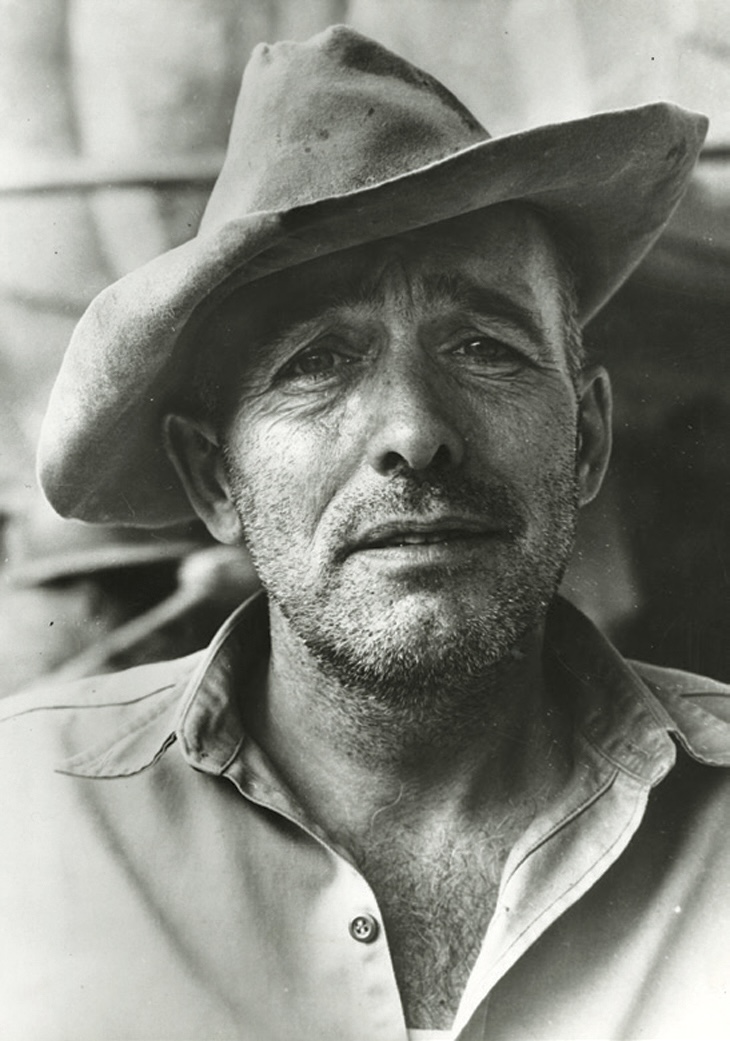
Vernon Pick was 51 years old when he became famous. But he had already packed several lifetimes into his first half-century on this planet.A portrait of Vernon Pick from the 1950s. Photo public domain.

Born in 1903 in Wisconsin, Pick grew up in the U.S. Midwest, joined the Marines, was discharged for being of “bad” character, worked in a Manitoba mine, learned to fly airplanes and became a self-taught electrical engineer. He ran an electric company for 17 years, then a printing press. He built his wife her own loom, repaired electric motors and took all sorts of university courses, including a writing class apparently taught by Sinclair Lewis.

And he dreamed of the type of personal independence that his idol, Henry Thoreau, wrote about in Walden, his enduring memoir about self-sufficient living.

By 1940, Pick had made enough money to buy a large plot of land in Minnesota where he imagined he could create something of a self-sustaining community. Crucially, the land had its own rundown hydro dam that could power the site. Pick rebuilt the dam, fixed up one of three houses and moved in with his wife in 1946.

But five years later, the mill burned down. Pick received $13,500 in insurance money, but it wasn’t enough to rebuild. And in a sign of restlessness to come, Pick seemed ready to move on. So he and his wife bought a truck and a trailer and headed south, toward the sunnier skies of Mexico.

They got only as far as Colorado Springs, where everyone seemed to be talking about the search for uranium. Between the nuclear arms race and the growing potential for atomic energy, a resource with a previously niche set of uses was suddenly in high demand. Pick bought a book about uranium prospecting, decided Mexico could wait and instead drove to Grand Junction, Colorado, a hub of uranium refining. According to a 1954 article published in the Buffalo Evening News Magazine, Pick walked into the offices of the Atomic Energy Commission, met its mining head and asked him: “Where’s a good area to look for uranium?”

Pick was told to head west, to a remote area in nearby Utah. And it was there, instead of lounging on a beach in Mexico, that the 48-year-old Pick went exploring. He would drive into a promising area as far as possible, load a backpack with 55 pounds of gear and start hiking. Pick would carry a heavy “scintillometer,” a device that can pick up radioactive material from a hundred metres or so away.

For months, he found little of value.

“He would drag himself in, hungry and dehydrated and tired,” his wife Ruth told a reporter. “For a couple days he just ate and slept, and then he was ready to go out again.”

Having started his prospecting with around $6,000, he was down to about $300 when he walked four days into the wilderness, stopped to rest under a cottonwood tree, spotted a promising strata of rocks on a cliff face and started climbing. When he got to the site, he turned on his scintillometer and watched its needle go wild.


RG Richardson City Guides

RG Richardson City Guides
Interactive City and Finance Guides

RG Richardson City Guides

RG Richardson City Guide has over 300 guides let our interactive search city guides do the searching, no more typing and they never go out of date. With over 13,900 preset searches, you only have to click on the preset icon. Search for restaurants, hotels, hostels, Airbnb, pubs, clubs, fast food, coffee shops, real estate, historical sites and facts all just by clicking on the icon. Even how to pack is all there.

Recognizing a lifetime of achievement

  Recognizing a lifetime of achievement The Pindar Lifetime Ac...