Thursday, 30 April 2026

The fight against data centers is escalating

 The fight against data centers is escalating

Growing movement to ban data centers

Jim West/Getty Images

Yesterday, 13 bullets were fired at the home of an Indianapolis city councilor who recently supported the construction of a data center in his district, the latest chapter in the growing backlash against the controversial buildings that power AI.

The elected official, Ron Gibson, said that a note left at the scene (where no one was physically harmed) read “No Data Centers.” The attack came days after he voted in favor of a data center project in an Indianapolis neighborhood where many locals had fought against it.

Maine and other states are pushing back

The state known for lobster and “oh, you mean that Portland” is expected to pass legislation this spring that would place a moratorium on data centers that consume more than 20 megawatts—a rebuke of the swelling energy costs that come with these computing factories. Other states are considering similar measures:

  • Statewide bans are on the table in nine states; Pennsylvania would make 10 if it proposes one of its own, which is expected.
  • Activists in Ohio are collecting signatures to get a statewide ban on the ballot in November.
  • Two states—South Dakota and Wisconsin—have rejected proposed bans on new data centers.

And that’s not all. Residents in Port Washington, WI, voted yesterday on a measure that would stop future data center development in the town of ~12,000 people. There are at least three other municipalities around the country that will consider something similar this year.

Big picture: While evidence shows that data centers can be environmental hazards (a new study says that they create heat islands within a 6-mile radius that can cause pollution and deaths), they are also job creators. The response to the bill in Maine, where a Senate seat is up for grabs in November, could serve as a “canary in the coal mine” for officials in other locales, according to a construction trade group that spoke to the Wall Street Journal.

Wednesday, 29 April 2026

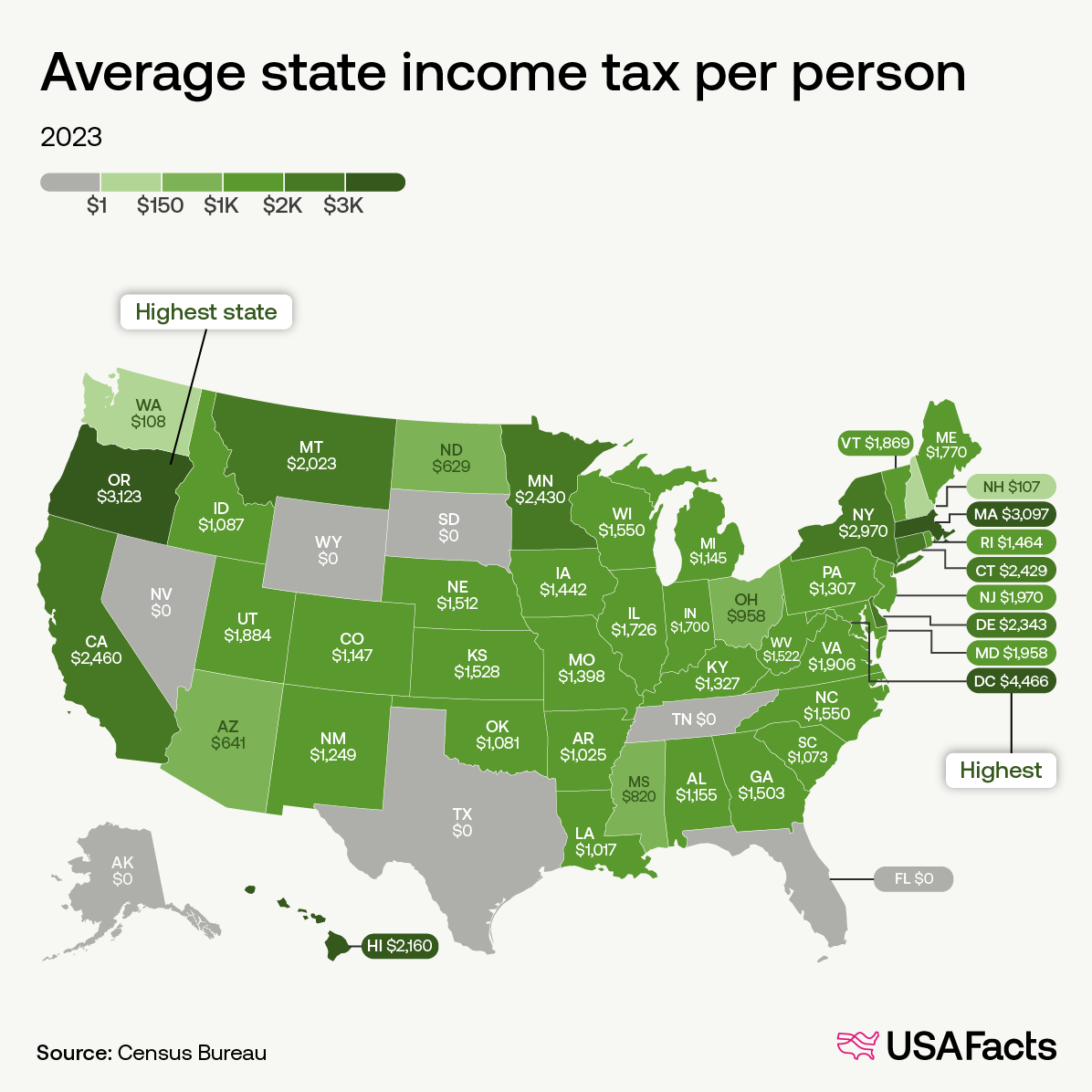
Income taxes are highest in these states


Tuesday, 28 April 2026

Getting started with VoIP.ms


Our long-term customers know this by heart, but if you're just getting started with VoIP.ms, your first step will be adding a DID (a.k.a. phone number).

Here’s how to do it step by step:

  1. Log in to your VoIP.ms portal
    Go to the DID Numbers section and select “Order DID.”
  2. Search for a number
    Choose your country, region, then browse available options.
  3. Select and configure
    Pick your number and assign it to a destination (SIP account, IVR, or call forwarding).
  4. Confirm your order
    Review pricing and complete the purchase. Your DID is ready to use right away!
  5. Test your setup
    Make a quick test call to confirm routing is working as expected.

That’s it! You now have a live number ready for inbound calls.

Anonymous Sources Detail Sam Altman’s Alleged Untrustworthiness in New Report

Anonymous Sources Detail Sam Altman’s Alleged Untrustworthiness in New Report

Anonymous Sources Detail Sam Altman’s Alleged Untrustworthiness in New Report
"I think there's a small but real chance he's eventually remembered as a Bernie Madoff- or Sam Bankman-Fried-level scammer."
BY ECE YILDIRIMPUBLISHED APRIL 6, 2026, 7:00 PM ET

READING TIME 5 MINUTES

OpenAI CEO Sam Altman at the Blackrock Infrastructure Summit held In Washington, Dc © Anna Moneymaker via Getty Images
READ LATER COMMENTS (17)


On Monday, The New Yorker published a lengthy investigation detailing the days leading up to and following Sam Altman’s brief ousting as OpenAI’s CEO.

Back in late 2023, OpenAI’s board of directors shocked Silicon Valley by firing Sam Altman seemingly out of the blue. Following a five-day media blitz by Altman and his supporters and a public letter demanding his return, Altman came back to the company as CEO. The board members who had orchestrated the coup were ousted and replaced with Altman allies such as economist Larry Summers and former Facebook CTO Bret Taylor, who is currently the chairman of the board at OpenAI.


When Altman was reinstated as CEO, OpenAI employees began referring to the turbulent few days as “the Blip,” in reference to the blip in the Marvel Cinematic Universe when the supervillain Thanos made half the world’s population disappear for five years.

According to the New Yorker report, citing interviews with dozens of people in the know, including Altman himself, the OpenAI executive was ousted because his own board members did not find him trustworthy enough to “have his finger on the button” of artificial superintelligence, a theoretical and highly contested super-powered future AI system that could outperform human intelligence on all fronts. The term is sometimes used interchangeably with artificial general intelligence (AGI), although it describes a step even beyond that.

Following secret memos sent to fellow board members by OpenAI’s then-chief scientist Ilya Sutskever, the board reportedly compiled a roughly seventy-page document evidencing Altman’s “consistent pattern” of lying, including about internal safety protocols.

The report says that Altman’s alleged history of lying extends to a time before OpenAI as well. According to the investigation, senior employees at Altman’s previous startup, a now-defunct location-sharing service called Loopt, asked the board to fire him as CEO due to concerns with his lack of transparency.

The accusations followed him to startup accelerator Y Combinator, which Altman led for five years until he was removed due to mistrust, according to the sources cited in the article. Y Combinator leadership has said that he wasn’t fired but was only asked to choose between the startup accelerator and OpenAI. The late hacktivist and former Reddit co-owner Aaron Swartz, who was in Altman’s cohort when he first joined Y Combinator as an entrepreneur with Loopt, allegedly described him as “a sociopath” who could “never be trusted.”

At OpenAI, Altman was accused of lying to executives and even to government officials. The report details an instance in which Altman told U.S. intelligence officials that China had launched a major AGI development project and asked for government funding to launch a counteroffensive, but then failed to show any evidence when asked.

The report also details instances of Altman allegedly gaslighting Anthropic co-founder and then-OpenAI employee Dario Amodei regarding a provision in the billion-dollar Microsoft deal OpenAI signed in 2019 that would override the altruistic clauses Amodei had included in the charter for the company. The clause in question was about AGI, and posited that if another company found a way to build it safely, then OpenAI would “stop competing with and start assisting this project,” as a non-profit with a safety-first objective. OpenAI has since changed its structure to become a for-profit corporation.

Even some Microsoft senior executives, with whom OpenAI has had a long partnership since the 2019 deal, described Altman as someone who “misrepresented, distorted, renegotiated, reneged on agreements.” One senior executive even apparently said this of Altman: “I think there’s a small but real chance he’s eventually remembered as a Bernie Madoff- or Sam Bankman-Fried-level scammer.”

Those are alarming words to read about any executive in charge of a company as large and consequential as OpenAI, but they have even more weight considering that OpenAI is the leading company creating a technology that many, including its early employees, have defined as a possible existential threat to humanity.

Under Sam Altman’s leadership, OpenAI’s technology has infiltrated pretty much all aspects of modern life. OpenAI’s AI is used by tens of millions of people around the world for health advice, and by numerous others for everything from automating work across industries to finishing homework for students and even offering murky companionship to some lonely people who seek it. ChatGPT is used throughout the federal government as well, and Altman has also recently sold the technology to the Pentagon.

This is all fueled by Altman’s salesmanship. He has sold the potential and purported realities of ChatGPT to so many people, leading to an unprecedented and potentially fragile dealmaking spree that has garnered so much investment that some experts say it is propping up the entire American economy right now.

The New Yorker report also claims that Altman assured the board that GPT-4 had been approved by a safety panel, which turned out to be a misrepresentation when a board member requested documentation of the approvals. Sutskever claimed in the memos that Altman also downplayed the need for safety approvals in conversation with former OpenAI CTO Mira Murati, citing the company’s general counsel. But when Murati asked the general counsel about it, he said he was “confused where sam got that impression.”

The accusations around ChatGPT’s safety features are particularly damning, considering the fallout of GPT-4o, the iteration of ChatGPT that followed GPT-4. The model’s knack for sycophancy reportedly caused instances of “AI psychosis” in vulnerable users, with some cases ending in fatalities.

Some of Altman’s inconsistencies have been well-documented publicly, too. Time and again, the OpenAI chief has published contradictory statements on things like the merits of putting ads in AI chatbots, the need for AI regulation, or whether ChatGPT’s voice feature unveiled in 2024 was inspired by Scarlett Johansson’s performance in the movie “Her.” Altman was also scrutinized recently over a whopping $100 billion Nvidia deal that just did not materialize as initially announced.

The report also details how the company’s culture vastly changed following Altman’s reinstatement as CEO. Before “the Blip,” the company had approached the concept of AGI cautiously, while after, AGI reportedly became a North Star for the company, with slogans like “feel the AGI” seen on merchandise around its offices. The alleged difference was seen in practice, too, as OpenAI disbanded some key teams focusing on chatbot safety, like the existential AI risk team and the superalignment team, which was co-led by Sutskever.

The report comes as Altman’s leadership is put under a microscope as the company begins preparing for a potential IPO.

According to a recent The Information report, Altman seems to be at odds with executives once again, this time regarding OpenAI’s readiness for an IPO. Altman reportedly wants to go public as soon as the fourth quarter of this year and is committing to spend $600 billion in the next five years despite expectations that OpenAI will burn more than $200 billion before it starts making money. Meanwhile, the report claims that OpenAI CFO Sarah Friar does not believe the company is ready to go public this year at all, due to the risky spending commitments. Unlike Altman, Friar reportedly does not yet believe that OpenAI’s revenue growth can support its financial commitments, nor is she certain that the company will even need to pour that much money into AI servers.

Monday, 27 April 2026

Social Media Users are Less Active on Platforms Due to Rise of Short-Form Video | PetaPixel

Social Media Users are Less Active on Platforms Due to Rise of Short-Form Video | PetaPixel

Social Media Users are Less Active on Platforms Due to Rise of Short-Form Video

A woman lies on a gray couch in a dimly lit room, smiling as she looks at her smartphone, which emits a soft light onto her face.

A new study revealed that U.K. social media users are less active due to the dominance of short-form video on the most popular platforms — in a trend that’s likely reflected across the Western world.

In a report published Thursday, Ofcom examined trends in adults’ social media habits and online behavior over the past year. The regulator’s latest survey, conducted between September 29 and November 28, gathered responses from 7,533 U.K. adults aged 16 and over on how they use social media, access news, and think about digital privacy, among other topics.

The findings show a notable drop in active participation. Just under half of adult social media users (49%) say they now post, share, or comment on platforms such as Instagram, Facebook, and X, down from 61% the previous year. The proportion of users exploring new websites has also declined, from 70% to 56%.

Ofcom says the decrease in active use appears to be linked to the growing influence of video-focused features and platforms, as well as concerns about the long-term impact of past posts on personal accounts.

Joseph Oxlade, senior research manager at Ofcom, tells The Guardian that the rise of video apps such as TikTok and Instagram’s Reels feature meant some users were posting and commenting less than they previously did on platforms like Facebook.

Despite this shift, overall social media use remains widespread. The report found that 89% of adult internet users in the UK use at least one social media platform, rising to 97% among those aged 16 to 34. The study also found that users are also becoming more selective about what they share. Concerns about data privacy, including the misuse of personal information such as photos, have contributed to changes in behavior, Oxlade tells The Guardian.

Some users have stopped posting altogether, while others are opting for less permanent forms of content. The report found that more people are choosing features like Instagram Stories instead of permanent grid posts, pointing to an increase in more “passive” forms of social media use.

Worries about future consequences are also growing. Nearly half of adults (49%) said they are concerned their posts could cause problems later in life, up from 43% a year earlier.

Social media expert Matt Navarra tells the BBC that the trend may reflect a shift toward what he described as “digital self-preservation,” with users moving to smaller, more private spaces such as group chats and direct messages.

“People haven’t fallen out of love with social media, I think they’ve just become a lot more intentional about how they show up on it,” Navarra says.

Sunday, 26 April 2026

Proton community member


Maine is poised to freeze large data-center construction


Maine Is About to Become the First State to Ban New Data Centers

Legislation that could be enacted this spring would pause construction of large new data centers until November 2027

 ET

An ambulance arrives at the Androscoggin Mill after an explosion at the paper mill in 2020.
At the site of an old paper mill in Jay, Maine—seen here in 2020—construction of a data center is expected to get under way in July. ROBERT F. BUKATY/AP

Maine is poised to freeze large data-center construction, which would make it the first state to enact such a measure as communities across the U.S. grapple with fallout from the boom in artificial intelligence.

The Maine bill calls for a ban on major new data-center construction until November 2027, so the state can assess the impact of such development on the environment and electricity grid.

The freeze would apply to data-center projects of at least 20 megawatts, which is enough energy to power more than 15,000 homes.

The bill passed a floor vote in the Democratic-controlled Maine House of Representatives last month, collecting a handful of Republican votes. It is expected to pass in the Senate, which is also majority Democratic. Gov. Janet Mills said she supports a freeze.

Democratic Gov. Janet Mills shaking hands with a lawmaker.
Maine’s Democratic Gov. Janet Mills said she supports a moratorium if it includes an exception for the project already planned in Jay. ROBERT F. BUKATY/AP

Maine has some of the country’s highest residential electricity prices, and elected officials are concerned that a surge in data-center power demand might further inflate costs. The AI build-out is driving up electricity costs for consumers in some parts of the country, and at the same time generating large tax revenues for local governments that continue to court developers.

The bill’s momentum will be watched closely by lawmakers in at least 10 other states that are advancing similar policies over concerns about straining local power sources and the cost. The effects of the artificial-intelligence race on the economy, energy costs and the environment is emerging as a major issue ahead of this year’s midterm elections. In Maine, a U.S. senate seat is up for grabs in November.

“I think Maine is the canary in the coal mine,” said Anirban Basu, chief economist for the Associated Builders and Contractors, a construction trade group that counts members who work on data centers. “Maine will be the first of many states to have such moratoria.”

Legislators have introduced measures to temporarily ban or restrict data centers in New York, South Carolina, Oklahoma and other states. In Ohio, one of the top states for data-center development, a group of rural activists is collecting signatures to put a statewide ban of large data centers on a November ballot.

Many other municipalities and counties, especially small ones in Michigan and Indiana, already have imposed their own temporary pauses. Denver and Detroit are among major cities considering such bans.

Data-center developers are growing increasingly wary of community and political opposition as they hunt for powered land across the country. Proposed local laws restricting data centers are “a red flag,” said Tracey Hyatt Bosman, a site selection consultant at BLS & Co. who works with data-center developers. “They do limit where we are looking,” she said.

Tony McDonald, who is developing a data center in the western Maine town of Jay, said he is scheduled to begin construction in July. “All of a sudden we’ve been caught in this dragnet,” he said.

Maine hasn’t been a magnet for Alphabet’s Google, Microsoft or other companies building hyperscale facilities for artificial intelligence. Recent data-center proposals in the Maine towns of Wiscasset and Lewiston were paused or failed at the local level, following resident opposition.

Some data-center developments in Maine have targeted defunct industrial sites, such as closed mills. One company recently proposed to build a $415 million underwater data center off Maine’s coast.

While it is possible the Maine moratorium bill could stumble in the amendment process, that a version of it eventually becomes law is a foregone conclusion among some state political operatives.

“That’s the political reality,” said Tony Buxton, a climate and energy attorney at Preti Flaherty, a legal and lobbying firm in Maine. “There is a very strong voter fear of data centers and AI.” 

Buxton’s firm has placed ads on social media advocating exemptions in the bill that would allow two already planned data-center projects to move forward in Jay and in Sanford, which is in southern Maine. These exemptions are being considered in the House.

Gov. Mills, a Democrat who is running for U.S. Senate in a highly publicized primary race against Iraq war veteran Graham Platner, said she supports the data moratorium if it includes an exception for the project already planned in Jay.

“The project is expected to bring much-needed jobs, economic activity and tax revenue to the region,” a spokesman for Mills said in a statement.

In the U.S. Congress, Sen. Bernie Sanders (I., Vt.) and Rep. Alexandria Ocasio-Cortez (D., N.Y.) last month unveiled legislative proposals to temporarily pause data-center construction nationwide.

Saturday, 25 April 2026

Tesla can’t get out of its slump


Tesla hood decal in the rain

Nurphoto/Getty Images

Teslas are selling like lukewarm cakes. The carmaker said yesterday that it shipped 6% more EVs last quarter than a year ago, which is considered a letdown, because Q1 2025 was when it partially paused production and faced backlash for Elon Musk’s politics.

Wall Street was hoping for more. Last quarter was Tesla’s second-worst quarter since 2022:

  • The 358k cars it delivered significantly undershot analysts’ projections, as well as the 408k vehicles it produced, leaving thousands of cars looking for homes.
  • Its budget 3 and Y models accounted for 95% of deliveries, while the Cybertruck remained an offbeat purchase.

Analysts blamed the disappointing sales on Tesla’s aging lineup, rising competition, and a broader industry downturn following the Trump administration’s nixing of a $7,500 EV tax credit last year.

No longer a consumer car company?

Though EVs are still its bread and butter, Tesla ties its future to launching the Optimus humanoid robot this year and mass-producing its autonomous taxi EV, CyberCab.

But investors may feel differently. They responded to yesterday’s performance update just like your parents reacted to your assurances that a C- in math wouldn’t hinder your rap career. Tesla’s stock fell by nearly 6% yesterday, and is down by almost 20% since the year began.

In a silver lining…soaring gas prices amid the war in Iran might be spurring some Americans to go electric. US sales of Hyundai’s EV Ioniq 5 rose by 13% last month, while Cadillac EV sales were up by 20% in Q1.

Friday, 24 April 2026

Microsoft offers buyouts to 7% of US staff

 Microsoft offers buyouts to 7% of US staff. In the latest sign that tech jobs are not as stable as they once were, Microsoft will offer buyouts to US workers at the senior-director level and below whose years of employment and age add up to 70+. The voluntary retirement program is the first in the history of the 51-year-old company, which, like its fellow tech giants, is committing tons of cash to developing AI. Microsoft is also updating how it awards bonuses and stock options. Meanwhile, Meta confirmed yesterday that it will lay off about 10% of its workforce, cutting about 8,000 jobs.

New AI Voice Agent for VoIP.ms


New AI Voice Agent for VoIP.ms. It’s designed to help businesses answer inbound calls automatically, route callers intelligently, and stay responsive without adding overhead.

What you can do
Answer calls 24/7 — Stay available after hours, during peak periods, or when your team is tied up.
Route callers intelligently — Direct people to the right extension, queue, or destination based on intent.
Handle FAQs automatically — Reduce repetitive call handling for common questions and routine requests.
Keep your lines responsive — Improve responsiveness without adding staff or extra process overhead.
This beta is best suited for VoIP.ms business customers, MSPs, resellers, and teams running real inbound call flows.

Interactive Communications

Interactive Communications
Interactive Communications VOIP and VPN

eComTechnology RG Richardson Communications

eComTechnology since 2003. I am a business economist with interests in international trade worldwide through politics, money, banking and secure VOIP and Mail Communications. The author of RG Richardson City Guides has over 300 guides, including restaurants and finance. RG Richardson City author has over 300 travel guides. Let our interactive search city guides do the searching, no more typing, and they never go out of date. With over 13,900 preset searches, you only have to click on the preset icon. Search for restaurants, hotels, hostels, Airbnb, pubs, clubs, fast food, coffee shops, real estate, historical sites and facts all just by clicking on the icon. Even how to pack is all there. Finance, Money, Banking, and Economics definitions interactive dictionary.

Netflix wants you scrolling clips on your phone

   Netflix wants you scrolling clips on your phone Nick Iluzada Netflix is finally acknowledging that most people looking to kill time while...