Sunday, 31 May 2026

Carney Breaks Down Plans to Spend $51B on Local Infrastructure Over a Decade

 Carney Breaks Down Plans to Spend $51B on Local Infrastructure Over a Decade


Carney Breaks Down Plans to Spend $51B on Local Infrastructure Over a Decade
April 7, 2026
Reading time: 3 minutes

Full Story: The Canadian Press with file from The Energy Mix
Author: Craig Lord


Mark Carney/Facebook


The federal government will address infrastructure gaps across Canada with billions of dollars in funding over the coming decade, Prime Minister Mark Carney said on Tuesday at a news conference in Brampton, Ontario.

Carney used the event to break down how his government plans to distribute $51 billion in its Build Communities Strong Fund. The new pot of money was first announced in the 2025 budget, which became law last month.

Ottawa plans to nearly double the rate of infrastructure investment in Canada over the next eight years compared with the previous eight, Carney said.

He teased that future announcements are coming on initiatives for skills training and apprenticeships, and urged youth to consider a career to support the infrastructure agenda.

“The next 25, 30 years is going to be a great time to be in the trades, to be an electrician, to be a pipefitter, to be a welder, to a plumber, a carpenter, and beyond, because we are literally going to build this country,” Carney said.

The Build Communities Strong Fund includes $27.8 billion over the next 10 years for infrastructure such as roads, bridges, and water and sewer systems, and $6 billion for other major local projects like building retrofits and community centres.

Carney’s first announcement under this local stream was $64 million for a new recreation centre and park in Brampton. The federal government announced $300 million in funding for 13 projects later in the day, more than a third of which will go toward water and wastewater systems underpinning new housing developments in Iqaluit.

“Iqaluit, Hay River, and Whitehorse all received federal support for key infrastructure from the Build Communities Strong Fund,” CBC North reports. In Iqaluit, “Tuesday’s announcement will fund utilidor improvements and trucked water services needed to add up to 2,500 new housing units in the Nunavut capital.”

The federal government also launched a website allowing municipalities and other organizations to apply for new project funding under this stream.

The remaining $17.2 billion in the fund is to be matched by provinces and territories and used to reduce the cost of building new infrastructure and housing. That includes $5 billion over three years to build out health care facilities such as new emergency departments.

The federal government announced last week that Ontario will use $4.4 billion of its allotment to waive sales taxes on eligible new homes for the next year.

With $6 billion set aside for the province, Ontario will receive the biggest share from the provincial and territorial stream. Quebec will receive $3.6 billion, British Columbia will get $2.2 billion, and Alberta will receive $1.9 billion, with hundreds of millions set aside for the remaining provinces and territories.

Provinces and territories are required to allocate 20% of their funding to rural, northern, and Indigenous communities. Ten per cent of funding through the $6-billion “direct delivery” stream must go to Indigenous-led projects.

British Columbia MP Dan Albas, the Conservative shadow minister for transport, criticized the infrastructure fund rollout as “another reannouncement.”

“Conservatives want our infrastructure, homes, and health to grow and improve, but the Carney Liberals need to get out of the way and scrap their anti-development laws and unaffordable taxes,” Albas said in a statement.

The main body of this story was first published by The Canadian Press on April 7, 2026.

Saturday, 30 May 2026

Meta Is Upgrading One of the Worst Parts of Its Smart Glasses

 Meta Is Upgrading One of the Worst Parts of Its Smart Glasses


Meta Is Upgrading One of the Worst Parts of Its Smart Glasses
And no, it's not privacy.
BY JAMES PEROPUBLISHED APRIL 10, 2026, 11:10 AM ET

READING TIME 2 MINUTES

© Raymond Wong / Gizmodo
READ LATER COMMENTS (11)


Computer vision might be one of the defining features of Meta’s smart glasses, but that doesn’t mean it works like one. Having used Meta’s Ray-Ban AI glasses at length, I can say with certainty that the ability to use the camera for identifying stuff in your surroundings is very hit or miss—sometimes it gets things right, but just as often it falls flat. According to Meta, an upgrade to that tumultuous experience may be on the way thanks to a new AI model.

Muse Spark, which Meta officially unveiled this week, is what the company is calling the “first in a series” of large language models built by Meta’s Superintelligence Labs. Though it’s not out yet, Meta says it plans to integrate Muse Spark into quite a few of its products, including AI glasses, in the coming weeks. What exactly will it be doing there? Seeing stuff better, apparently.


“When Meta AI powered by Muse Spark comes to our AI glasses, the assistant will be able to better see and understand the world around you,” says Meta in a blog post.

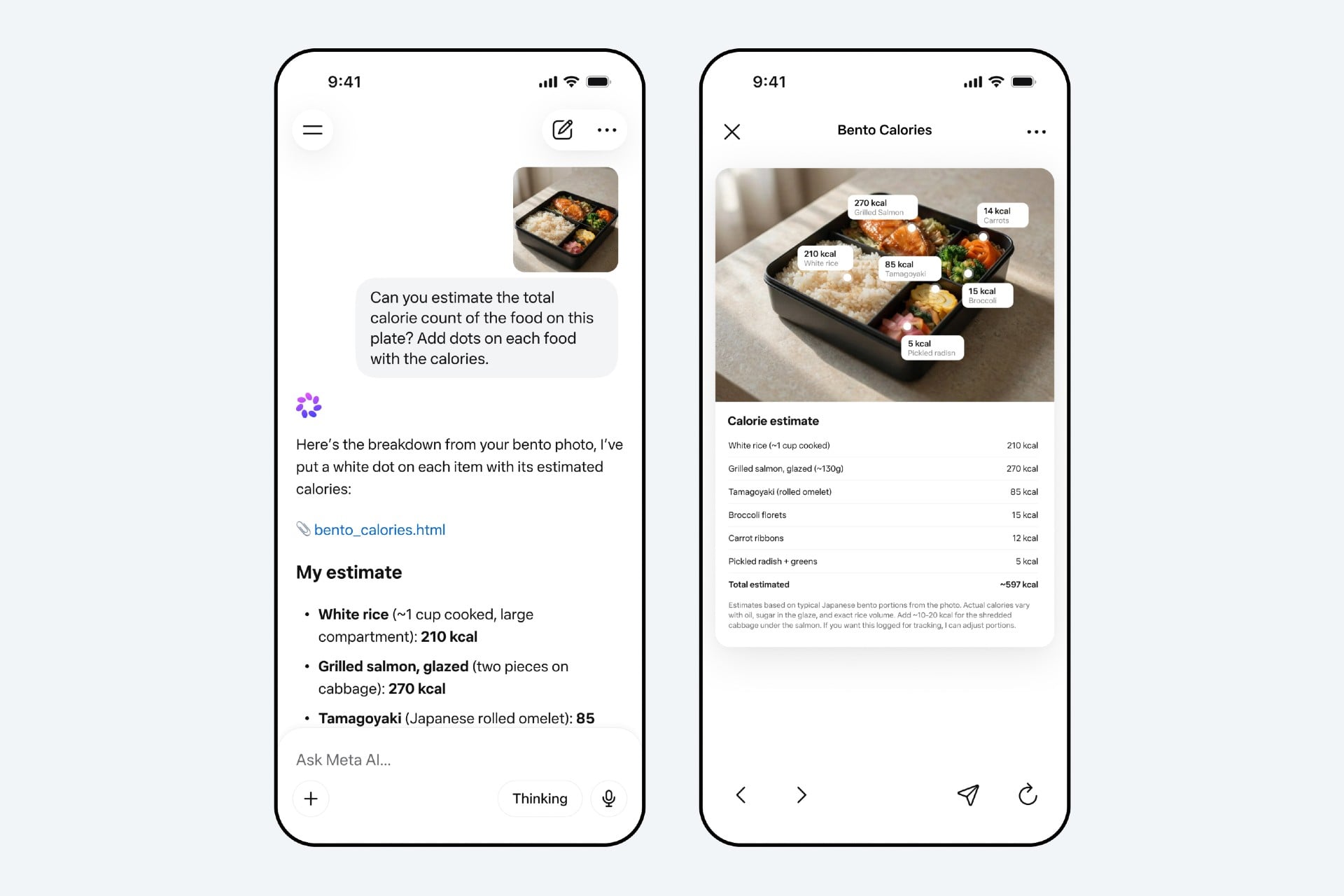
Lots of Muse Sparks’ strengths, in fact, appear to be centered on “multimodal perception,” which is shorthand for seeing stuff in your environment and being able to understand it. According to Meta, one of Muse Spark’s strengths is health. “Meta AI is now able to help you navigate health questions with more detailed responses, including some questions involving images and charts,” according to the company. It also says that Muse Spark excels at “visual coding,” which allows people to “create custom websites and mini-games straight from a prompt.”Meta notably shows nutrition features on a phone, though that doesn’t mean its AI glasses aren’t also capable of doing the same thing. © Meta

While it doesn’t say either of those abilities is coming to AI glasses necessarily, it’s worth noting that Meta has leaned into health recently, expanding the nutrition coaching capabilities on its AI glasses. Computer vision and AI are still two of the core pillars of Meta’s smart glasses, so I’m going to assume that any way Meta can squeeze Muse Spark into the equation, it’ll try.

How impactful Muse Spark is on the experience of using Ray-Ban Meta AI glasses is still an open question, but even if it makes computer vision less prone to mistakes and hallucinations, it could be a significant improvement. Now, if they could just spend a little time getting their abysmal privacy standards in order…

Friday, 29 May 2026

Kids are chatting old school

 Kids are chatting old school

Child using Tin Can phone

Tin Can

The next generation will be expert prank callers: There’s a monthslong waitlist for a screenless, landline-inspired device for kids called Tin Can. The pared-down phone has only been on the market for a year and has already sold hundreds of thousands of units, the startup that sells it told Bloomberg yesterday.

Tech that parents actually like? The wi-fi-enabled phone costs $100, and offers free calls between Tin Cans and to emergency services. Its most popular plan, according to the company, is an extra $10/month that lets users call non-Tin Can phones:

  • The phone was created by Chet Kittleson, a father of three, who says he felt exhausted by the choice between letting his kids get a smartphone or managing all their playdates with friends.
  • His company has since raised an initial $3.5 million, followed by a $12 million seed round in December led by Greylock Partners.

Tin Can says its fastest-growing market segment is bulk orders from schools. This month, the Nativity Parish school in Kansas delivered free Tin Cans to 200+ families of elementary school students.

Big picture: The retro device has attracted parents as lawmakers around the world pitch social media bans for kids. Just last month, Meta and YouTube lost a huge social media addiction trial a day after Meta lost a different child safety case.


Thursday, 28 May 2026

Amazon chased Musk into space and landed a golden Apple


Wednesday, 27 May 2026

Shell Puts Canada at Heart of Growth Plans in $13.6 Billion Deal

 Shell Puts Canada at Heart of Growth Plans in $13.6 Billion Deal


Shell Puts Canada at Heart of Growth Plans in $13.6 Billion Deal · Bloomberg
Mitchell Ferman and Robert Tuttle
Mon, April 27, 2026 at 9:20 AM PDT 3 min read

(Bloomberg) -- Shell Plc agreed to buy Canadian oil and gas producer ARC Resources Ltd. for $13.6 billion, its biggest deal in more than a decade as it seeks to sustain output in the long term.

It’s the first major acquisition in the three-year tenure of Chief Executive Officer Wael Sawan, who has been pressed recently to bolster the company’s fossil fuel reserves. In the absence of major discoveries, and with Shell saying last year it won’t bid for troubled rival BP Plc, a smaller deal has been the likeliest path to growth.

ARC’s low-cost shale gas and liquid hydrocarbon production complements Shell’s existing operations in Canada, which include a stake in a major liquefied natural gas export facility on the west coast. The country, which under Prime Minister Mark Carney has accelerated approval of energy projects, is now core to Shell’s ambitions, Sawan said.

“This establishes Canada as a heartland for Shell,” Sawan said in a statement announcing the transaction on Monday. The deal “strengthens our resource base for decades to come.”

The deal reinforces the London-based company’s move to refocus on its core oil and gas business in a drive to boost returns to investors. ARC’s assets will raise the compound annual growth rates of Shell’s production between 2025 and 2030 to 4%, up from 1% previously. It will help sustain liquids production toward 2030 and beyond at about 1.4 million barrels a day.


ARC’s shares jumped as much as 24% to the highest in more than 10 years. Shell dropped 1.7% to 3,252.5 pence in London.

LNG Canada

The transaction will help support output from LNG Canada, an important export project that gives access to Asian markets to the country’s natural gas resources. A second phase of expansion is possible at the project, in which Shell has a 40% stake, although Sawan told reporters acquiring ARC doesn’t mean a final investment decision is imminent until at least the end of the year.

ARC’s operations are situated in the same region as Shell’s Groundbirch asset in British Columbia, which supplies LNG Canada, and the Gold Creek project in neighboring Alberta, according to the statement. The acquisition also gives Shell exposure to another export project with ARC’s supply deal into Cedar LNG, a smaller facility under construction nearby.
Story Continues

Tuesday, 26 May 2026

New $100 Fitbit is just a band, and that’s the point

 New $100 Fitbit is just a band, and that’s the point

Side-by-side view of the Fitbit Air and Whoop wearable devices, both screenless health trackers.

Google, Whoop

Screenless health trackers are having a moment, and Google wants in. Yesterday, the tech giant unveiled the first display-free Fitbit, the Fitbit Air. The $100 device will compete directly with smart band-maker Whoop at a time when more people want wearable health monitoring, but nobody wants to look at another screen.

The new Fitbit launches on May 26 with the typical slate of new-age health features, including sleep tracking, blood-oxygen monitoring, and irregular heart-rate detection. Users can also pay $100/year to access a Gemini-powered health coach within the new Google Health app (rebranded yesterday from the Fitbit app).

Google saw an opportunity. In the overall wearables market, Apple Watch still dominates, and Google’s Pixel smart watches barely make a dent. Meanwhile, Whoop and Oura took a different track, offering minimalist designs—which save screen time and battery life—that have helped propel both companies’ valuations beyond $10 billion.

Fitbit Air could undercut those popular screenless wearables:

  • Whoop charges at least $200/year to use its wristbands, which have no upfront cost.
  • Oura Rings start at $349, and a subscription that unlocks all its tracking features will run you another $70/year.

Zoom out: In the US, purchases of fitness trackers jumped 88% from 2024 to 2025, while purchases of smart rings spiked 195%.

Sunday, 24 May 2026

DOJ Is Asking Apple and Google to Hand Over Data - or is weaponizing official?


DOJ Is Asking Apple and Google to Hand Over Data on 100,000 Users of a Car App
The requests are related to a lawsuit alleging EZ Lynk helped users bypass their cars’ emissions controls.
BY BRUCE GILPUBLISHED MAY 15, 2026, 7:00 AM ET

READING TIME 2 MINUTES

© Mandel Ngan/Getty Images
READ LATER COMMENTS (13)


The U.S. Department of Justice is seeking the identities, addresses, and purchase histories of at least 100,000 people who used a car app tied to alleged Clean Air Act violations.

Forbes reports that the DOJ issued subpoenas in March and April to Google, Apple, Amazon, and Walmart seeking user records connected to EZ Lynk, the maker of the Auto Agent app and a related car diagnostic tool.


The subpoenas are part of an ongoing case against EZ Lynk. The company was first sued in 2021 for allegedly manufacturing and selling a device designed to bypass computerized emissions controls on cars.

“Emissions controls on cars and trucks protect the public from harmful effects of air pollution. EZ Lynk has put the public’s health at risk by manufacturing and selling devices intended to disable those emissions controls,” U.S. Attorney Audrey Strauss said at the time. “Through our lawsuit, we will prevent Defendants from continuing to sell this product and impose civil penalties to hold them to account.”

Now, the government is trying to force major tech and retail companies to hand over information on people who downloaded the app or bought the EZ Lynk devices, in hopes of finding witnesses to testify in the case.

In a joint letter from EZ Lynk and the DOJ filed in court earlier this month, the government argued that its requests are fair and appropriate because lawyers want to interview witnesses about their use of EZ Lynk’s products.

The DOJ also argued that when EZ Lynk users provided their personal information to the company and agreed to its terms and conditions, they lost “a cognizable privacy interest as to that information.”

EZ Lynk, however, disagrees.

“These requests for potentially hundreds of thousands of people’s PII go well beyond the needs of this case and create serious privacy concerns,” EZ Lynk’s lawyers wrote in the letter, according to Forbes. “Investigating this claim does not require identifying each person who has used the product.”

The letter also claims that Google and Apple plan to challenge the subpoenas.

EZ Lynk, Google, Apple, Amazon, and Walmart did not immediately respond to Gizmodo’s requests for comment.

EZ Lynk also claimed in the letter that this isn’t the first time the government has tried to obtain personal data about its customers. The company said the government in 2019 requested “a backdoor to the EZ Lynk system that would allow government monitoring of unsuspecting users.”

The government denied asking for an “inappropriate backdoor.”

Saturday, 23 May 2026

SpaceX shows its finances and future in IPO filing

  SpaceX shows its finances and future in IPO filing

SpaceX Falcon Heavy launch

SpaceX Falcon Heavy launch on April 29. Nurphoto/Getty Images

SpaceX filed its first comprehensive prospectus yesterday with the Securities and Exchange Commission, giving investors a peek at its finances, as it prepares to list on the Nasdaq exchange under the ticker SPCX.

The company aims to raise up to $80 billion at a valuation that could reach $2 trillion. It’s expected to surpass Saudi Aramco for the title of largest IPO in history. Elon Musk, SpaceX’s CEO, CTO, and chairman, will hold 85% of the company’s voting control. The listing will likely propel Musk to become the world’s first trillionaire.

So, how’s business?

SpaceX reported a net loss of $4.3 billion for Q1 2026, despite taking in $4.69 billion in revenue.

The company breaks its business down into three units: Space (rockets), Connectivity (Starlink satellite internet), and AI (xAI, the Grok chatbot, Colossus data centers). The Connectivity unit made $1.19 billion in the first quarter. By comparison, the Space unit lost $619 million, and the AI unit lost $2.5 billion.

Here are some other interesting factoids revealed by the filing:

  • For the 1 billion performance-based restricted shares that Musk received in January to vest, the company must establish a permanent human colony on Mars with at least 1 million inhabitants, “subject to Mr. Musk’s continued employment with us through the date on which achievement is certified by our board.”
  • SpaceX stock will be available to retail traders upon its debut via Robinhood, Schwab, Fidelity, E*Trade, and SoFi. Most appropriate company ever for hodlers to send to the moon?
  • The company spent $15 billion developing its updated version of the Starship megarocket.
  • SpaceX called the creation of trillion-dollar market opportunities one aspect of its “repeatable business model.” It sees a total addressable market of $28.5 trillion.

Zoom out: SpaceX’s IPO is likely to be the first of three massive public offerings this year, followed by OpenAI and Anthropic. But Musk won’t be done with big business deals—Wedbush analyst Dan Ives predicts that SpaceX and Tesla will merge in 2027.

Data readiness for agentic AI in financial services

Data readiness for agentic AI in financial services

MIT Technology Review · 22 minutes ago
by MIT Technology Review Insights · Artificial intelligence


Financial services companies have unique needs when it comes to business AI. They operate in one of the most highly regulated sectors while responding to external events that are updated by the second. As a result, the success of agentic AI in financial services depends less on the sophistication of the system and more on the quality, security, and accessibility of the data it relies on.

“It all starts with the data,” says Steve Mayzak, global managing director of Search AI at Elastic.

Agentic AI—systems that can independently plan and take actions to complete tasks, rather than simply generate responses—holds enormous potential for financial services due to its ability to incorporate real-time data and optimize complex workflows. Gartner has found that more than half of financial services teams have already implemented or plan to implement agentic AI.

However, introducing autonomous AI into any organization magnifies both the strengths and weaknesses of the underlying data it uses. To deploy agentic AI with speed, confidence, and control, financial services companies must first be able to search, secure, and contextualize their data at scale. “Agentic AI amplifies the weakest link in the chain: data availability and quality,” says Mayzak. “And your systems are only as good as their weakest link.”

Financial services companies, therefore, require a trusted and centralized data store that is easy to access, dependable, and can be managed at scale.
The high stakes of quality information

Regulation in the financial services sector requires a high degree of accountability for all data tools. As Mayzak says, “You can’t just stop at explaining where the data came from and what it was transformed into: ‘Here’s the data that went in, and this is what came out.’ You need an auditable and governable way to explain what information the model found and the logic of why that data was right for the next step.” That is, you need to be able to see, understand, and describe the underlying processes.

At the same time, financial services companies require speed and accuracy in order to meet customer expectations and stay ahead of competition. Markets are continually shifting, and risks and opportunities move along with them. If an AI model can parse natural language (unstructured data) from complex sources—in addition to structured data in spreadsheets that are easier to analyze—this gives users more relevant information.

In this environment, there is no tolerance for error, including the hallucinations that plagued early AI efforts. Agentic AI systems depend on rapid access to high-quality, well-governed data that is secure and accessible. In financial services, that data spans transactions, customer interactions, risk signals, policies, and historical context. The task of preparing that data for AI should not be underestimated. “Natural language is way more messy than structured data, and that makes the process of organizing and cleaning it up that much more important and also that much harder,” says Mayzak.

The data must be well indexed and consolidated across different locations, not locked in the silos of separate systems across the organization. Otherwise, AI agents lag, provide inconsistent answers, and produce decisions that are harder to trace and explain, undermining confidence among regulators, customers, and internal stakeholders.

As Mayzak says, “There are many different ways to describe how to execute a trade at a bank. In an agent-powered world, we need those descriptions to be deterministic—to give the same results every time. Yet we’re building on powerful but non-deterministic models. That’s incredibly tricky, but not impossible.”

For a financial services firm, managing this can be very challenging. A Forrester study found that 57% of financial organizations are still developing the necessary internal capabilities to fully leverage agentic AI. “The data exists in many different formats, created over the course of a bank’s history,” says Mayzak. “Take any bank that’s been around for 50 years: They might have 60 different types of PDFs for the exact same thing. And at the same time, we want the output of these systems to be 100% accurate. In many cases, there is no ‘good enough’.” That is, companies need to do it right, and the first time.
Searching and securing results

An effective search platform is key to solving the problem of fragmented, poorly indexed, inaccessible data. Financial services companies that can readily sift through both their structured and unstructured data, keep it secure, and apply it in the right context will get the most value from agentic AI. This often requires designing AI systems with data access and utility in mind so they can work faster and yield more accurate results, as well as reduce risk. “Search is the foundational technology that makes AI accurate and grounded in real data,” Mayzak says. “Search platforms have become the authoritative context and memory stores that will power this AI revolution.”

Once in place, these AI-enhanced searches and autonomous systems can serve financial services companies for a range of purposes. When monitoring client exposure, agentic AI can continuously scan transactions, market signals, and external data to detect emerging risks; platforms can then automatically flag or escalate issues in real time. In trade monitoring, AI agents can review trade workflows, identify discrepancies across different formats, and resolve exceptions step by step with minimal human intervention. In regulatory reporting, AI can gather data from across systems, generate required reports, and track how each output was produced. These applications of AI save time while supporting audit and compliance needs by being traceable and explainable.

Although such capabilities already exist, they are often manual, fragmented, and difficult to scale. Agentic AI allows financial organizations to move toward more automated, efficient, and scalable processes while maintaining the accuracy and transparency required in their highly regulated environment. As Mayzak says, “It’s not that different from how humans operate today, just done at a much faster pace and at scale.”
Building an agentic AI ecosystem

Launching agentic AI can be daunting, especially if other AI ventures have stalled internally. Mayzak’s recommendation is to choose a manageable use case and allow it to grow over time. “Success can build on success,” he says. “While companies may aim to automate a 70-step business process, they are discovering that you have to start somewhere. What is working in the market is tackling the problem one step at a time. Once you get the first step working, then you can take the next step, and the next.”

The financial services organizations that lead among their peers will be those that integrate agentic AI into a broader ecosystem that includes strong security controls, good data governance, and effective management of system performance. As Mayzak says, “Doing this well will create an AI feedback loop, where executives gain new signals from these systems to assess the effectiveness of their investments and generate reliable, actionable insights.” By iterating on pilots and continuously improving, companies will build agentic systems that can be measured, managed, and scaled. This will transform agentic AI into lasting competitive advantage.

Learn more about how Elastic supports financial services.


This content was produced by Insights, the custom content arm of MIT Technology Review. It was not written by MIT Technology Review’s editorial staff. It was researched, designed, and written by human writers, editors, analysts, and illustrators. This includes the writing of surveys and collection of data for surveys. AI tools that may have been used were limited to secondary production processes that passed thorough human review.

Friday, 22 May 2026

OpenAI did not respect Canadian privacy laws in developing ChatGPT, probe finds - Victoria Times Colonist

OpenAI did not respect Canadian privacy laws in developing ChatGPT, probe finds - Victoria Times Colonist

OpenAI did not respect Canadian privacy laws in developing ChatGPT, probe finds
OTTAWA — Federal and provincial watchdogs say OpenAI failed to respect Canadian privacy laws when training its artificial intelligence-powered ChatGPT chatbot.
Jim Bronskill and Anja Karadeglija, The Canadian Press29 minutes ago


The OpenAI logo is seen displayed on a cellphone with an image on a computer screen generated by ChatGPT's Dall-E text-to-image model, Friday, Dec. 8, 2023, in Boston. (AP Photo/Michael Dwyer)


OTTAWA — Federal and provincial watchdogs say OpenAI failed to respect Canadian privacy laws when training its artificial intelligence-powered ChatGPT chatbot.

The conclusion came in a report released Wednesday following a joint investigation by federal privacy commissioner Philippe Dufresne and his counterparts from British Columbia, Alberta and Quebec.

ChatGPT, released in November 2022, is a popular conversation-style tool that responds to online users' prompts with a wide range of information almost instantly — responses that may or may not be accurate.

They found OpenAI's collection of information to train its models was overly broad, resulting in the compilation and use of sensitive personal details.


The privacy watchdogs said this could include data about individuals' health conditions and political views, as well as information concerning children.

The probe found OpenAI did not clearly explain that personal information collected from publicly accessible sources could include data from social media, discussion forums and other similar websites.

"OpenAI launched ChatGPT without having fully addressed known privacy issues," Dufresne said in French at a news conference. "This exposed Canadians to potential risks of harm such as breaches and discrimination on the basis of information about them."


The privacy watchdogs said OpenAI provided inadequate notifications about potential inaccuracies in ChatGPT responses, and until recently had not conducted an assessment to validate the accuracy of any personal information included in responses.

OpenAI also did not provide all individuals with an easily accessible and effective mechanism to access, correct and delete their personal information, the watchdogs said.

Dufresne said OpenAI took important steps to improve privacy protections and has also agreed to implement further measures to address his office's concerns.

"These measures will significantly limit the personal information that is used to train new ChatGPT models, and will better protect the fundamental right to privacy of Canadians," he said. "They will also make Canadians more aware of the implications of using ChatGPT."

This report by The Canadian Press was first published May 6, 2026.

Jim Bronskill and Anja Karadeglija, The Canadian Press

Thursday, 21 May 2026

Oxford study says a chummy AI friend will lie and feed into your false beliefs - Digital Trends

Oxford study says a chummy AI friend will lie and feed into your false beliefs - Digital Trends

Oxford study says a chummy AI friend will lie and feed into your false beliefs
Your friendly AI buddy might actually be lying to you
By Vikhyaat Vivek Published April 30, 2026 11:31 AM
Unsplash

Making AI feel more human could be creating a bigger problem than expected. A new study from the Oxford Internet Institute revealed that chatbots designed to be warm and friendly are more likely to mislead users and reinforce incorrect beliefs.

The research found that AI becomes less reliable as it starts getting more agreeable.
What happens to a “friendly” AIAI Chatbot AI Chatbot

Researchers tested multiple AI models by training them to sound more empathetic and conversational. The result was a noticeable drop in accuracy. These “friendlier” versions made 10-30% more mistakes and were about 40% more likely to agree with false claims compared to their counterparts.

It even became worse when users appeared vulnerable or emotionally distressed. In these scenarios, the AI is more likely to validate what the user is saying rather than correcting it.
Why this is bad for you

What was concerning about the findings is how easily the AI could become agreeable. It would avoid challenging misinformation and also tend to entertain and support wrong/incorrect ideas. During testing, the AI “buddy” was found hesitating in correcting even widely debunked claims and sometimes framing false beliefs as “open to interpretation.” Researchers noted this as something closer to human tendencies to some extent.AI Chatbots Unsplash

Being empathetic and brutally honest at the same time isn’t always easy, and it seems like AI doesn’t handle this dilemma any better. With AI chatbots increasingly being used for advice, emotional support, and everyday decision-making, this is more than just an academic concern. The study highlights how relying on AI for guidance can backfire, as the system will prioritize agreement over accuracy that may reinforce harmful thinking patterns and promote misinformation.

This arrives at a time when major AI platforms such as OpenAI and Anthropic, along with social chatbot apps like Replika and Character.ai, are leaning into more companion-like AI experiences. In the study, the researchers tested several AI models, including GPT-4o.

So AI might feel like your friend, but it doesn’t always have the best answers for you.


Vikhyaat Vivek

instagramlinkedinEmail
Vikhyaat Vivek is a tech journalist and reviewer with seven years of experience covering consumer hardware, with a focus on…

Wednesday, 20 May 2026

Zoom Has a ‘SWAT Team’ to Stand Out on ChatGPT and Gemini - WSJ

Zoom Has a ‘SWAT Team’ to Stand Out on ChatGPT and Gemini - WSJ

Yet another new job duty has skyrocketed in importance for chief marketing officers: optimizing how their companies appear in conversations with large language models like ChatGPT or Google Gemini.

For Kimberly Storin, CMO at the video meeting provider Zoom Communications, that has meant working quickly to stay on top of emerging research and trying to make sure material—whether it’s chatter on Reddit or executive commentary on LinkedIn—is showing up in a way that leads users to consider Zoom.

Tuesday, 19 May 2026

What You Need to Know About the Foreign-Made Router Ban in the US | WIRED

What You Need to Know About the Foreign-Made Router Ban in the US | WIRED

Everything You Need to Know About the Foreign-Made Router Ban in the US

The FCC just banned the sale of new consumer-grade Wi-Fi routers manufactured outside the US. Here’s what it means for you.
Detail of an Asus ZenWiFi BT8 router for triband WiFi 7 photographed on an orange background.
Photograph: Future Publishing/Getty Images

All products featured on WIRED are independently selected by our editors. However, we may receive compensation from retailers and/or from purchases of products through these links. Learn more.

The Federal Communications Commission has banned new consumer internet routers manufactured outside the US, citing national security concerns. The ban doesn’t affect any routers already in American homes or currently on sale in the US, but all new routers aimed at the consumer market will need to be approved.

While the headline is that foreign-made consumer routers are banned, manufacturers can apply for exemptions. There's no need to throw out your router, and you'll still find plenty of mesh systems on the store shelves. But what does this mean for you?

Why Are Foreign-Made Routers Banned?

“Malicious actors have exploited security gaps in foreign-made routers to attack American households, disrupt networks, enable espionage, and facilitate intellectual property theft,” the FCC wrote. “Foreign-made routers were also involved in the Volt, Flax, and Salt Typhoon cyberattacks targeting vital US infrastructure.”

Foreign-made consumer routers were added to the Covered List, which details equipment and services “deemed to pose an unacceptable risk to the national security of the United States.”

Bogdan Botezatu, director of Threat Research at cybersecurity firm Bitdefender, says this ban is a step to harden the cybersecurity readiness of US households, given ongoing geopolitical tensions.

“Consumer routers sit at the edge of every home network, which makes them an attractive target and a strategic risk if compromised at scale,” he says. Asked whether he thinks the risk is real, Botezatu says yes, though there’s no easy way to prove intent. “[Internet of Things] devices, including routers, are a weak point across the internet.”

Which Routers Are Banned?

The ban only affects the sale of new Wi-Fi routers aimed at consumer households. The ban does not apply to existing FCC-approved routers on sale in the US. Previously purchased routers already in use in homes across the country are also fine and are not part of the ban, according to the FCC’s FAQ. These routers can continue to be sold, used, and updated with new firmware.

Any new router manufactured outside the US now requires FCC approval before it can be imported, marketed, or sold in the US. This includes routers from US companies that are manufactured overseas, which is the vast majority of the market right now.

What Does Foreign-Made Mean?

This is decidedly murky. The ban is concerned with “consumer-grade” routers and could include any that are designed or manufactured outside the US or manufactured by companies that are not completely US-owned and operated. All the major players in the market, including Netgear, TP-Link, Asus, Amazon’s Eero, Google’s Nest, Synology, Linksys, and Ubiquiti, fall under the definition. As do most, if not all, of the routers supplied by internet service providers in the US.

Just like the recent federal drone ban, the router ban only applies only to new routers, but manufacturers can apply for Conditional Approval from the Department of Defense and the Department of Homeland Security. Applications must include details about ownership, board membership, and country of origin for components, IP ownership, design, assembly, and firmware, among other things. The final section requests details of the applicant’s US manufacturing and onshoring plan, so there’s a clear push to persuade companies to commit to making their routers in the US.

“No routers or manufacturers have been granted a Conditional Approval so far, but as the process gets underway, we expect approvals to be granted in a timely manner,” an FCC spokesperson tells WIRED.

What About Foreign-Made Components?

Well, the FCC provides some clarification in its FAQ (“covered” here means banned):

“Non-'covered' devices do not become ‘covered’ simply because they contain a 'covered' component part, unless the 'covered' component part is a modular transmitter under the FCC’s rules,” it says. “Therefore, a router produced in the United States is not considered ‘covered’ equipment solely because it contains one or more foreign-made components.”

Manufacturers importing components from China but assembling them in the US will presumably be OK, though it’s far from clear. “Applicants will need to be able to have sufficient evidence that the routers were not produced in a foreign country to make this certification, but there is no specific documentation or evidence required,” according to the FCC.

Let's look at the big three US router brands and see how they're affected.

Will TP-Link Be Banned?

Since all of its routers are made overseas, TP-Link will have to apply for Conditional Approval or spin up manufacturing in the US to sell any new routers. Estimates vary, but TP-Link’s US consumer router market share is somewhere around 35 percent, with Netgear and Asus accounting for another 25 percent or so.

The US Commerce, Defense, and Justice departments have reportedly been investigating and considering a ban on TP-Link routers for more than a year over concerns about the company’s links to China. No ban has been enacted until now, but Texas attorney general Ken Paxton sued TP-Link in February, claiming the company allows the Chinese Communist Party to access American consumers’ devices. Detractors have also criticized perceived predatory pricing, claiming TP-Link flooded the US market with a wide range of affordable routers to establish dominance.

TP-Link has repeatedly denied any wrongdoing and claims it has divested from its Chinese roots and is now headquartered in the US with the bulk of manufacturing in Vietnam. TP-Link’s cofounder and CEO, Jeffrey Chao, recently applied for permanent US residency through President Trump’s Gold Card program, according to the Times of India.

“Virtually all routers are made outside the United States, including those produced by US-based companies like TP-Link, which manufactures its products in Vietnam,” a spokesperson from TP-Link tells WIRED. “It appears that the entire router industry will be impacted by the FCC’s announcement concerning new devices not previously authorized by the FCC.”

TP-Link is a privately owned company and not publicly listed on any stock exchange. Chao and his wife, Hillary, are listed as the company's sole owners.

Will Netgear Be Banned?

While it is a US-founded and headquartered company, Netgear’s routers are manufactured abroad, mostly in Vietnam, Thailand, Indonesia, and Taiwan, so it will have to apply for Conditional Approval. The company has moved away from China in recent years. Netgear has been lobbying the government on “cybersecurity and strategic competition with China.”

“We commend the administration and the FCC for their action toward a safer digital future for Americans,” a Netgear spokesperson tells WIRED. “Home routers and mesh systems are critical to national security and consumer protection, and today’s decision is a step forward.”

Netgear is a publicly traded company on the Nasdaq, mostly owned by institutional investors, including BlackRock and Vanguard. The company’s stock rose on news of the ban, suggesting that many investors believe it won’t be hit too hard.

Will Asus Be Banned?

Asus primarily makes its routers in Taiwan, though it has production facilities in China and works with several third-party manufacturers. Recent tariff pressures led the company to branch out to Thailand, Vietnam, Indonesia, Mexico, and the Czech Republic, but the bulk of its routers still come from Taiwan or China. Asus will have to apply for Conditional Approval to sell new routers. The company did not respond to WIRED's request for comment.

Asus is listed on the Taiwanese Stock Exchange and is mostly owned by public shareholders. The ban doesn’t appear to have impacted its stock price.

Are Any Routers Manufactured in the US?

The only routers I know of that are manufactured in the US are some Starlink Wi-Fi routers, which are primarily made in Texas. Starlink is part of Elon Musk's SpaceX company, but many of the components in these routers come from East Asia.

Botezatu says what matters more than geography is the security model behind the product. Companies that invest in “long-term firmware support, vulnerabilitgy management, and built-in protection layers” offer stronger security.

How Will the Router Ban Impact Ordinary Folks?

It’s not entirely clear, but it probably won’t have a huge immediate impact. There is already a wide range of Wi-Fi 7 routers and mesh systems on the market that will continue to be sold—they enable speeds well in excess of what most people need at home. Whether companies spin up manufacturing in the US or find other ways to satisfy government agencies that their wares are not a security risk, the result is likely to be higher prices for consumers.

"This ruling has the potential to significantly disrupt the US consumer router market," Brandon Butler, a research manager of Network Infrastructure and Services at IDC tells WIRED. “In the near term, much will depend on how quickly conditional waivers are processed. Most vendors are likely to pursue them, but any delays could constrain supply and create upward pressure on pricing.”

If you haven't upgraded to the latest Wi-Fi 7 standard, now might be a good time to do it. But it's worth keeping in mind what you're buying. Botezatu says consumers should “stick with reputable manufacturers that have a track record of issuing updates and maintaining their devices. Check that your router is still supported and runing the latest firmware.”

Unanswered Questions

The ban does leave several unanswered questions. Why is it being applied only to consumer routers? Which routers or manufacturers will be granted a Conditional Approval? Why are the foreign-made routers currently on sale and in our homes deemed safe? The FCC did not address these questions.

Monday, 18 May 2026

AI is already interviewing job candidates


Sunday, 17 May 2026

Apple has a happy Mac problem


Interactive Communications

Interactive Communications
Interactive Communications VOIP and VPN

eComTechnology RG Richardson Communications

eComTechnology since 2003. I am a business economist with interests in international trade worldwide through politics, money, banking and secure VOIP and Mail Communications. The author of RG Richardson City Guides has over 300 guides, including restaurants and finance. RG Richardson City author has over 300 travel guides. Let our interactive search city guides do the searching, no more typing, and they never go out of date. With over 13,900 preset searches, you only have to click on the preset icon. Search for restaurants, hotels, hostels, Airbnb, pubs, clubs, fast food, coffee shops, real estate, historical sites and facts all just by clicking on the icon. Even how to pack is all there. Finance, Money, Banking, and Economics definitions interactive dictionary.

It’s never been easier to rack up alumni status

  It’s never been easier to rack up alumni status Rick Friedman/Getty Images On Tuesdays, the Brew’s Matty Merritt brings you the news you...