eComTechnology

eComTechnology
Interactive services

Friday, 12 June 2026

Starbucks Scraps Disastrous AI Tool

 

Starbucks Scraps Disastrous AI Tool

The AI never had its coffee.
Starbucks Coffee circular sign with the iconic twin-tailed mermaid logo, mounted on a green bracket attached to a building. The background is an orange grid pattern. The sign is black and white with bold text.
Illustration by Tag Hartman-Simkins / Futurism. Source: Getty Images

Hold onto your pumpkin spice lattes, because Starbucks is canning its AI tool after it turned out to be a total disaster, Reuters reports, less than year after it debuted.

The tool, which was deployed across its North American stores, was designed to automate inventory management with the goal of providing accurate real-time information that could help Starbucks address ingredient shortages at its locations. 

But according to previous Reuters reporting, the error-prone AI frequently miscounted and mislabeled items, confusing different types of milk and sometimes forgetting to count them altogether.

Now, it’s getting the axe.

“Starting today, Automated Counting will be retired,” read an internal company newsletter from Monday obtained by the news agency. “Beverage components and milk will now be counted the same way you count other inventory categories in your coffeehouse.”

Having lasted just nine months, the AI experiment stuck around longer than some of the coffee chain’s seasonal drink offerings, but didn’t approach anywhere near the level of permanent revolutionary impact the tech promises, or indeed the company was hoping for. You also have to wonder if a human employee who couldn’t do the bare minimum of counting stuff would be shown anywhere near the same amount of leeway the AI got at the chain infamous for its union busting.

In any case, it’s a quick reversal from Starbucks. It was only in February that it told Reuters that the AI already helped improve product availability. On Thursday, it only explained that the AI program’s termination was part of a decision to “standardize how inventory is counted across coffeehouses as we continue to focus on consistency and execution at scale.” 

The tool, built by NomadGo, was intended to allow employees to “count everything in your inventory… with just a wave of a smartphone or tablet,” its website claims. In practice, employees held up a company tablet in front of shelves stocked with ingredients like syrups and milks, and the app scanned it with lidar and a camera, per Reuters

Also in practice: it didn’t always work. In an embarrassing augury of things to come, it failed to recognize a peppermint syrup bottle in an official video Starbucks uploaded when the collaboration was announced.

This is only the latest questionable example of restaurants, an industry far-removed from tech, trying to embrace AI that ultimately backfires. Earlier this week, one of Pizza Hut’s largest franchisees sued the pie-slinging chain over its mandatory deployment of an AI-powered kitchen management system, alleging that it dramatically slowed down delivery times and caused over $100 million in losses.

This also isn’t Starbucks first foray with the tech. Last month, it collaborated with OpenAI to allow customers to place orders through ChatGPT, a feature that quickly became a laughingstock online.


Thursday, 11 June 2026

Is your wearable device’s stress detection accurate?

 Is your wearable device’s stress detection accurate?

Person wearing fitness tracker smartwatch

Unsplash

In the never-ending race to put a doctor on your arm, Garmin, Samsung, Fitbit, and Oura each purport to offer stress-tracking based on physiological signals, like heart rate variability and sleep. That all sounds great, but in practice, these features aren’t necessarily reliable, and all this health monitoring can actually make you feel more anxious.

A recent study on Garmin’s stress-tracking found that wearables can often cry wolf:

  • A quarter of participants were told they were stressed or not stressed when they actually felt the opposite.
  • Stress scores didn’t significantly increase for any participants when they did feel stressed.
  • The study’s author noted that his own Garmin has mistaken heart-rate-raising activities, like exercise or excitedly talking to a friend, for stress.

To stress-tracking’s credit, some hardware junkies say their wearable devices have helped them regulate their nerves, but drawing conclusions from biometrics can also backfire. If you’re already an anxious person, for example, getting frequent notifications of stress, possible hypertension, or an irregular heartbeat could worsen your anxiety.

Wednesday, 10 June 2026

Proton community update


You might buy SpaceX stock without even realizing it

 You might buy SpaceX stock without even realizing it

Illustration showing the SpaceX logo in the middle of the image, above it is imagery related to space including stars and a rocket ship in shades of blue, and below it is money, coins, and a stock market graph in shades of green.

Niv Bavarsky

On Tuesdays, the Brew’s Matty Merritt brings you the news you need to make life a little easier during your 9-5, 5-9, or OOO.

Not long ago, index funds were considered a pretty boring investment—a good place to park cash that you didn’t want to get swept away in the volatile ups-and-downs of hot new trades because of the rules governing which companies were included. That’s also what made them one of the most popular features of Americans’ retirement accounts.

But just a week after SpaceX’s IPO on Friday, it will be able to slide into some index funds, despite reporting billion-dollar losses last year and the first three months of 2026.

Which ones? Those that track the stocks of the Nasdaq and FTSE Russell indexes. Within the last few months, both changed their methodology for when a company can join the indexes after becoming public. Now, what used to be a roughly three-month wait period is just five days for some of FTSE Russell’s indexes and 15 for the Nasdaq.

But the S&P keeps the wait. On Friday, S&P Global said it wouldn’t change rules to fast-track stocks into the S&P 500, which would prevent the nearly $7.5 trillion in passively managed funds that follow it from being invested in both SpaceX and other massive IPOs expected this year, like Anthropic and OpenAI.

Tuesday, 9 June 2026

Apple Settles Alleged False Advertising Suit Over AI-Powered Siri

Apple Settles Alleged False Advertising Suit Over AI-Powered Siri

Apple Settles Alleged False Advertising Suit Over AI-Powered Siri
It seems consumers expected an AI-powered version of Siri to do amazing things that it still, to this day, cannot do.
BY MIKE PEARLPUBLISHED MAY 5, 2026, 8:23 PM ET

READING TIME 3 MINUTES

© Thomas Trutschel/Photothek via Getty Images
READ LATER COMMENTS (5)


According to the New York Times, if you bought an iPhone 16 or certain iPhone 15 between June of 2024 and March of 2025, you may soon be eligible to receive a check for as much as $95 per device as part of a class action lawsuit related to Apple Intelligence and Siri. The allegedly flawed Apple Intelligence features that were part of the suit originally shipped on iPhone 15 Pro and Pro Max in June of 2024. The Apple Intelligence-native iPhone 16 line shipped later that year.

On Tuesday, Apple settled claims in U.S. District Court in San Jose, California over alleged false advertising. The suit argued that Apple led consumers to believe the Apple Intelligence suite of features was more capable than it actually was. The total settlement amount, still awaiting a judge’s approval, is $250 million.


Apple maintains that it did nothing wrong. Marni Goldberg, an Apple spokesperson gave a statement to the Times, claiming that beginning with “the launch of Apple Intelligence,” Apple has “introduced dozens of features across many languages that are integrated across Apple’s platforms,” and that the company had “resolved this matter to stay focused on doing what we do best, delivering the most innovative products and services to our users.”

This lawsuit was “fallout,” according to Axios, from Apple’s acknowledgement last year that AI upgrades to Siri were not going to be released on schedule. A statement to Daring Fireball at the time said Apple had “been working on a more personalized Siri, giving it more awareness of your personal context, as well as the ability to take action for you within and across your apps,” but added, “It’s going to take us longer than we thought to deliver on these features and we anticipate rolling them out in the coming year.”

The next day, it was reported that Apple had pulled a now-notorious ad starring Bella Ramsey:


The ad is a nice summary of the “more personal” Siri concept that still has not been realized. We see Ramsey notice a person whose name they know they should know, so they quickly ask Siri “the name of the guy I had a meeting with a couple of months ago at Cafe Grenel?” It’s up to the viewer to presume this beefed-up version of Siri is able to use this prompt to draw on, say, an email, and produce the right answer. It immediately replies, “You met Zac Wingate at Cafe Grenel a couple of months ago.”

To put this class action settlement in context, Apple had been struggling mightily with Siri ever since—deservedly or not—ChatGPT created new consumer expectations for an AI-powered assistant. “AI is what most investors are really excited about. Almost all momentum in the market in general is being fueled by AI,” a portfolio manager named Brian Mulberry told the Wall Street Journal in February of 2024. Mulberry lamented that “Apple really hasn’t made a big splash in the AI space yet.”

So the Apple Intelligence rollout was perceived as coming late, but it was also, it seems, too early—given that it was sued and ended up settling for $250 million. In an interview with TechRadar last year after the smoke cleared around Siri’s underperformance, Apple software chief Craig Federighi explained that the company was working on a “version 2” of the new Siri that would work in all the personalized ways consumers had come to expect, but that Apple was no longer publicly offering a speculative release schedule for that version.

Monday, 8 June 2026

Japanese Airport Trialing Humanoid Robots as Baggage Handlers

Japanese Airport Trialing Humanoid Robots as Baggage Handlers

Japanese Airport Trialing Humanoid Robots as Baggage Handlers

No pressure, since they'll be working at one of the busiest airports in the world.
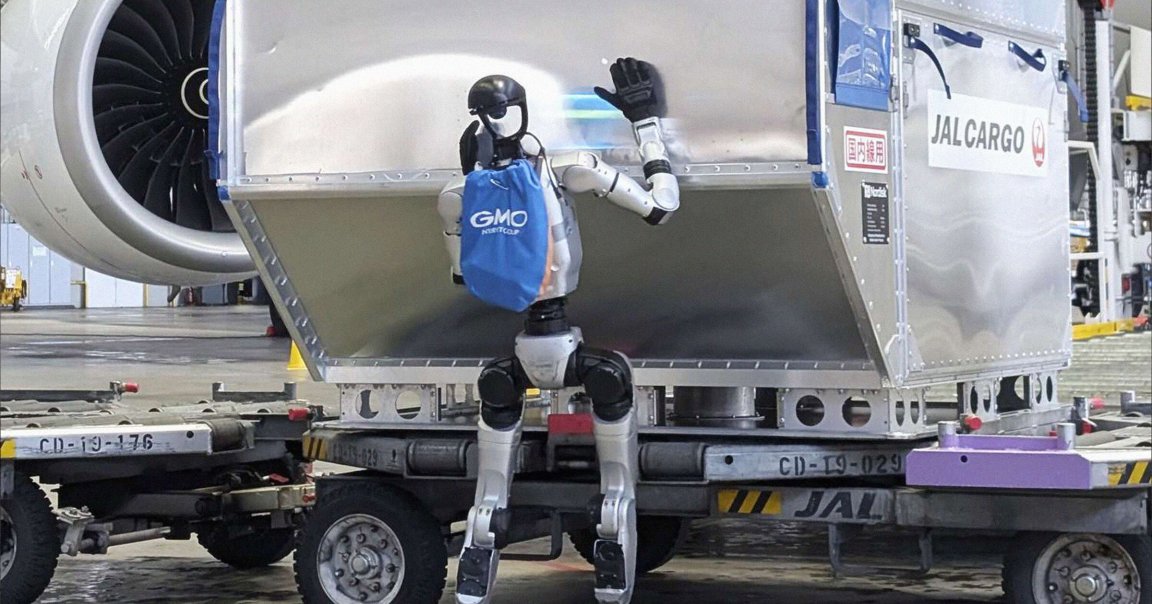
A humanoid robot is shown unloading a jet at an airport.
Kyodo News / Getty Images

The future is truly upon us — because the next time your check-in luggage gets battered, you could be blaming a robot.

Starting in May, Japan Airlines, in partnership with GMO AI & Robotics, will start trialing humanoid robots to help baggage handlers at Tokyo’s Haneda airport, it announced Monday, in the hopes that they could one day alleviate a labor shortage.

In a demonstration held in front of the media, one of the mechanical helpers built by the Chinese Robotics company Unitree gently pushes — or should we say barely touches — a metal container stacked with suitcases towards a passenger jet. Its contribution is entirely perfunctory, though, since the container is actually being moved by a conveyor belt; the robot didn’t “help” with anything at all.

Not that the robot’s aware. Oblivious, the Unitree machine proudly waves to his human colleague controlling the belt, who kindly returns a thumbs-up.

The stunt is clearly not a serious demonstration of the robots’ capabilities — if it does have meaningful capabilities at all — but Japan Airlines certainly sounds serious about the experiment, since it’s planning for it to run until 2028. 

It will be a trial by fire for the androids. Serving more than 60 million passengers per year, Haneda is easily one of the busiest air travel hubs in the world. Slip-ups could lead to luggage being lost or damaged, or costly delays.

They’ll also face steep competition. We’re not trying to launder Japan’s PR any more than it already gets, but its baggage handlers are pretty lauded for being thorough and gentle, and going above and beyond. That’s kind of remarkable, since the only other time baggage handlers make the news is for piling together your fragile belongings like sandbags.

How capable the bots prove remains to be seen. It could go horribly wrong, given the number of robot flameouts we’ve witnessed. But in theory they’ll help Japan’s baggage handlers deal with the influx of tourists, seven million of whom visited in the first two months of this year alone.

“While airports appear highly automated and standardised, their back-end operations still rely heavily on human labour and face serious labour shortages,” GMO AI & Robotics’ president Tomohiro Uchida told reporters, per the BBC.

Sunday, 7 June 2026

Oil Slicks Spread Through Persian Gulf, Threatening Fragile Ecosystems


Oil Slicks Spread Through Persian Gulf, Threatening Fragile Ecosystems
May 25, 2026
Reading time: 4 minutes


The Strait of Hormuz (NASA Johnson/flickr)


As peace talks drag on and the American-Israeli war against Iran enters its fourth month, environmental advocates are urging attention to yet another bitter consequence of dropping bombs on the world’s largest centre of fossil fuel production: ecosystem-ravaging oil slicks.

Satellite imagery confirms that marine environments are being poisoned by oil leaking from fossil fuel infrastructure destroyed or compromised by the fighting. This latest threat follows the toxic “black rain” that blanketed Tehran after Israel bombed four fuel depots near the Iranian capital in March.

Now, oil slicks from early April attacks on infrastructure on the island of Lavan, some 250 kilometres west of the Strait of Hormuz, have reached Shidvar—a tiny coral island nature reserve that shelters endangered sea turtles and dolphins, and serves as a breeding ground for tens of thousands of migratory seabirds.

Videos posted to social media show “large dark ribbons of oil snaking along the island’s pristine white sand beaches,” reports The New York Times, which broke the news of Shidvar’s emergence as yet more collateral damage in the conflict.

By last month, CNN said the oil slicks were visible from space.

The oil spills coincide with breeding season for many birds and nesting season for the island’s turtles.

The Persian Gulf’s latest encounter with conflict-driven oil slicks began just hours after the war began Feb. 28, with a U.S. warplane attack on IRIS Shahid Bagheri, a 240-metre Iranian drone carrier that was reportedly docked near the Bandar Abbas Naval Harbor in the Strait.

Bombed again on March 6, the vessel likely had “significant” fuel on board, given its reported range of 22,000 nautical miles (40,750 kilometres) and ability to go an entire year without refuelling, The Guardian wrote at the time.

Since then, it has been grounded in shallow water near Iran’s Qeshm Island, home to the Hara Biosphere Reserve, a mangrove-filled wetland that provides vital habitat to flamingos, herons, egrets, and pelicans, as well as sea snakes and turtles. The waters around Qeshm, the Persian Gulf’s largest island, also sustain many kinds of fish and crustaceans that provide local communities with sustenance and work.

Satellite images from March 18 show a kilometres-long plume of bunker fuel from the Shahid Bagheri moving west towards the Hara Reserve.

With the fate of the reserve still uncertain, the United Nations is calling for a permanent global network to monitor environmental disasters in conflict zones using very-high resolution satellite imagery.

“Ecologically catastrophic in potential, geographically remote, and unfolding in a conflict zone where no cleanup crews can yet reach,” the Hara wetland crisis proves the urgent need for such a system, writes the UN.

Compounding all the dangers posed by the bombing of oil and gas infrastructure and leakages into nearby ecosystems is a frequent fog of uncertainty over who may be to blame for a particular disaster.

Just who is responsible for the attacks on Lavan Island remains unclear, for example, with Iran blaming unnamed “enemies” for the assault, CNN reported in a late April post.

The causes of two large oil slicks that appeared in the waters surrounding the Kharg Island oil export facility are also unconfirmed. The first appeared on satellite images on May 6, the second on May 16.

Potential causes of the spills include a crude oil leak from one of the large tankers moored off Kharg Island at the time, or a rupture in a decades-old undersea pipeline that connects the export facility to the Abuzar oil field, reports the New York Times.

Others have speculated—without evidence, notes the Times—that the slick might be evidence that Kharg Island is being forced to discharge oil that it has no room to store, with exports largely suspended since the end of February.

“The naval blockade has likely pushed Iran’s oil system into a dangerous state,” Nima Shokri, professor at the school of civil and environmental engineering at the Hamburg University of Technology, told the Times.

Further compounding all the harm is Iran’s own refusal to acknowledge the environmental cataclysm arriving on the crest of each oil-tipped wave. As of May 19, the Iranian government had yet to publicly acknowledge Shidvar Island’s condition, reported The Associated Press.

Hackers tricked Meta AI into helping hijack accounts

An illustration of a hacker talking to Meta's AI chatbot, portrayed as a face on a computer with an Instagram logo

Niv Bavarsky

Your mom was right: Asking nicely is the best way to get what you want—even if what you want is to hack famous people’s Instagram accounts. That’s apparently how hackers got Meta’s AI customer support to aid them in taking over high-profile handles.

It’s unclear how many accounts were impacted, but victims appear to include the Obama White House account, the US Space Force’s chief master sergeant, and a former Meta employee turned security researcher.

It was surprisingly easy to dupe Meta’s chatbot, as purported hackers’ social media posts show. According to 404 Media:

  • First, the hackers used a VPN to make themselves appear in the geographic area of the targeted account’s owner (thus bypassing automatic account protections).
  • Next, they asked the Meta AI Support Assistant to add a new email address to the account, prompting the bot to send a code.
  • Armed with the code, the hacker could request a password reset, which the bot then sent to the new email, thereby handing over control of the account.

But the bot won’t be rolling out the welcome mat for hackers any more. Yesterday, a Meta spokesperson said that the issue “has been resolved and we are securing impacted accounts.”

Zoom out: The bot’s blunder highlights the risks of the increasingly popular practice of handing over important business functions to AI agents.

Saturday, 6 June 2026

Dell’s Massive XPS Price Hikes


Dell’s Massive XPS Price Hikes Spell the Doom of Cheap PCs
Welcome to the age of high-end lightweight laptops costing $3,000 or more.
BY KYLE BARRPUBLISHED MAY 18, 2026, 2:15 PM ET

READING TIME 2 MINUTES

The Dell XPS 16 now costs nearly 20% more than it did a few weeks ago. © Raymond Wong; Gizmodo composite
READ LATER COMMENTS (10)


No laptop can escape the plague of spiking RAM prices. In what feels like a watershed moment for notebooks everywhere, Dell’s longtime high-end XPS laptops now cost close to or more than $3,000 if you want the latest and greatest specs and screen.

The company’s revised XPS 14 and XPS 16 models were supposed to help get the company’s notebook brands back on track. Now, these already expensive laptops cost nearly 25% more. When we first reviewed the XPS 14, it cost $2,200 for the high-end model that comes with an Intel Core Ultra X7 358H chip, 32GB of RAM, and the OLED touch display. Now, as of May 18, the laptop costs $2,900 at Best Buy. An XPS 16 came with a $2,350 price tag when Gizmodo reviewed it this month. Now, it’s $2,950.

These laptops cost even more on Dell’s own webstore (these laptops also come with limited game and creative software bundles when ordering direct from Dell). Those prices are not even the highest-end version of the laptops. There are additional configurations with a higher-end Intel Core X9 388H that cost $3,000 at 14 inches and $3,050 at 16 inches. Overall, Dell’s new pricing scheme for its longtime XPS laptop lineup feels more like our PC-loving brains are being pile-driven into hard concrete.


There is one non-OLED version of the XPS 16 with the same chip that currently costs $2,480 on Dell’s online storefront. In an email, a Dell spokesperson confirmed that these were indeed the new prices of its 2026 XPS models, adding, “It has been a dynamic time in our industry for component costs along with other factors.”

Just two years ago, you could expect to grab a decently powerful gaming laptop with an OLED screen and a discrete GPU for under $3,000. In 2026, Dell’s beloved Alienware brand now hopes to sell an Alienware 15 “budget” laptop starting at $1,300 for the lowest-end configuration and costing $2,300 with a higher-end GPU and 32GB of RAM.

Essentially, the pricing scheme consumers had come to expect for all PCs is getting thrown out the window. Fellow PC maker Lenovo recently spiked the price of its Legion Go 2 gaming handheld to $2,000. More device makers are actively considering scaling back the capabilities of their gadgets in order to keep prices steady, a process best described as “shrinkflation.”

Gizmodo was pretty positive about Dell’s redesigned XPS models. They featured bright, beautiful OLED displays, strong performance with Intel’s latest Core Ultra Series 3 chips, and a high-quality chassis. Sure, their seamless keyboards grew increasingly annoying to type on, but they at least captured their own unique look in a world full of dull, gray boxes.

Are either of these laptops worth close to $3,000? It may not matter anymore. Soon, more and more PCs may hike costs to compensate for the ballooning prices of RAM and other memory components.

Interactive Communications

Interactive Communications
Interactive Communications VOIP and VPN

eComTechnology RG Richardson Communications

eComTechnology since 2003. I am a business economist with interests in international trade worldwide through politics, money, banking and secure VOIP and Mail Communications. The author of RG Richardson City Guides has over 300 guides, including restaurants and finance. RG Richardson City author has over 300 travel guides. Let our interactive search city guides do the searching, no more typing, and they never go out of date. With over 13,900 preset searches, you only have to click on the preset icon. Search for restaurants, hotels, hostels, Airbnb, pubs, clubs, fast food, coffee shops, real estate, historical sites and facts all just by clicking on the icon. Even how to pack is all there. Finance, Money, Banking, and Economics definitions interactive dictionary.

Top Chinese Court Issues Sweeping Legal Crackdown on AI Deepfakes

Top Chinese Court Issues Sweeping Legal Crackdown on AI Deepfakes "AI face-swapping technology can indiscriminately harvest anyone'...