eComTechnology

eComTechnology
Interactive services

Friday, 19 June 2026

Canada’s Stablecoin Framework


Canada’s Stablecoin Framework

1. Introduction

A stablecoin is a digital asset designed to maintain a stable value relative to an underlying asset. A fiat-backed stablecoin is a particular type of stablecoin that is pegged to one fiat currency of reference (e.g., CAD or USD).

There is currently no comprehensive regulation of the issuance of fiat-backed stablecoins in Canada, and that is the focus of the new federal framework. This framework, proposed through Budget 2025 with the legislation introduced in Bill C-15, will make stablecoins safer to hold and use in Canada, ensuring that issuers maintain proper reserves, offer redemption at par in the referenced fiat currency, maintain appropriate data security practices, and have sound corporate and financial governance.

The framework will complement existing federal and provincial regimes, including the Retail Payment Activities Act.

1.1 What will Canada's Stablecoin Framework do?

The goal of the proposed stablecoin framework is to promote safe innovation and competition in the financial sector through regulations for Canadian financial technology companies to innovate and issue stablecoins, while ensuring that consumers are protected. The framework will apply to domestic and foreign issuers.

The proposed framework follows recent developments of legislative and regulatory frameworks for stablecoins in other jurisdictions, such as the United States and European Union. In August 2025, the United States enacted the Guiding and Establishing National Innovation for US Stablecoins (GENIUS) Act, following the full adoption of the Markets in Crypto Assets regulations in the European Union in 2024. Canada's stablecoin framework is designed to be compatible with these frameworks, with key elements consistent with recommendations of the Financial Stability Board.

Table 1
Benefits of Canada's Stablecoin Framework
IndividualsIssuers
Confidence that fiat-backed stablecoin issued to Canadians are safe and subject to comprehensive oversight by the Bank of CanadaConsistent and appropriate regulatory framework that applies across the country
Redemption at par in the underlying fiat currency, with transparency in published redemption policiesInternational recognition and potential for interoperability/reciprocity agreements
Disclosures from issuersUnlocking new business opportunities

Canadians currently primarily use fiat-backed stablecoins as a store of value when trading other cryptocurrencies, and as a bridge between the traditional fiat currency/financial system and the digital asset space. However, with Canada's stablecoin framework, Canadians will be able to feel more confident in using fiat-backed stablecoins for payment purposes, such as for sending money abroad.

1.2 Policy Objectives for Canada's Stablecoin Framework

Competition is central to productivity, innovation, and affordability. Developing regulations for fiat-backed stablecoins will respond to the government's commitment to increase innovation and competition in the financial sector by helping to provide Canadians with options for digital payments, international money transfers, and more.

The development of Canada's stablecoin framework was guided by four public policy objectives:

  • Enabling innovation and competition: Creating a regulated, safe, and predictable environment for issuers of stablecoins to operate in Canada.
  • Consumer protection: Ensuring timely redemption, appropriate management of reserve assets, and requiring disclosure of information so Canadian consumers can feel confident holding and using stablecoins.
  • International alignment: Ensuring that Canada's framework is consistent with the Financial Stability Board recommendations for stablecoin regulation, and preparing for potential future interoperability with the United States, European Union, and other jurisdictions.
  • Safeguarding financial stability: Ensuring that stablecoins retain their peg to the referenced fiat currency and maintain sufficient reserve assets, and in sufficient composition, to enable timely redemption.

2. Course of Action

The government has introduced legislation through the 2025 Budget Implementation Act that will require issuers to, among other requirements:

  • register with the Bank of Canada, provide necessary information on an ongoing basis and as requested, and be subject to prudential requirements overseen by the Bank of Canada;
  • maintain a 1:1 reserve of high-quality liquid assets, in the reference currency of the stablecoins;
  • create and adhere to a redemption policy for stablecoin holders, and offer at-par redemption; and,
  • create and adhere to policies around corporate governance, risk management, data security, and recovery and resolution.

The Department of Finance Canada, working closely with the Bank of Canada, will begin regulatory development once the legislation has received Royal Assent. Once completed, draft regulations will be published in the Canada Gazette for consultations before being finalized. It is expected that this work will continue over 12-18 months from early 2026, with the stablecoin framework coming into force in 2027.

2.1 Governance

The Bank of Canada will administer the framework and supervise stablecoin issuers, building on their expertise in payment service provider supervision under the Retail Payment Activities Act and their responsibility for supervising financial market infrastructure, including systemically important and prominent payment systems under the Payment, Clearing and Settlement Act. The Department of Finance will continue its role in respect of policy and legislative/regulatory development.

Canada's stablecoin framework includes safeguards to protect the public interest and national security. The Stablecoin Act provides the Minister of Finance with the authority to address risks related to national security. The Minister's exercise of the national security authorities will be supported by security and intelligence agencies.

2.2 Scope

Figure 1
Visual overlay of the stablecoin regulatory landscape in Canada
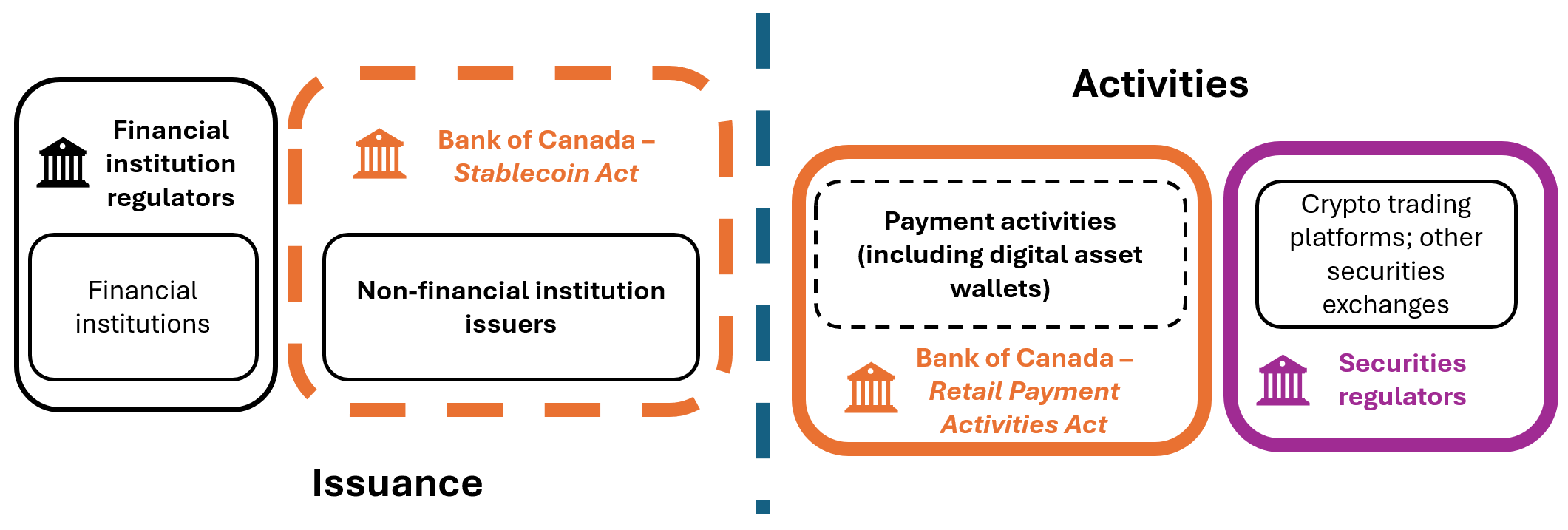
Figure 1: Visual  overlay of the stablecoin regulatory landscape in Canada

Dashed lines indicate a proposed new framework, or a new entry into an existing framework.

Text version

Issuance

  • Finacial institution regulars
    • Financial institutions
  • Proposed new framework: Bank of Canada – Stablecoin Act
    • Non-financial institution issuers

Activities

  • Bank of Canada – Retail Payment Activities Act
    • Proposed new framework: Payment activities (including digital asset wallets)
  • Securities regulators
    • Crypto trading platforms; other securities exchanges

Canada's stablecoin framework will only regulate the issuance of fiat-backed stablecoins by non-financial institutions. All non-financial institution issuers of fiat-backed stablecoins in Canada will be subject to the framework and supervision by the Bank of Canada. Federal, provincial and foreign financial institutions that are prudentially regulated, such as banks or credit unions, are already subject to comprehensive regulation of their business activities. Other types of stablecoins (non-fiat-backed) will continue to be regulated by their respective provincial or territorial securities regulator.

The framework will apply to domestic and foreign issuers who make fiat-backed stablecoins available to Canadians, directly or indirectly.  It does not distinguish between CAD-denominated vs foreign-currency-denominated stablecoins.

The use and exchange of fiat-backed stablecoins will continue to be regulated according to how they are used. Securities regulators will regulate the exchange and trading of fiat-backed stablecoins on securities exchanges and crypto-trading platforms. The Bank of Canada, under the Retail Payment Activities Act, will supervise payment service providers that perform payment functions in a fiat-backed stablecoin, subject to that stablecoin being prescribed in regulation.

2.3 Registration

Non-financial institution issuers will need to apply for registration with the Bank of Canada. As part of this application, issuers will need to provide:

  • information on corporate ownership, structure and financial health;
  • technology information related to the stablecoin that is planned to be issued; and,
  • compliance information related to the Stablecoin Act (the Act).

Registration will be an ongoing obligation, with various requirements for issuers to provide updated information to the Bank of Canada within the time and in the manner to be specified in the regulations and when significant changes occur. Issuers will also need to provide to the Bank of Canada reports containing compliance-related information certified by a chartered accountant and supported by an opinion from a legal practitioner.

2.4 Reserves

Issuers will need to maintain a reserve of assets of equal or greater value than the value of stablecoins that have been minted. The assets must be held in cash or high-quality cash-like assets at a qualified custodian and must be segregated from the other assets of the issuer and the qualified custodian. Issuers must ensure that, in the event of their insolvency, the reserve assets are not accessible to creditors other than the holders of the outstanding stablecoins.

2.5 Redemption

Issuers will need to establish, publish, and follow a redemption policy that spells out how a stablecoin holder can redeem their stablecoin in the referenced currency.  This will include the timing and manner of redemption, any fees that may be charged, and a description of the role of third parties.

2.6 Other provisions

Issuers will need to:

  • establish, publish, and follow policies on corporate governance, data security, risk management, and recovery and resolution;
  • not offer interest or yield to stablecoin holders;
  • not represent that their stablecoin is legal tender, a deposit, or insured under a public deposit insurance system;
  • not communicate or provide false or misleading information, by the use of such terms, expressions, logos, symbols, or illustrations to be specified in the regulations; and,
  • provide the Bank of Canada or the Minister of Finance with any information requested.

Issuers of stablecoins will also be subject to anti-money laundering and anti-terrorist financing (AML/ATF) requirements established under the Proceeds of Crime (Money Laundering) and Terrorist Financing Act as they are considered money services businesses (MSBs) that are dealing in virtual currencies. 

2.7 Enforcement

Canada's stablecoin framework includes key protections to ensure that issuers respect their obligations under the Act. Non-compliance can be addressed by the Bank of Canada through compliance agreements and administrative monetary penalties.

The proposed framework provides authorities to the Minister of Finance that align with existing financial sector statutes, including the Retail Payment Activities Act and the Consumer-Driven Banking Act, to refuse access to the framework for national security-related reasons.The Minister can also prohibit an issuer from taking any measures related to issuing stablecoins to people in Canada if it serves the public interest or for reasons related to national security. Consistent with the federal legislation of financial institutions, the Act provides the Minister with the power to impose conditions or require undertakings, if the Minister is of the opinion that it is necessary for national security reasons.

3. Next Steps

With the legislation having received Royal Assent, the Department of Finance has begun the development of supporting regulations for the Stablecoin Act. Once completed, draft regulations will be published in the Canada Gazette.

The Department will continue to work with the Bank of Canada and other key partners to monitor ongoing domestic and international developments in this evolving market and ensure that Canada's stablecoin framework provides a safe environment for innovation and competition while protecting consumers and the stability of Canada's financial system.

Page details

Date modified:

2026-03-31

Thursday, 18 June 2026

It’s never been easier to rack up alumni status

 It’s never been easier to rack up alumni status

Harvard Business School graduation ceremony

Rick Friedman/Getty Images

On Tuesdays, the Brew’s Matty Merritt brings you the news you need to make life a little easier during your 9-5, 5-9, or OOO.

You could spend years studying for the GRE and going the traditional grad school route to have the privilege of dropping “when I was at Wharton.” But nowadays, there’s another option: You could just power through the school’s five-week Advanced Management Program.

Amid declining enrollment, cash-strapped schools are courting shorter term students through their executive education programs, according to Bloomberg:

  • These program are cheaper and less time-consuming for older, working students, but are also a rapidly growing source of income for universities.
  • Last year, Harvard University brought in $612 million from its program, a huge jump from $155 million 20 years ago.

Popular short-term courses cover everything from AI to how to be a founder. Hampton University in Virginia even rolled out a program this year to help professional athletes transition into commercial real estate.

When Americans choose Chinese AI

 When Americans choose Chinese AI


Developers say DeepSeek is good enough for a fraction of the cost. “You don’t need God to write your email.”

Rest of World/iStock
By VIOLA ZHOU
+
17 JUNE 2026
TRANSLATE


U.S. developers and startups are adopting Chinese AI models to significantly reduce their operational costs.
Chinese models are gaining market share because they can handle most common tasks at a fraction of the price of U.S. alternatives.
Chinese AI companies face major hurdles in converting this popularity into revenue due to political scrutiny and data security concerns in the U.S. market.


Stu Clott, an operations manager and part-time developer in San Diego, used to code with Claude. But he recently found a cheaper alternative: DeepSeek.

While an hourlong coding session would cost about $10 on Claude, the same work cost less than 50 cents on DeepSeek, Clott said. Over the past few weeks, he has used the Chinese model for everything from coding to personal counseling and building software to manage his family’s bank accounts.

“I laugh every time I go see [the costs],” Clott told Rest of World. “The output quality, to be honest, I can’t tell the difference.”

U.S.-based developers and small companies are turning to Chinese models to cut costs. Although Chinese models still lag behind the best American ones in performance, they can handle most tasks at a fraction of the price. But under political scrutiny, Chinese companies still face the challenge of turning that popularity into significant revenue.

Tech reporting from beyond Silicon ValleySee the full picture of how technology is shaping the world. Twice a week, straight to your inbox.

Email

Chinese companies have kept prices low thanks to lower salaries and infrastructure expenses at home. Many have also released open models and offered subsidized plans to attract early adopters. Models from DeepSeek, Xiaomii MiMo, and Minimax are now among the most cost-efficient available, according to an Artificial Analysis index that measures models’ performance against cost.

EXPLORE CHARTS >>

The affordability is especially attractive to independent developers and startups. Lindy, a San Francisco-based company that builds AI work assistants, recently made a switch from Anthropic models to DeepSeek, according to its founder Flo Crivello, who announced the move on X in June. Crivello said the switch saved the firm millions of dollars. “You don’t need God to write your email,” he said on tech news show MTS. “If you can get those lower tiers of intelligence for a tenth of the price, it would be foolish not to do it.”

Ruben Garcia Jr., a Dallas-based developer who builds websites and mobile apps for businesses, told Rest of World he uses both U.S. and Chinese models to run the AI agents that fulfill client requests automatically.

He pays $500 a month for Claude and ChatGPT for the most complex planning and reviewing tasks, and another $200 a month for Minimax, Moonshot’s Kimi, and Xiaomi MiMo — models that handle 90% of the tasks, such as coding and voice recognition.

On OpenRouter, a platform that helps developers direct tasks to different AI models, those from DeepSeek, Tencent, Minimax, and Xiaomi are now the four most popular. Vercel, another AI service provider, said DeepSeek’s share of token usage jumped from under 1% to 17% in May, although its share of revenue stayed near 1%. Tokens are the units of text or data that AI models process.

EXPLORE CHARTS >>

“[AI] adoption at large companies is fairly saturated,” Kyle Chan, a fellow at the Brookings Institution, told Rest of World. “The growth market for Chinese companies would be medium-sized businesses that are starting to get into AI but are wary of the costs.”

In the U.S. market, however, Chinese model developers still face an uphill battle turning their popularity into revenue.

Companies that use Chinese models have come under political scrutiny. Lawmakers launched investigations into Airbnb and Anysphere, owner of coding platform Cursor, after the companies disclosed they had used Chinese open models like Qwen and Kimi to build their AI infrastructure. Airbnb chief executive Brian Chesky later clarified that the company was not sending any data to the model developers.


If the Chinese models come out and they are frontier and cheaper, I’m going that direction.”Ruben Garcia Jr., Dallas-based developer

Large companies, especially those in highly regulated industries, will be reluctant to use Chinese models due to concerns about data security, censorship, and geopolitical risks, Poe Zhao, Beijing-based founder of China tech newsletter Hello China Tech, told Rest of World.

Businesses that do use Chinese models are trying to have their data processed in the U.S. Some run open-source models on their own servers, and others have accessed them through American cloud companies rather than paying Chinese developers directly. Lindy’s founder Crivello said on X that his company accessed DeepSeek through an American provider, after a commenter questioned if user data was being sent to China.
Related Stories


AI glasses are catching on in China, from shopping to cheating


How cheap Chinese phones catapulted Kenya into the global digital economy


Can open-source beat OpenAI?


China builds a rival satellite constellation as SpaceX goes public

These cloud providers may share revenue with Chinese AI companies, but this arrangement prevents the companies from building long-term relationships with American clients, Zhao said. “Chinese models are becoming part of the global AI infrastructure layer,” he said. “But usage is only the first step. The next test is whether Chinese model developers can convert that usage into revenue, enterprise trust, and durable distribution.”

Chinese companies could also lose some competitive edge as U.S. rivals join the price war. OpenAI is now considering significant price cuts as it competes with Anthropic for enterprise users, The Wall Street Journal reported.

For now, developers say Chinese models still provide the best value for what they are paying. Clott and Garcia said they didn’t believe U.S. companies would do any better at protecting user privacy than Chinese companies.

“I don’t mind Chinese [companies] looking at my data: Hey, have fun with it. Learn and get better,” Garcia said. “If the Chinese models come out and they are frontier and cheaper, I’m going that direction.”

Viola Zhou
+ is a reporter for Rest of World covering China's tech scene. She is based in New York City.

Wednesday, 17 June 2026

Kristi Noem hired in strategic advisory role for B.C. mining company

Kristi Noem hired in strategic advisory role for B.C. mining company

By Amy Judd Global News
Posted June 16, 2026 7:54 pm

2 min read


Former U.S. secretary of homeland security and current special envoy to the Shield of the Americas, Kristi L. Noem, has been hired by a British Columbia mineral exploration company.
LEAVE A COMMENTSHARE THIS ITEM ON FACEBOOKSHARE THIS ITEM VIA WHATSAPPSEND THIS PAGE TO SOMEONE VIA EMAILSEE MORE SHARING OPTIONS

DESCREASE ARTICLE FONT SIZE
INCREASE ARTICLE FONT SIZE

Former U.S. secretary of homeland security and current special envoy to the Shield of the Americas Kristi L. Noem has been hired by a British Columbia mineral exploration company.

In a release on its website, NovaRed Mining Inc., whose head office is located in Vancouver, said Noem has joined the company in a “strategic advisory role to support NovaRed’s mission of acquiring and advancing critical mineral exploration opportunities through its artificial intelligence-enhanced technology platform.”

In March, Noem was reassigned from her role as secretary of the Department of Homeland Security, after serving 13 months.

In a post on Truth Social, U.S. President Donald Trump said that Noem, “who has served us well, and has had numerous and spectacular results (especially on the Border!, will be moving to the new role of ‘Special Envoy for The Shield of the Americas.’”
STORY CONTINUES BELOW ADVERTISEMENT


9:40Krist Noem blames ‘violent’ protesters for Minneapolis chaos


Stick to the Facts

Add Global News as a Preferred Source on Google to see more of our stories in your search results.


Following the announcement, Noem thanked Trump for appointing her as the Special Envoy for the Shield of the Americas and said she looks forward to working with U.S. Secretary of State Marco Rubio and Defense Secretary Pete Hegseth.

Get breaking BC news
Get breaking BC news delivered to your inbox as it happens so you won't miss a trending story.SIGN UP FOR BREAKING BC NEWSLETTERGET STARTED
BY PROVIDING YOUR EMAIL ADDRESS, YOU HAVE READ AND AGREE TO GLOBAL NEWS' TERMS AND CONDITIONS AND PRIVACY POLICY.

“The Western Hemisphere is absolutely critical for U.S. security. In this new role, I will be able to build on the partnerships and national security expertise, I forged over the last 13 months as Secretary of Homeland Security,” Noem wrote.

Noem faced criticism while overseeing Trump’s immigration crackdown, including over the shooting deaths of two protesters — Renee Good and Alex Pretti — in Minneapolis at the hands of immigration enforcement officers. The former South Dakota governor was also criticized over the way her department has spent billions of dollars allocated to it by Congress.

How much money does the US federal government collect?


USAFacts
How much money does the US federal government collect? 
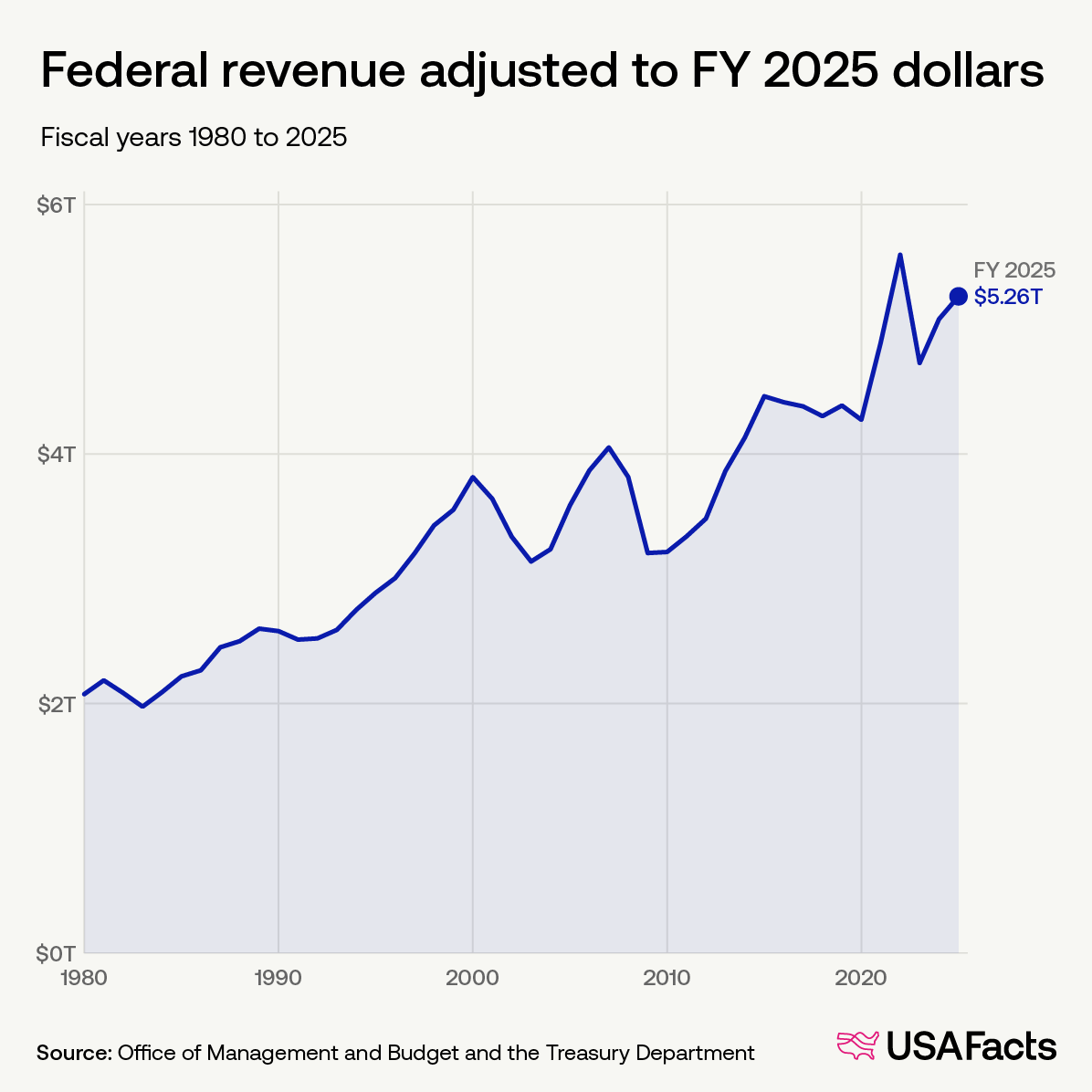
Federal revenue has increased 2.5 times from FY 1980 to 2025 (adjusted for inflation), while the nation’s population increased about 1.5 times. That means the government is collecting more revenue per person, on average, than it used to. Let’s look at what the government collects and how that’s changed.  
  • Government revenue is the total amount of money received from individual and corporate taxes, as well as other sources. In fiscal year 2025, the federal government collected $5.26 trillion, or about $15,400 per person in the US. Of course, the amount collected per person varies based on their income and other factors.  
     
  • Revenues were up 3.6% from the $5.08 trillion collected in FY 2024 after adjusting for inflation. Higher revenue from individual income taxes drove this growth from the year prior, and could have been due to a variety of factors, including income growth or the number of taxpayers. 
Federal revenue adjusted to FY 2025 dollars
  • For comparison, federal revenue was up 19.9% from the $4.39 trillion collected in FY 2019, just before the COVID-19 pandemic.  
     
  • The government shares preliminary revenue data on what it’s collected so far this fiscal year, which began on October 1, 2025. The early data shows it has brought in $1.25 trillion in individual income taxes and $870.5 billion in payroll taxes in the first six months of FY 2026. 
     
  • The government’s fiscal year 2026 budget deficit was about $954 billion as of this past April. 
     
  • For a deeper dive into how the government collects revenue, watch this video featuring USAFacts Founder Steve Ballmer.  

Tuesday, 16 June 2026

April Was the Worst Ever Month on Record for Crypto Hacks


April Was the Worst Ever Month on Record for Crypto Hacks

Drift and Kelp DAO were the two most notable crypto hacks in April, combining for $579 million in losses.
BY 

READING TIME 3 MINUTES

 COMMENTS (24)

April was the worst month on record for crypto projects getting hacked, with 29 incidents tracked by crypto data provider DefiLlama. In terms of dollar value, $651 million in losses were recorded, which is the largest monthly total since March 2022 (excluding the February 2025 Bybit hack), according to crypto security firm Certik. In response to these most recent incidents, many crypto market observers are questioning whether blockchain infrastructure can be relied upon by traditional financial institutions. Additionally, the centrally-planned responses to many of these hacks have also exposed the decentralization theater that is prevalent throughout the industry.

Drift and Kelp DAO were the two most notable crypto hacks in April, combining for $579 million in losses. The situation with Drift also points to a persistent problem in the crypto industry of thefts originating from North Korea. According to the Drift team, the hack of their protocol involved a six-month social engineering operation that eventually led to North Korean agents gaining access to critical infrastructure that allowed a sophisticated manipulation of the protocol in order to extract hundreds of millions of dollars worth of crypto. Blockchain analytics firm TRM Labs also recently put out a report pointing out that 76% of all crypto value extracted from hacks this year is connected to North Korea (solely from the Drift and Kelp DAO incidents), with the regime taking in more than $6 billion from their crypto hacking operations over the years.

Monday, 15 June 2026

Next-gen Proton Mail mobile apps


Sign up today!

Sunday, 14 June 2026

Ring of Fire Push Pits Critical Minerals Against Carbon Peatlands

Ring of Fire Push Pits Critical Minerals Against Carbon Peatlands, Indigenous Rights
May 25, 2026
Reading time: 9 minutes

Kylie Brezden - Stephen Lewis Climate Journalism Fellow


Camp site within the Ring of Fire, 2025/Trevor Hesselink as supplied by Wildlands League


In northern Ontario, hundreds of kilometres from the nearest highway, a vast stretch of peatlands and boreal forest is being positioned as central to Canada’s economic future.

Beneath the dense peatlands of the James Bay Lowlands lies the Ring of Fire, a 5,000-square-kilometre section of mineral-rich geological formation in the McFaulds greenstone belt, mapped as a crescent of nickel, chromite, copper, platinum, and titanium deposits that could be used in cell phones, computers, medical devices, and electric vehicles. Above those underground treasures, the world’s largest intact peatland ecosystem stores vast amounts of carbon and supports Indigenous communities that have lived there for generations.

The push to develop the region has brought these realities into tension. The Ontario government has framed the Ring of Fire as essential to Canada’s economic growth, citing projections of C$22 billion in economic output over 30 years and 70,000 jobs tied to development in the region. However, scientists, Indigenous leaders, and policy experts say the environmental, social, and economic implications of disturbing the region remain deeply uncertain.
How We Got Here

The Ring of Fire region has been in discussion for nearly two decades.

Interest in the region took off in 2007 when Noront Resources, now owned by Wyloo Minerals, announced the Eagle’s Nest discovery of nickel, copper, and platinum near McFaulds Lake. These were followed by chromite discoveries in areas known as Black Thor and Blackbird, and vanadium-titanium deposits in areas known as Thunderbird. The discoveries triggered an urgency and quickly turned into some of Canada’s most talked-about mining prospects.

By the early 2010s, the region was widely promoted as a transformative economic opportunity, with early estimates placing its value in the billions of dollars. Those figures were later questioned because they failed to account for the costs of extraction or project feasibility. Activities stalled with high infrastructure costs, volatile commodity markets, and unresolved questions around access and consultations hampering development for more than a decade.

Cliffs Natural Resources, an Ohio-based mining company, invested heavily in the region before abandoning the endeavour and selling its chromite assets at a loss, citing mounting costs and logistical challenges.

At the same time, tensions surfaced on the ground. In 2010, members of nearby First Nations communities blockaded access to exploration sites, citing a lack of consultation and concerns about environmental impacts, as documented by Ginoogaming First Nation.

Today, momentum has returned. Ontario has announced plans to accelerate development timelines, positioning the region as critical to securing domestic mineral supply chains. But many of the same questions remain: not just whether the minerals can be feasibly extracted here at enormous infrastructure costs, but whether the plan to do so aligns with Canada’s climate commitments and its obligations to Indigenous peoples.
A Place Few Get to Visit

For most Ontarians, the Ring of Fire exists more as a concept than a place. For others, it is known as the Breathing Lands, where the land supports [pdf] hundreds of plant, mammal, and fish species.

More than 90% of Ontario’s population lives in the south, while the north accounts for most of its land mass. The Ring of Fire sits roughly 500 kilometres northeast of Thunder Bay, without permanent road access and disconnected from the provincial power grid.

The region lies within Treaty 9 territory and is home to one of the largest Indigenous populations in Ontario. Approximately 30,000 Indigenous people, including 34 First Nations, live in the broader area, according to a planning report co-written by First Nations partners and the Impact Assessment Agency of Canada that establishes the terms of reference for assessing the environmental, social, and economic impacts of development in the region.

“This area is one which First Nations people have always relied on, cared for, and known by their own names,” the report states.

This region is not simply a remote resource deposit but a living land that all Ontarians are connected to.
What Sits Above the Minerals

The minerals beneath the ground are only part of the story.

The Hudson Bay Lowlands host one of the largest peatland complexes in the world. These peatlands form over hundreds to thousands of years, as waterlogged conditions slow the decomposition of plant material, allowing carbon to accumulate and remain stored.

“Peatlands are one of the most important carbon stores on the planet,” Adam Kirkwood, a peatland conservation scientist with Wildlife Conservation Society Canada, told The Energy Mix. “Globally, they hold roughly twice as much carbon as all the world’s forests combined.”

Scientists say the concern is not limited to the environmental impacts of mining itself. Roads, transmission lines, and other infrastructure required to support development could also disrupt these waterlogged systems, potentially increasing carbon releases and wildfire risks. Peatlands in the Ring of Fire store approximately 550 million tonnes of carbon, equivalent to two billion tonnes of carbon dioxide if fully decomposed, Kirkwood added.

Local First Nations say [pdf] the peatlands and wetlands in the region are closely tied to their traditional knowledge, food systems, and cultural practices.

“People in northern communities still rely on the land and local animals for food security, especially when boil water advisories can last for years and the cost of basic goods in remote stores is so high,” Ramon Kataquapit, founder of the Okiniwak Indigenous Youth Movement, told The Mix in an interview.

Framed as key to Canada’s low-carbon transition, mineral extraction in the Ring of Fire carries its own climate costs: “This isn’t just a local issue,” said Anna Baggio, conservation director at the Wildlands League. “It has broader climate and economic implications, especially when you consider the role of peatlands as a major carbon sink.”
Why Here, Why Now?

The renewed push for development is tied to growing demand for critical minerals. But whether the Ring of Fire is necessary to meet that demand remains an open question. The United States Geological Survey [pdf] stated in February 2026 that known global chromite resources in the ground are “sufficient to meet conceivable demand for centuries.”

“There are real questions about whether the Ring of Fire is necessary for the clean energy transition, especially when similar minerals are available in other parts of Ontario with existing infrastructure,” said Janet Sumner, executive director of the Wildlands League.

Ontario [pdf] already has mines and advanced projects in regions near Sudbury and Timmins, where infrastructure is established.

“The question isn’t just about accessing critical minerals,” Sumner told The Mix. “It’s whether doing it here creates greater environmental and community risks than the alternatives.”

There are also uncertainties around the economic case.

“We still don’t have a current full feasibility study for the project, so there are significant unknowns around how viable these deposits actually are,” said Jamie Kneen, national program co-lead at MiningWatch Canada.

Mining companies typically conduct feasibility studies to assess whether a project is economically and technically viable enough to attract investment and move forward. While previous studies were completed on some Ring of Fire deposits more than a decade ago, Kneen said, “they are now outdated.”
Who Decides the Path Forward?

Beyond economics and environmental risk, developing the Ring of Fire is also a question of governance.

Two Indigenous communities, Marten Falls and Webequie First Nations, support the construction of roads in the region, citing the need for improved community access, reduced isolation, and economic opportunities associated with development. At the same time, concerns remain around consultation, environmental impacts, and Indigenous jurisdiction.

Related Story: As Canada Warms, First Nations Lose Vital Ice Roads

Fourteen First Nations in Ontario have brought forth a constitutional challenge against Ontario’s Bill 5, which allows the province to designate “special economic zones,” where certain laws and regulatory requirements could be streamlined or set aside to accelerate development. Ontario Premier Doug Ford said last June that he would make the Ring of Fire a special economic zone “as quickly as possible.” The court challenge also targets the federal government’s Bill C-5, which is designed to fast-track major projects deemed to be in the national interest.

According to Kate Kempton, senior counsel at Woodward & Company LLP and counsel for the First Nations involved in the challenge, both laws allow cabinet or ministers to make decisions without regard for existing laws, potentially bypassing environmental assessments and human rights protections, and cutting off meaningful engagement with Indigenous communities.

“If environmental assessment and other process requirements are not applied, there’s a huge risk that impacts to ecosystems and communities won’t be understood before decisions are made,” she said.

“How can governments fast-track development while weakening the protections and treaty obligations meant to safeguard our communities and future generations?” Kataquapit added.

For many First Nations in the region, the issue is not only whether development proceeds, but whether they have a meaningful role in shaping how it happens.
Next Steps

Wyloo has continued developing the Eagle’s Nest project, while discussions around transportation and infrastructure corridors remain ongoing. In March 2026, Ontario announced an accelerated plan to complete roads to the Ring of Fire five years ahead of schedule, signalling increasing political momentum behind development in the region.

Large-scale mining projects would typically require environmental assessments, infrastructure approvals, consultation and engagement processes, and updated feasibility studies assessing economic and technical viability. Uncertainty remains over whether—and to what extent—Ontario’s Bill 5 and the federal Bill C-5 could accelerate approvals for major projects, a prospect that concerns Kneen.

“There hasn’t been enough discussion about the full environmental, social, and community impacts of development in this region,” he said.

For now, the push to open up the Ring of Fire continues, the province pressing ahead with its roads, legislation, and development plans.

Ontario ministries and several First Nations communities contacted for this story did not respond to requests for comment by time of publication.
This story is part of The Energy Mix’s partnership with the Small Change Fund.


Kylie Brezden

Stephen Lewis Fellow


Kylie Brezden is a freelance climate and environment writer focused on climate adaptation and how infrastructure, policy, and systems shape responses to climate risk in Canada. She holds a master’s degree in climate change and has experience across the public and private sectors.

Saturday, 13 June 2026

The labor market has a teeny problem

  The labor market has a teeny problem

A teenage employee wipes a restaurant counter.

Albany Times Union/Hearst Newspapers/Getty Images

Your angry neighbor may have a tough time finding a teenage service worker to scream at this summer. That’s because teen employment is on pace for its lowest level in decades.

It’s not just because teenagers are busy with extracurricular activities and social media—summer jobs are getting as hard to find as lightning bugs. Outplacement agency Challenger, Gray & Christmas projects:

  • Teens will be hired for 790,000 jobs in May, June, and July this year.
  • That’s down from 801,000 jobs last summer and 1,077,000 jobs in 2024.

Where’d the jobs go? Some are disappearing because of AI-driven automation, while others are being taken by older workers, who’ve increasingly put off retirement, the agency said. But hiring in the teen-filled entertainment and leisure sector (theme parks, hotels, activity centers, etc.) is also down 70% from last year, due to higher costs from inflation and gas prices, per Challenger, Gray & Christmas.

It’s not all bad: If a teen wants to be like Wendy Peffercorn, lifeguard job postings are up 78% this year, the Wall Street Journal reported, citing Indeed. And more teens are landing in retail, workforce platform Revelio Labs’ data shows, according to Barron’s.

Meal ticket: Teens are also finding work via Uber and DoorDash. Workers aged 17 to 25 are the fastest-growing age group on gig-work apps, and Gen Z registrations are up 8.4% year over year, according to mobile app researcher Apptopia.

Interactive Communications

Interactive Communications
Interactive Communications VOIP and VPN

eComTechnology RG Richardson Communications

eComTechnology since 2003. I am a business economist with interests in international trade worldwide through politics, money, banking and secure VOIP and Mail Communications. The author of RG Richardson City Guides has over 300 guides, including restaurants and finance. RG Richardson City author has over 300 travel guides. Let our interactive search city guides do the searching, no more typing, and they never go out of date. With over 13,900 preset searches, you only have to click on the preset icon. Search for restaurants, hotels, hostels, Airbnb, pubs, clubs, fast food, coffee shops, real estate, historical sites and facts all just by clicking on the icon. Even how to pack is all there. Finance, Money, Banking, and Economics definitions interactive dictionary.

Top Chinese Court Issues Sweeping Legal Crackdown on AI Deepfakes

Top Chinese Court Issues Sweeping Legal Crackdown on AI Deepfakes "AI face-swapping technology can indiscriminately harvest anyone'...