eComTechnology

eComTechnology
Interactive services

Saturday, 20 June 2026

Nvidia’s new PC chips represent CEO Huang’s bid to win at every layer of AI stack - Not good?

 Nvidia’s new PC chips represent CEO Huang’s bid to win at every layer of AI stack

Published Tue, Jun 2 20268:00 AM EDT

Katie Tarasov@KatieTarasov

Kif Leswing@kifleswingWATCH LIVE

All MAGA?

Key Points
Nvidia’s announced entry into the PC chip market sent shares of AMD, Intel and Qualcomm lower on Monday as Wall Street recognized the threat.
Jensen Huang, Nvidia’s CEO, signaled his intent to “reinvent the PC.”
Analysts see Nvidia moving beyond the data center and to the so-called edge, as smaller devices become capable of running AI workloads without tapping the cloud.

In this articleNVDA-0.23 (-0.10%)

Jensen Huang, chief executive officer of Nvidia Corp., presents the RTX Spark Superchip at the Nvidia GTC conference on the sidelines of Computex 2026 in Taipei, Taiwan, on Monday, June 1, 2026.
Lam Yik Fei | Bloomberg | Getty Images


As important as Nvidia has become to the tech industry, its entire run-up in recent years has been tied to the data center. Now the chipmaker is going after the PC market, and Wall Street is recognizing the threat it poses.

During a keynote address at Taiwan’s Computex conference on Monday, Nvidia CEO Jensen Huang said his company, along with Microsoft, is going to “reinvent the PC.” Nvidia’s plan to build system-on-chips, or SoCs, for PCs sent shares of Advanced Micro Devices, Intel and Qualcomm downward.


It’s the latest sign of Nvidia moving beyond the data center for artificial intelligence and to the so-called edge, where smaller devices like phones or computers run advanced AI models on their installed chips without tapping the cloud.

“Nvidia getting into the space is Jensen recognizing that he wants to own every bit of the AI stack in some shape,” said IDC analyst Tom Mainelli.

While makers of PC central processing units, or CPUs, and mobile phone chips sank on Monday, Nvidia’s stock popped more than 6%. With a market cap of about $5.4 trillion, Nvidia is worth more than any company on the planet, and is almost $1 trillion above its closest U.S. peer.

Nvidia is officially entering the PC market with a chip called RTX Spark, which is a joint effort with Taiwan’s MediaTek. The RTX Spark, which Huang also referred to as the N1X, debuts later this year on a fresh line of Windows PCs from Microsoft, Dell, HP, ASUS, Lenovo and MSI.

“This reinvention of the computer is as big of a deal as the reinvention of the phone into what we now know as the smartphone,” Huang said, pointing to the fact agentic AI will run across all new computers.


watch now
VIDEO02:46
D.A. Davidson’s Gil Luria says Nvidia’s push into PC chips is ‘a very big deal’


Nvidia has a major balance sheet advantage and has all the momentum in the world. But that doesn’t mean it’s going to be easy to crack a market that has historically been controlled by the duopoly of Intel and AMD. Additionally, Qualcomm has introduced new SoCs for Windows laptops in the past two years, and Apple, which has about 9% of the PC market, started making its own processors in 2020.

Nvidia’s rise has been fueled by selling systems based around the data center graphics processing unit, or GPU, which is better suited for running cutting-edge AI models with unlimited power, cooling and space. As chips become powerful enough to perform AI at the edge, Nvidia is racing to get there.

“All AI computing, regardless where it is, that’s the prize,” said chip analyst Patrick Moorhead. “Jensen is not going to be happy if they just get data center or data center and auto. They want everything on the edge.”
Second chance for AI PCs


Financially, the PC is just a blip for Nvidia, at least in the near term.

Creative Strategies analyst Ben Bajarin estimated on Monday that Nvidia’s networking business alone — which reported about $15 billion in sales in the most recent quarter — will be at least 20 times the size of Nvidia’s PC business. Total data center revenue in the latest quarter topped $75 billion.

Intel’s client computing group, mostly comprised of PC chip sales, reported $32.2 billion in revenue for all of 2025.

“PC for Nvidia is highly underpenetrated, so this is the start of an attempt to gain share for an edge story,” Bajarin said.

Jay Goldberg, an analyst at Seaport Research Partners, wrote in a note he doesn’t expect material numbers from Nvidia’s PC chips “any time soon.” He has a sell rating on the stock.

It’s also far from the high-growth market that Nvidia’s been leading since generative AI took off in late 2022. Market researcher IDC estimates that 296 million PC chips were shipped in 2025, increasing for the first time in three years, but still well below the pandemic-era peak of 361 million in 2021. Nvidia could sell 10 million PC chips over the next two years, Moorhead said.

The “AI PC,” a concept introduced by Microsoft and its PC partners in 2024, hasn’t sparked much of a revival, due to a lack of new software and Microsoft’s challenges with its Copilot technology.

But some analysts say Nvidia’s prowess in AI could bring a different level of enthusiasm and credibility.

“Nvidia’s not the first to do it,” Mainelli said. “But because they bring the GPU chops and because so much of AI in the cloud is built on Nvidia, the fact they’re pushing this out to the device is pretty interesting.”

Nvidia’s RTX Spark chips will pair the company’s cutting-edge Blackwell GPU with a MediaTek CPU on the same SoC. It will also have a feature called unified memory, which allows the CPU and GPU to access the same memory on a single SoC, eliminating a major AI bottleneck and allowing the chip to run bigger and more capable AI models.

In revealing the chip, Huang connected the technology to one of the hottest trends in Silicon Valley: AI agents. Every developer is seemingly obsessed with their ability to run agents like OpenClaw or Hermes Agent in the background to become much more productive.

Huang suggested that those kinds of agents might run perfectly well locally, where they’ll be cheaper than in the cloud.

“Look how beautiful it is — this agent could run 24/7, meter free,” Huang said, holding up a small Nvidia-based computer from MSI. “No meter anxiety.”

Nvidia CEO Jensen Huang introduces the RTX Spark during his keynote speech at Computex 2026 in Taipei on June 1, 2026. Nvidia unveiled a powerful laptop chip for Windows machines on June 1, staking its claim in the market for next-generation consumer PCs integrated with artificial intelligence.
Photo by I-Hwa Cheng / AFP via Getty Images
Another chip in the x86 wall


Nvidia’s announcement is also the latest sign of the power of Arm.

For decades, CPUs have been built on the x86 instruction sets pioneered by Intel in the 1970s and AMD a couple decades later.

Arm’s alternative power-efficient architecture went mainstream when Apple adopted it for the first iPhone in 2007. Then Amazon popularized Arm-based chips for data centers when it announced its in-house Graviton processor in 2018. Nvidia tried to buy Arm for $40 billion in 2020 in a preview of its SoC ambitions. The deal was spiked by regulators.

Cloud rivals Google and Microsoft followed Amazon with their own custom Arm CPUs for data centers. Now the entire CPU market is having a resurgence as mass AI adoption shifts from call-and-answer chatbots to task-oriented agentic apps. The overall market for CPUs is exploding into what Huang says will be a $200 billion industry.

Within the CPU renaissance, a flurry of companies have been switching from x86 to Arm.

Apple ended a 15-year reliance on Intel x86 chips in 2023, and now uses its own Arm-based processors for its computers. The latest MacBooks released in March come with a higher price tag and Apple’s latest M5 CPU.

Arm unveiled its first in-house CPU in March, with Meta, OpenAI, Cloudflare and SAP as early customers. AMD is also reportedly working toward an Arm-based PC chip.

Nvidia’s RTX Spark chips are likely to show up first in pricey computers, with budget options coming down the road. Nvidia-powered computers with AI features from companies like Adobe and Microsoft could be the first laptops in years to give Apple’s MacBooks significant competition in the premium category.

“This is the closest thing to take on the MacBook Pro for the Windows ecosystem,” Moorhead said.
Friday, 19 June 2026

Canada’s Stablecoin Framework


Canada’s Stablecoin Framework

1. Introduction

A stablecoin is a digital asset designed to maintain a stable value relative to an underlying asset. A fiat-backed stablecoin is a particular type of stablecoin that is pegged to one fiat currency of reference (e.g., CAD or USD).

There is currently no comprehensive regulation of the issuance of fiat-backed stablecoins in Canada, and that is the focus of the new federal framework. This framework, proposed through Budget 2025 with the legislation introduced in Bill C-15, will make stablecoins safer to hold and use in Canada, ensuring that issuers maintain proper reserves, offer redemption at par in the referenced fiat currency, maintain appropriate data security practices, and have sound corporate and financial governance.

The framework will complement existing federal and provincial regimes, including the Retail Payment Activities Act.

1.1 What will Canada's Stablecoin Framework do?

The goal of the proposed stablecoin framework is to promote safe innovation and competition in the financial sector through regulations for Canadian financial technology companies to innovate and issue stablecoins, while ensuring that consumers are protected. The framework will apply to domestic and foreign issuers.

The proposed framework follows recent developments of legislative and regulatory frameworks for stablecoins in other jurisdictions, such as the United States and European Union. In August 2025, the United States enacted the Guiding and Establishing National Innovation for US Stablecoins (GENIUS) Act, following the full adoption of the Markets in Crypto Assets regulations in the European Union in 2024. Canada's stablecoin framework is designed to be compatible with these frameworks, with key elements consistent with recommendations of the Financial Stability Board.

Table 1
Benefits of Canada's Stablecoin Framework
IndividualsIssuers
Confidence that fiat-backed stablecoin issued to Canadians are safe and subject to comprehensive oversight by the Bank of CanadaConsistent and appropriate regulatory framework that applies across the country
Redemption at par in the underlying fiat currency, with transparency in published redemption policiesInternational recognition and potential for interoperability/reciprocity agreements
Disclosures from issuersUnlocking new business opportunities

Canadians currently primarily use fiat-backed stablecoins as a store of value when trading other cryptocurrencies, and as a bridge between the traditional fiat currency/financial system and the digital asset space. However, with Canada's stablecoin framework, Canadians will be able to feel more confident in using fiat-backed stablecoins for payment purposes, such as for sending money abroad.

1.2 Policy Objectives for Canada's Stablecoin Framework

Competition is central to productivity, innovation, and affordability. Developing regulations for fiat-backed stablecoins will respond to the government's commitment to increase innovation and competition in the financial sector by helping to provide Canadians with options for digital payments, international money transfers, and more.

The development of Canada's stablecoin framework was guided by four public policy objectives:

  • Enabling innovation and competition: Creating a regulated, safe, and predictable environment for issuers of stablecoins to operate in Canada.
  • Consumer protection: Ensuring timely redemption, appropriate management of reserve assets, and requiring disclosure of information so Canadian consumers can feel confident holding and using stablecoins.
  • International alignment: Ensuring that Canada's framework is consistent with the Financial Stability Board recommendations for stablecoin regulation, and preparing for potential future interoperability with the United States, European Union, and other jurisdictions.
  • Safeguarding financial stability: Ensuring that stablecoins retain their peg to the referenced fiat currency and maintain sufficient reserve assets, and in sufficient composition, to enable timely redemption.

2. Course of Action

The government has introduced legislation through the 2025 Budget Implementation Act that will require issuers to, among other requirements:

  • register with the Bank of Canada, provide necessary information on an ongoing basis and as requested, and be subject to prudential requirements overseen by the Bank of Canada;
  • maintain a 1:1 reserve of high-quality liquid assets, in the reference currency of the stablecoins;
  • create and adhere to a redemption policy for stablecoin holders, and offer at-par redemption; and,
  • create and adhere to policies around corporate governance, risk management, data security, and recovery and resolution.

The Department of Finance Canada, working closely with the Bank of Canada, will begin regulatory development once the legislation has received Royal Assent. Once completed, draft regulations will be published in the Canada Gazette for consultations before being finalized. It is expected that this work will continue over 12-18 months from early 2026, with the stablecoin framework coming into force in 2027.

2.1 Governance

The Bank of Canada will administer the framework and supervise stablecoin issuers, building on their expertise in payment service provider supervision under the Retail Payment Activities Act and their responsibility for supervising financial market infrastructure, including systemically important and prominent payment systems under the Payment, Clearing and Settlement Act. The Department of Finance will continue its role in respect of policy and legislative/regulatory development.

Canada's stablecoin framework includes safeguards to protect the public interest and national security. The Stablecoin Act provides the Minister of Finance with the authority to address risks related to national security. The Minister's exercise of the national security authorities will be supported by security and intelligence agencies.

2.2 Scope

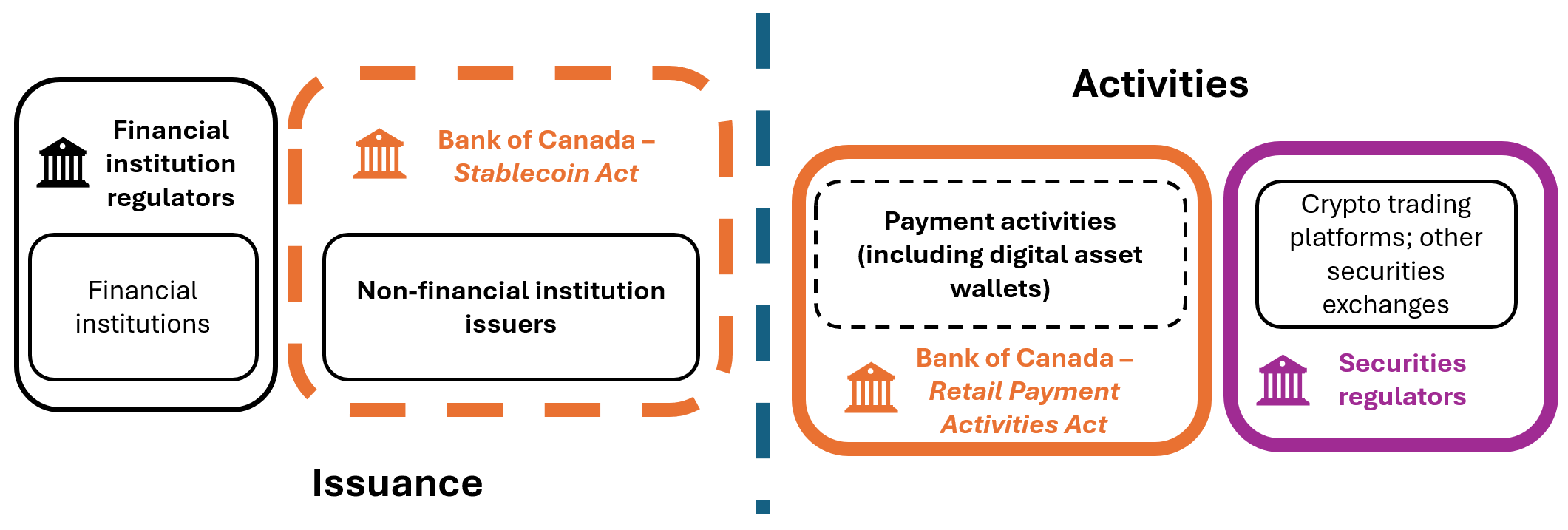
Figure 1
Visual overlay of the stablecoin regulatory landscape in Canada
Figure 1: Visual  overlay of the stablecoin regulatory landscape in Canada

Dashed lines indicate a proposed new framework, or a new entry into an existing framework.

Text version

Issuance

  • Finacial institution regulars
    • Financial institutions
  • Proposed new framework: Bank of Canada – Stablecoin Act
    • Non-financial institution issuers

Activities

  • Bank of Canada – Retail Payment Activities Act
    • Proposed new framework: Payment activities (including digital asset wallets)
  • Securities regulators
    • Crypto trading platforms; other securities exchanges

Canada's stablecoin framework will only regulate the issuance of fiat-backed stablecoins by non-financial institutions. All non-financial institution issuers of fiat-backed stablecoins in Canada will be subject to the framework and supervision by the Bank of Canada. Federal, provincial and foreign financial institutions that are prudentially regulated, such as banks or credit unions, are already subject to comprehensive regulation of their business activities. Other types of stablecoins (non-fiat-backed) will continue to be regulated by their respective provincial or territorial securities regulator.

The framework will apply to domestic and foreign issuers who make fiat-backed stablecoins available to Canadians, directly or indirectly.  It does not distinguish between CAD-denominated vs foreign-currency-denominated stablecoins.

The use and exchange of fiat-backed stablecoins will continue to be regulated according to how they are used. Securities regulators will regulate the exchange and trading of fiat-backed stablecoins on securities exchanges and crypto-trading platforms. The Bank of Canada, under the Retail Payment Activities Act, will supervise payment service providers that perform payment functions in a fiat-backed stablecoin, subject to that stablecoin being prescribed in regulation.

2.3 Registration

Non-financial institution issuers will need to apply for registration with the Bank of Canada. As part of this application, issuers will need to provide:

  • information on corporate ownership, structure and financial health;
  • technology information related to the stablecoin that is planned to be issued; and,
  • compliance information related to the Stablecoin Act (the Act).

Registration will be an ongoing obligation, with various requirements for issuers to provide updated information to the Bank of Canada within the time and in the manner to be specified in the regulations and when significant changes occur. Issuers will also need to provide to the Bank of Canada reports containing compliance-related information certified by a chartered accountant and supported by an opinion from a legal practitioner.

2.4 Reserves

Issuers will need to maintain a reserve of assets of equal or greater value than the value of stablecoins that have been minted. The assets must be held in cash or high-quality cash-like assets at a qualified custodian and must be segregated from the other assets of the issuer and the qualified custodian. Issuers must ensure that, in the event of their insolvency, the reserve assets are not accessible to creditors other than the holders of the outstanding stablecoins.

2.5 Redemption

Issuers will need to establish, publish, and follow a redemption policy that spells out how a stablecoin holder can redeem their stablecoin in the referenced currency.  This will include the timing and manner of redemption, any fees that may be charged, and a description of the role of third parties.

2.6 Other provisions

Issuers will need to:

  • establish, publish, and follow policies on corporate governance, data security, risk management, and recovery and resolution;
  • not offer interest or yield to stablecoin holders;
  • not represent that their stablecoin is legal tender, a deposit, or insured under a public deposit insurance system;
  • not communicate or provide false or misleading information, by the use of such terms, expressions, logos, symbols, or illustrations to be specified in the regulations; and,
  • provide the Bank of Canada or the Minister of Finance with any information requested.

Issuers of stablecoins will also be subject to anti-money laundering and anti-terrorist financing (AML/ATF) requirements established under the Proceeds of Crime (Money Laundering) and Terrorist Financing Act as they are considered money services businesses (MSBs) that are dealing in virtual currencies. 

2.7 Enforcement

Canada's stablecoin framework includes key protections to ensure that issuers respect their obligations under the Act. Non-compliance can be addressed by the Bank of Canada through compliance agreements and administrative monetary penalties.

The proposed framework provides authorities to the Minister of Finance that align with existing financial sector statutes, including the Retail Payment Activities Act and the Consumer-Driven Banking Act, to refuse access to the framework for national security-related reasons.The Minister can also prohibit an issuer from taking any measures related to issuing stablecoins to people in Canada if it serves the public interest or for reasons related to national security. Consistent with the federal legislation of financial institutions, the Act provides the Minister with the power to impose conditions or require undertakings, if the Minister is of the opinion that it is necessary for national security reasons.

3. Next Steps

With the legislation having received Royal Assent, the Department of Finance has begun the development of supporting regulations for the Stablecoin Act. Once completed, draft regulations will be published in the Canada Gazette.

The Department will continue to work with the Bank of Canada and other key partners to monitor ongoing domestic and international developments in this evolving market and ensure that Canada's stablecoin framework provides a safe environment for innovation and competition while protecting consumers and the stability of Canada's financial system.

Page details

Date modified:

2026-03-31

Thursday, 18 June 2026

It’s never been easier to rack up alumni status

 It’s never been easier to rack up alumni status

Harvard Business School graduation ceremony

Rick Friedman/Getty Images

On Tuesdays, the Brew’s Matty Merritt brings you the news you need to make life a little easier during your 9-5, 5-9, or OOO.

You could spend years studying for the GRE and going the traditional grad school route to have the privilege of dropping “when I was at Wharton.” But nowadays, there’s another option: You could just power through the school’s five-week Advanced Management Program.

Amid declining enrollment, cash-strapped schools are courting shorter term students through their executive education programs, according to Bloomberg:

  • These program are cheaper and less time-consuming for older, working students, but are also a rapidly growing source of income for universities.
  • Last year, Harvard University brought in $612 million from its program, a huge jump from $155 million 20 years ago.

Popular short-term courses cover everything from AI to how to be a founder. Hampton University in Virginia even rolled out a program this year to help professional athletes transition into commercial real estate.

When Americans choose Chinese AI

 When Americans choose Chinese AI


Developers say DeepSeek is good enough for a fraction of the cost. “You don’t need God to write your email.”

Rest of World/iStock
By VIOLA ZHOU
+
17 JUNE 2026
TRANSLATE


U.S. developers and startups are adopting Chinese AI models to significantly reduce their operational costs.
Chinese models are gaining market share because they can handle most common tasks at a fraction of the price of U.S. alternatives.
Chinese AI companies face major hurdles in converting this popularity into revenue due to political scrutiny and data security concerns in the U.S. market.


Stu Clott, an operations manager and part-time developer in San Diego, used to code with Claude. But he recently found a cheaper alternative: DeepSeek.

While an hourlong coding session would cost about $10 on Claude, the same work cost less than 50 cents on DeepSeek, Clott said. Over the past few weeks, he has used the Chinese model for everything from coding to personal counseling and building software to manage his family’s bank accounts.

“I laugh every time I go see [the costs],” Clott told Rest of World. “The output quality, to be honest, I can’t tell the difference.”

U.S.-based developers and small companies are turning to Chinese models to cut costs. Although Chinese models still lag behind the best American ones in performance, they can handle most tasks at a fraction of the price. But under political scrutiny, Chinese companies still face the challenge of turning that popularity into significant revenue.

Tech reporting from beyond Silicon ValleySee the full picture of how technology is shaping the world. Twice a week, straight to your inbox.

Email

Chinese companies have kept prices low thanks to lower salaries and infrastructure expenses at home. Many have also released open models and offered subsidized plans to attract early adopters. Models from DeepSeek, Xiaomii MiMo, and Minimax are now among the most cost-efficient available, according to an Artificial Analysis index that measures models’ performance against cost.

EXPLORE CHARTS >>

The affordability is especially attractive to independent developers and startups. Lindy, a San Francisco-based company that builds AI work assistants, recently made a switch from Anthropic models to DeepSeek, according to its founder Flo Crivello, who announced the move on X in June. Crivello said the switch saved the firm millions of dollars. “You don’t need God to write your email,” he said on tech news show MTS. “If you can get those lower tiers of intelligence for a tenth of the price, it would be foolish not to do it.”

Ruben Garcia Jr., a Dallas-based developer who builds websites and mobile apps for businesses, told Rest of World he uses both U.S. and Chinese models to run the AI agents that fulfill client requests automatically.

He pays $500 a month for Claude and ChatGPT for the most complex planning and reviewing tasks, and another $200 a month for Minimax, Moonshot’s Kimi, and Xiaomi MiMo — models that handle 90% of the tasks, such as coding and voice recognition.

On OpenRouter, a platform that helps developers direct tasks to different AI models, those from DeepSeek, Tencent, Minimax, and Xiaomi are now the four most popular. Vercel, another AI service provider, said DeepSeek’s share of token usage jumped from under 1% to 17% in May, although its share of revenue stayed near 1%. Tokens are the units of text or data that AI models process.

EXPLORE CHARTS >>

“[AI] adoption at large companies is fairly saturated,” Kyle Chan, a fellow at the Brookings Institution, told Rest of World. “The growth market for Chinese companies would be medium-sized businesses that are starting to get into AI but are wary of the costs.”

In the U.S. market, however, Chinese model developers still face an uphill battle turning their popularity into revenue.

Companies that use Chinese models have come under political scrutiny. Lawmakers launched investigations into Airbnb and Anysphere, owner of coding platform Cursor, after the companies disclosed they had used Chinese open models like Qwen and Kimi to build their AI infrastructure. Airbnb chief executive Brian Chesky later clarified that the company was not sending any data to the model developers.


If the Chinese models come out and they are frontier and cheaper, I’m going that direction.”Ruben Garcia Jr., Dallas-based developer

Large companies, especially those in highly regulated industries, will be reluctant to use Chinese models due to concerns about data security, censorship, and geopolitical risks, Poe Zhao, Beijing-based founder of China tech newsletter Hello China Tech, told Rest of World.

Businesses that do use Chinese models are trying to have their data processed in the U.S. Some run open-source models on their own servers, and others have accessed them through American cloud companies rather than paying Chinese developers directly. Lindy’s founder Crivello said on X that his company accessed DeepSeek through an American provider, after a commenter questioned if user data was being sent to China.
Related Stories


AI glasses are catching on in China, from shopping to cheating


How cheap Chinese phones catapulted Kenya into the global digital economy


Can open-source beat OpenAI?


China builds a rival satellite constellation as SpaceX goes public

These cloud providers may share revenue with Chinese AI companies, but this arrangement prevents the companies from building long-term relationships with American clients, Zhao said. “Chinese models are becoming part of the global AI infrastructure layer,” he said. “But usage is only the first step. The next test is whether Chinese model developers can convert that usage into revenue, enterprise trust, and durable distribution.”

Chinese companies could also lose some competitive edge as U.S. rivals join the price war. OpenAI is now considering significant price cuts as it competes with Anthropic for enterprise users, The Wall Street Journal reported.

For now, developers say Chinese models still provide the best value for what they are paying. Clott and Garcia said they didn’t believe U.S. companies would do any better at protecting user privacy than Chinese companies.

“I don’t mind Chinese [companies] looking at my data: Hey, have fun with it. Learn and get better,” Garcia said. “If the Chinese models come out and they are frontier and cheaper, I’m going that direction.”

Viola Zhou
+ is a reporter for Rest of World covering China's tech scene. She is based in New York City.

Wednesday, 17 June 2026

Kristi Noem hired in strategic advisory role for B.C. mining company

Kristi Noem hired in strategic advisory role for B.C. mining company

By Amy Judd Global News
Posted June 16, 2026 7:54 pm

2 min read


Former U.S. secretary of homeland security and current special envoy to the Shield of the Americas, Kristi L. Noem, has been hired by a British Columbia mineral exploration company.
LEAVE A COMMENTSHARE THIS ITEM ON FACEBOOKSHARE THIS ITEM VIA WHATSAPPSEND THIS PAGE TO SOMEONE VIA EMAILSEE MORE SHARING OPTIONS

DESCREASE ARTICLE FONT SIZE
INCREASE ARTICLE FONT SIZE

Former U.S. secretary of homeland security and current special envoy to the Shield of the Americas Kristi L. Noem has been hired by a British Columbia mineral exploration company.

In a release on its website, NovaRed Mining Inc., whose head office is located in Vancouver, said Noem has joined the company in a “strategic advisory role to support NovaRed’s mission of acquiring and advancing critical mineral exploration opportunities through its artificial intelligence-enhanced technology platform.”

In March, Noem was reassigned from her role as secretary of the Department of Homeland Security, after serving 13 months.

In a post on Truth Social, U.S. President Donald Trump said that Noem, “who has served us well, and has had numerous and spectacular results (especially on the Border!, will be moving to the new role of ‘Special Envoy for The Shield of the Americas.’”
STORY CONTINUES BELOW ADVERTISEMENT


9:40Krist Noem blames ‘violent’ protesters for Minneapolis chaos


Stick to the Facts

Add Global News as a Preferred Source on Google to see more of our stories in your search results.


Following the announcement, Noem thanked Trump for appointing her as the Special Envoy for the Shield of the Americas and said she looks forward to working with U.S. Secretary of State Marco Rubio and Defense Secretary Pete Hegseth.

Get breaking BC news
Get breaking BC news delivered to your inbox as it happens so you won't miss a trending story.SIGN UP FOR BREAKING BC NEWSLETTERGET STARTED
BY PROVIDING YOUR EMAIL ADDRESS, YOU HAVE READ AND AGREE TO GLOBAL NEWS' TERMS AND CONDITIONS AND PRIVACY POLICY.

“The Western Hemisphere is absolutely critical for U.S. security. In this new role, I will be able to build on the partnerships and national security expertise, I forged over the last 13 months as Secretary of Homeland Security,” Noem wrote.

Noem faced criticism while overseeing Trump’s immigration crackdown, including over the shooting deaths of two protesters — Renee Good and Alex Pretti — in Minneapolis at the hands of immigration enforcement officers. The former South Dakota governor was also criticized over the way her department has spent billions of dollars allocated to it by Congress.

How much money does the US federal government collect?


USAFacts
How much money does the US federal government collect? 
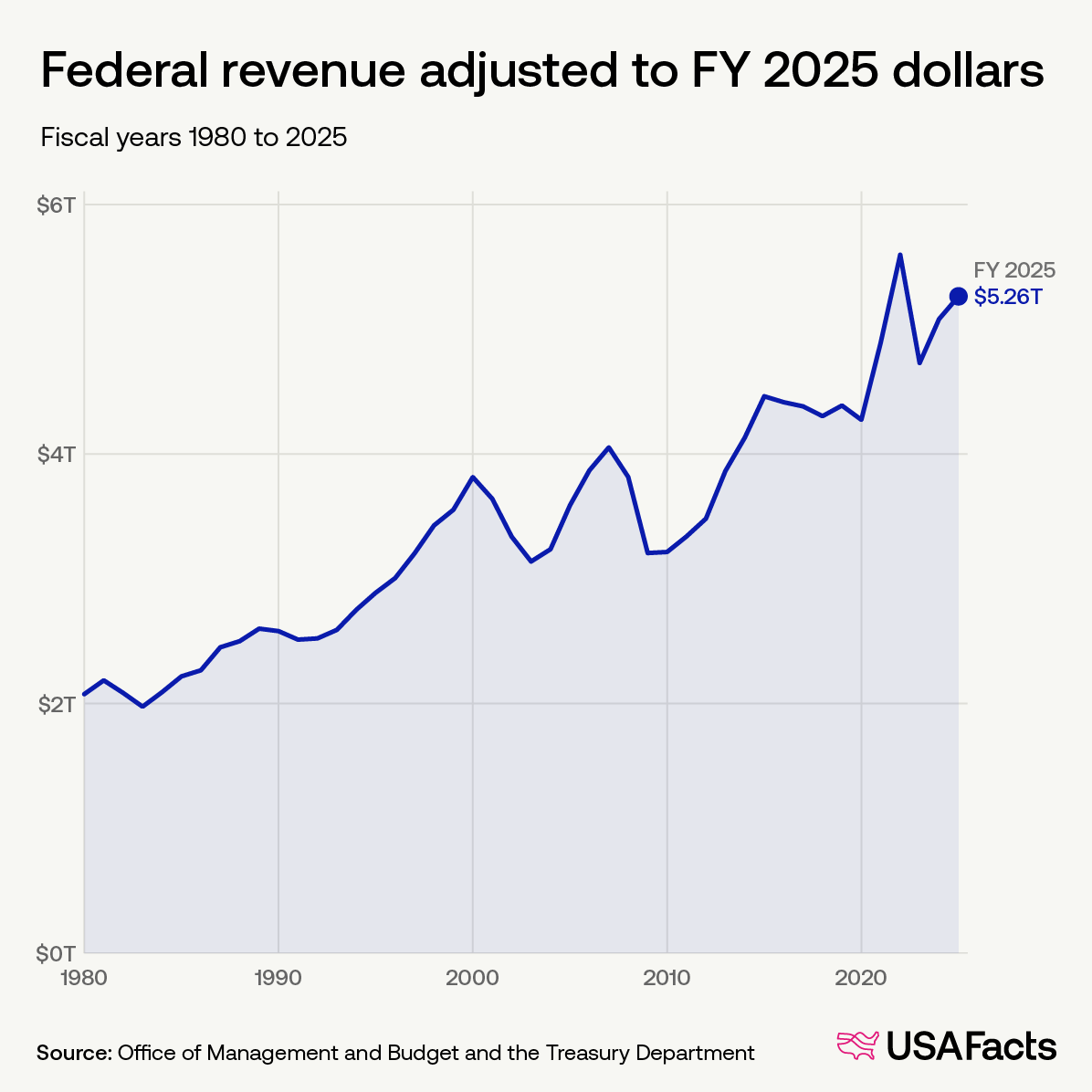
Federal revenue has increased 2.5 times from FY 1980 to 2025 (adjusted for inflation), while the nation’s population increased about 1.5 times. That means the government is collecting more revenue per person, on average, than it used to. Let’s look at what the government collects and how that’s changed.  
  • Government revenue is the total amount of money received from individual and corporate taxes, as well as other sources. In fiscal year 2025, the federal government collected $5.26 trillion, or about $15,400 per person in the US. Of course, the amount collected per person varies based on their income and other factors.  
     
  • Revenues were up 3.6% from the $5.08 trillion collected in FY 2024 after adjusting for inflation. Higher revenue from individual income taxes drove this growth from the year prior, and could have been due to a variety of factors, including income growth or the number of taxpayers. 
Federal revenue adjusted to FY 2025 dollars
  • For comparison, federal revenue was up 19.9% from the $4.39 trillion collected in FY 2019, just before the COVID-19 pandemic.  
     
  • The government shares preliminary revenue data on what it’s collected so far this fiscal year, which began on October 1, 2025. The early data shows it has brought in $1.25 trillion in individual income taxes and $870.5 billion in payroll taxes in the first six months of FY 2026. 
     
  • The government’s fiscal year 2026 budget deficit was about $954 billion as of this past April. 
     
  • For a deeper dive into how the government collects revenue, watch this video featuring USAFacts Founder Steve Ballmer.  

Tuesday, 16 June 2026

April Was the Worst Ever Month on Record for Crypto Hacks


April Was the Worst Ever Month on Record for Crypto Hacks

Drift and Kelp DAO were the two most notable crypto hacks in April, combining for $579 million in losses.
BY 

READING TIME 3 MINUTES

 COMMENTS (24)

April was the worst month on record for crypto projects getting hacked, with 29 incidents tracked by crypto data provider DefiLlama. In terms of dollar value, $651 million in losses were recorded, which is the largest monthly total since March 2022 (excluding the February 2025 Bybit hack), according to crypto security firm Certik. In response to these most recent incidents, many crypto market observers are questioning whether blockchain infrastructure can be relied upon by traditional financial institutions. Additionally, the centrally-planned responses to many of these hacks have also exposed the decentralization theater that is prevalent throughout the industry.

Drift and Kelp DAO were the two most notable crypto hacks in April, combining for $579 million in losses. The situation with Drift also points to a persistent problem in the crypto industry of thefts originating from North Korea. According to the Drift team, the hack of their protocol involved a six-month social engineering operation that eventually led to North Korean agents gaining access to critical infrastructure that allowed a sophisticated manipulation of the protocol in order to extract hundreds of millions of dollars worth of crypto. Blockchain analytics firm TRM Labs also recently put out a report pointing out that 76% of all crypto value extracted from hacks this year is connected to North Korea (solely from the Drift and Kelp DAO incidents), with the regime taking in more than $6 billion from their crypto hacking operations over the years.

Monday, 15 June 2026

Next-gen Proton Mail mobile apps


Sign up today!

Interactive Communications

Interactive Communications
Interactive Communications VOIP and VPN

eComTechnology RG Richardson Communications

eComTechnology since 2003. I am a business economist with interests in international trade worldwide through politics, money, banking and secure VOIP and Mail Communications. The author of RG Richardson City Guides has over 300 guides, including restaurants and finance. RG Richardson City author has over 300 travel guides. Let our interactive search city guides do the searching, no more typing, and they never go out of date. With over 13,900 preset searches, you only have to click on the preset icon. Search for restaurants, hotels, hostels, Airbnb, pubs, clubs, fast food, coffee shops, real estate, historical sites and facts all just by clicking on the icon. Even how to pack is all there. Finance, Money, Banking, and Economics definitions interactive dictionary.

A Chinese AI Model Just Shot to Number One on the Charts

 A Chinese AI Model Just Shot to Number One on the Charts, Sending Shockwaves Through the American Tech Industry US tech execs are shaking i...