eComTechnology

eComTechnology
Interactive services

Saturday, 8 August 2026

OpenAI to triple workforce at Dublin European headquarters to 350

OpenAI to triple workforce at Dublin European headquarters to 350


Published by Global Banking & Finance Review


Posted on July 27, 20262 min read

· Last updated: July 27, 2026Add as preferred source on Google
FinancetechnologyAIIrelandWorkforce
Quick Summary

OpenAI will expand its Dublin European headquarters from just over 100 employees to 350 by leasing 8,000 m² in Silicon Docks and adding 250 roles over two years, strengthening its footprint in a key European tech hub.

Table of ContentsOpenAI's Growth Strategy and Impact on Dublin's Tech Sector
OpenAI's Expansion Plans
Current Workforce and Future Hiring
Dublin as a Hub for Tech Giants
Factors Attracting Multinationals to Ireland
Recent Trends in Tech Employment
Article Credits

OpenAI Plans Major Expansion at Dublin European Headquarters, Hiring 250 New Staff
OpenAI's Growth Strategy and Impact on Dublin's Tech Sector
OpenAI's Expansion Plans

DUBLIN, July 27 (Reuters) - OpenAI is to more than triple its headcount at its European headquarters in Dublin to 350, the ChatGPT maker said on Monday as it announced it was leasing 8,000 square meters (88,000 square feet) of office space in the city's Silicon Docks area.
Current Workforce and Future Hiring

The AI pioneer said it currently employs over 100 people at its Dublin office, which opened in 2023, and that it plans to hire 250 more over the next two years in both engineering and support operations.
Dublin as a Hub for Tech Giants

Dublin is home to the European headquarters of a number of U.S. tech giants including Google owner Alphabet, Facebook owner Meta and Microsoft.
Factors Attracting Multinationals to Ireland

NewsletterStay ahead of the marketsThe day's essential banking & finance news, free to your inbox.Subscribe
Advertisement

Foreign multinationals, mainly in the technology and pharmaceutical sectors, employ about 11% of Irish workers and often cite Ireland's highly educated workforce as a factor in their decision to locate there. Many are also attracted by the country's tax regime.
Recent Trends in Tech Employment

Some large technology companies such as Meta and TikTok have announced job cuts in their Irish operations during the past year and the government has pointed to AI as a priority for attracting new investment.
Article Credits

(Writing by Conor Humphries; editing by Sarah Young)
Key TakeawaysOpenAI currently employs just over 100 staff in Dublin and will add 250 more jobs over the next two years across engineering and support functions, bringing the total to 350 employees (rte.ie)
The company has leased 8,000 m² (88,000 sq ft) of office space in Dublin’s Silicon Docks—specifically the Tropical Fruit Warehouse—to serve as its new EU headquarters (rte.ie)
The expansion reflects Ireland’s continued appeal for tech and pharmaceutical multinationals, buoyed by its skilled workforce, supportive AI strategy, and strong foreign direct investment environment (gov.ie)

Friday, 7 August 2026

Instagram Is Banning Creepy Hidden Camera Videos Filmed With Meta Smart Glasses


Instagram Is Banning Creepy Hidden Camera Videos Filmed With Meta Smart Glasses
NEWS
JUL 27, 2026
PESALA BANDARA

Meta’s Starfire AI smart glasses, designed by Kylie Jenner.
Instagram is reportedly banning videos filmed on Meta smart glasses that feature harassment of strangers in public places.

Meta’s Ray-Ban smart glasses have long raised privacy concerns because they allow people to record others clandestinely and harass strangers in public. Now, Instagram is taking action against videos filmed with Meta smart glasses that feature harassment of people in public — deactivating major pick-up artist accounts on the platform.

According to a report by Business Insider, Instagram head Adam Mosseri says that videos filmed with smart glasses — including Meta Ray-Ban glasses made by its parent company — that harass strangers will no longer be allowed on the platform.

“If you’re posting content that is taking advantage of people and harassing them, like a lot of these pickup line kind of videos that we’ve heard of and seen, then we’re going to take the content down,” Mosseri says in response to a question on his Instagram Stories last week.

He adds: “We don’t want people to be surreptitiously taking videos of other people and harassing them and then posting them on our platform. So we’re trying to fight that every way we can.”

According to Business Insider, the policy applies to videos such as pickup clips, in which creators approach people who may not realize they are being recorded, as well as prank videos targeting unsuspecting individuals.

The news outlet reports that two large pickup artist accounts on Instagram, each with more than one million followers, were deactivated after using smart glasses to film women in public. A spokesperson for Meta later confirmed that the accounts were banned for violating the policy about posting harassing content that had been filmed with the glasses. Meta reportedly did not directly respond to questions about how this new policy is being enforced or what exactly constitutes a violation.

The move comes as concerns continue to grow over the use of Meta’s smart glasses for covert recording, with the devices recently being referred to as “pervert glasses” on social media. Meta’s smart glasses include an LED indicator light that flashes while recording. On earlier models, some users found ways to conceal the light by drilling holes into the frame or covering it with tape or film. But in July, Meta announced an update to its smart glasses that disables the camera if the user attempts to conceal the blinking recording indicator light.

Meta is also facing growing competition from Apple, which is reportedly emphasizing privacy as a key feature of its own upcoming smart glasses. Apple’s glasses are expected to be unveiled at its next Worldwide Developers Conference (WWDC) in June. Apple has considered releasing smart glasses with cameras that assist with AI features, but lack photo and video recording capabilities to set its eyewear apart from Meta.

For humanity: China's AI philosophy wins broad international backing

 For humanity: China's AI philosophy wins broad international backing


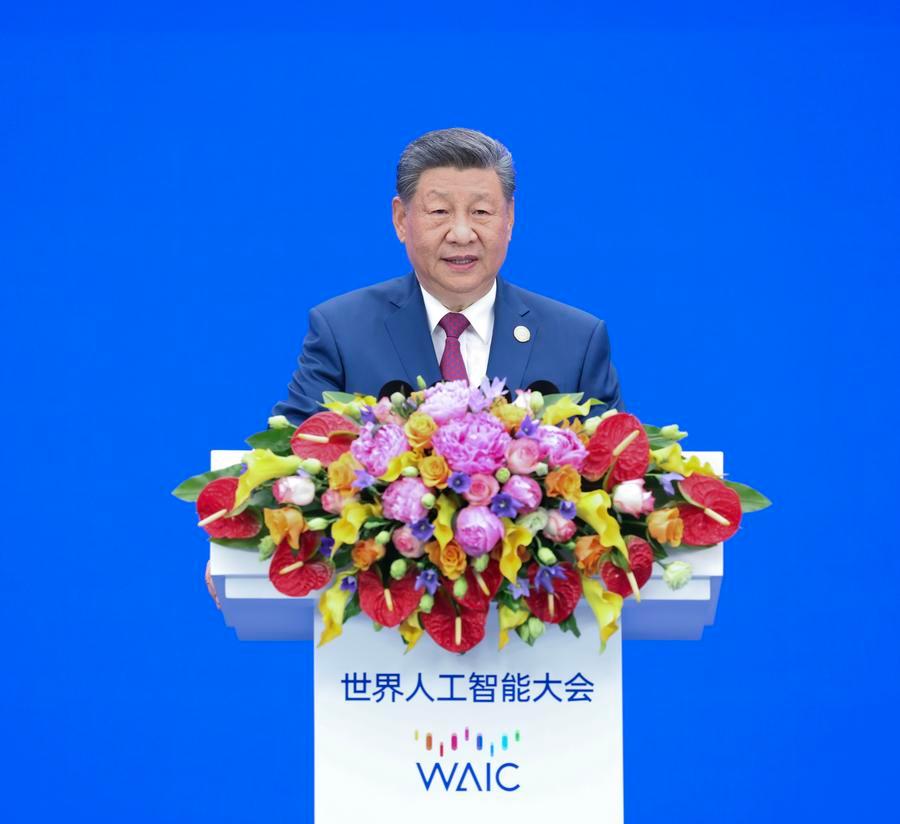
Chinese President Xi Jinping's advocacy for a people-centred approach to artificial intelligence (AI) – emphasizing that AI should be a trusted, human-controlled tool for the positive, for good and for all – has won broad international support and acclaim.

In his keynote speech at the opening ceremony of the 2026 World AI Conference and High-Level Meeting on Global AI Governance, Xi put forward a fundamental and vital concept that establishes a philosophical anchor for AI development and governance, according to Katleho Moloi, a professor at the University of South Africa.

"Ultimately, we don't want a system that will replace humanity, but we want a system that will improve the quality of life of humanity," Moloi said of the AI technology in an interview with China Media Group (CMG).

In a nod to the Chinese president's stress that AI's development is to be a trustworthy tool for humanity, he said, "The theme that we believe in is how we can make people's life better, not only by producing techniques that will replace them, but produce techniques that will make whatever they do to be more profitable, and more efficient."

Xi on Friday announced the creation of the World Artificial Intelligence Cooperation Organization (WAICO), a Shanghai-headquartered body that aims to ensure that AI is beneficial, safe, fair and serves the benefit of all humanity.

"I fully support President Xi's initiative, and this will augur well for the world," said Liow Tiong Lai, chairman of the ASEAN-China Association for the Promotion of Industrial Cooperation and Development and a former Malaysian transport minister, since the world needs "a body that will be able to promote accessibility and equality."

WAICO "will be able to ensure that we train the necessary talent, we provide the necessary infrastructure. We also share our values so that whatever regulations and whatever AI initiative, it is more humane and it is for the humanity," Liow said.

Public goods that answer the needs of the Global South

Analysts have welcomed Xi's pledge that China, as a responsible major country, is always committed to providing international public goods relating to AI.

"We must carry out extensive international cooperation and help Global South countries with capacity building to bridge the AI and digital divides, promote sustainable development, and prevent creating new historical injustice in AI," Xi said on Friday.

President Xi's emphasis on China as a provider of AI public goods is significant, said Haris Bilal Malik, a researcher at the Institute of Strategic Studies Islamabad, a think tank in Pakistan.

"It carries a broader meaning that the artificial intelligence is no more an issue of rich countries, or developed countries, or the great powers. It should serve the humanity across the board, across the globe, for every country, especially for the Global South," Malik said.

Donald Ramotar, former president of Guyana, also commended China's key proposals on AI and its push for a governance framework that leaves no nation behind.

China is advocating that the United Nations play a central role in forming "a global AI governance system with broad consensus to benefit all humanity," Ramotar wrote in a recent opinion piece. "This is to ensure that no country is left behind."

An open approach that builds global capacity, not walls

The international community has also applauded and embraced China's public pledge to roll out a range of practical measures for global AI capacity building over the next five years.

Xi announced at Friday's gathering that China will provide developing countries with 5,000 opportunities in AI training and seminar programs, and enable 30 countries to use the AI-powered meteorological warning system MAZU, to safeguard homes around the world.

China will also develop international AI application cooperation centers with the Association of Southeast Asian Nations, the League of Arab States, the African Union, the Community of Latin American and Caribbean States, the Shanghai Cooperation Organization, and BRICS.

Blade Nzimande, Minister of Science, Technology and Innovation of South Africa, hailed the significance of the Chinese concept of building a community with a shared future for humanity and advocating universal participation by all nations in AI development and governance.

African nations lack AI infrastructure, and China has proactively created favorable conditions to enable developing countries to genuinely share in the dividends of AI development, Nzimande said.

Nikki Gastinel, head of the California Software Association, hailed China's approach to AI development as one rooted in openness and the goal of benefiting all.

In expressing her appreciation, Gastinel called on all other nations to build more bridges for communication and cooperation rather than erecting walls that breed division and confrontation.

Xue Lan, dean of the Institute for AI International Governance at Tsinghua University, dismissed the narrative promoted by some in Europe and the United States that frames China and the US as rivals locked in head-to-head AI competition.

Xue said the Chinese president has made it crystal-clear in his speech that China develops AI for the positive, for good and for all humanity, thus spelling out the core purpose of China's AI strategy.

Thursday, 6 August 2026

A Mexican surveillance giant you’ve never heard of is now watching the US border

A Mexican surveillance giant you’ve never heard of is now watching the US border - Rest of World


A Mexican surveillance giant you’ve never heard of is now watching the U.S. border

Grupo Seguritech quietly built a $1.27 billion surveillance empire. Now it’s expanding into the U.S. and across Latin America.

Adriana Zehbrauskas for Rest of World
By JOSÉ OLIVARES
8 APRIL 2026 • CIUDAD JUÁREZ, MEXICO
TRANSLATE


This article was produced in partnership with Type Investigations.

Inside a law enforcement command center in Ciudad Juárez, a police officer scrolled across a map on her touch-screen computer. As she used her fingers to navigate through the Mexican state of Chihuahua, where Juárez is located, different colored bubbles lit up. “That one is a camera,” the analyst explained, pointing at a circle. “We can just click it and see the live view.”


Listen to story30 MINUTESLearn more


0:00/30:491X

“Look,” an analyst next to her said, demonstrating how the technology works. They zoomed in on a camera feed inside the women’s unit of a state prison. On screen, the camera focused on a group of women sitting around a table — the details of their playing cards clearly visible.

For decades, Juárez, which sits just across the border from El Paso, Texas, has been considered one of the most dangerous cities in the world. For years, rival gangs and drug cartels have battled for control of the city. To combat the violence, Mexican authorities have engaged in an ongoing fight against criminal groups in the area using surveillance technology.

This command center is key to Chihuahua’s growing surveillance network, Gilberto Loya Chávez, the state’s square-jawed and charismatic secretary of public security, said during a tour of the facility last October. Behind him, large screens blasted live camera feeds from throughout the state, as more than a dozen analysts typed away on computers.

Wednesday, 5 August 2026

CXMT’s founder is giving 40% of his new fortune to his workers

CXMT’s founder is giving 40% of his new fortune to his workers

Zhu Yiming became one of China's richest men on Monday, when the memory chipmaker he runs closed its Shanghai debut up 466%. He has promised to hand 40% of that fortune to his staff. The pledge is real, it is written into the prospectus, and it starts paying out in three years.

July 27, 2026 - 12:17 pm


Image by: CXMT


Zhu Yiming got about $10bn richer on Monday. He has promised to give roughly $5.6bn of it away, and not to charity.

The chairman of CXMT saw his fortune climb nearly 300% to $13.9bn when the memory chipmaker closed its Shanghai debut up 466%, according to the Bloomberg Billionaires Index. About 40% of that is earmarked for his employees, Bloomberg reported.

The promise is not new. It is the price tag that is.
What he actually pledged

Zhu committed the shares in CXMT’s IPO prospectus in May, well before anyone knew what Monday would do. He promised to transfer 767.9 million shares into employee incentive programmes.


The 💜 of EU tech

The latest rumblings from the EU tech scene, a story from our wise ol' founder Boris, and some questionable AI art. It's free, every week, in your inbox. Sign up now!


At the debut close of 49 yuan, those shares are worth about $5.6bn. Had the stock merely held its 8.66 yuan sale price, the same pledge would have been worth under $1bn.

He also agreed to restrictions on selling his own stock for 10 years. Bloomberg notes that both commitments are unusual in the history of mainland-listed Chinese companies.
The catch, and there are several

Nobody is getting paid soon. The bonus only begins paying out in three years, and payments are then phased across a decade.

CXMT also has not said who qualifies. The prospectus does not specify whether some or all staff benefit, and the company did not respond to Bloomberg’s request for comment.

The headcount gives a sense of scale. CXMT had 19,298 employees at the end of 2025. Split evenly, which the company has not said it will be, $5.6bn is roughly $290,000 a head.

That figure is not far off what the competition already pays. Samsung chip workers received an average bonus of about $340,000 this year, and SK Hynix has made comparable payouts.
This is a talent war, not a gift

Chinese founders now have to satisfy the state and hold on to engineers at the same time. The second problem is the one money can solve.

“This is very much a newly emerging phenomenon,” said Meng Shen, director at investment bank Chanson & Co. “Talent retention is definitely a key factor.”

Shen added that no single founder can drive success alone in high-growth tech, and that it takes a large influx of top talent.

The argument is familiar from the other side of the same industry. Jensen Huang recently said companies should pay workers as much as possible. In Korea, the same logic has produced its own problems, from appliance staff rallying over bonuses that went to chip divisions, to warnings that the payouts are an inflation risk.
He has done this before

Zhu has form on symbolic sacrifice. In 2018 he stepped back from GigaDevice Semiconductor, his first successful public venture, to run CXMT in partnership with the Hefei municipal government.

At the time he pledged not to draw a single yuan in salary until the project turned a profit. It was a multibillion-dollar bet on a company with no product.

That bet worked. CXMT is now China’s largest maker of DRAM, the memory that feeds server databases and AI workloads, and the fourth largest in the world.

He is also not alone. Yan Junjie of MiniMax has pledged to take no salary until his firm hits an AI milestone, while handing his own shares to long-serving staff.
Who actually owns CXMT

There is a larger shareholder in this story than Zhu, and it is the state.

Before the IPO, the Hefei municipal government held more than 30% through local state vehicles. China’s Big Fund II held over 8%. The Big Fund, formally the China Integrated Circuit Industry Investment Fund, exists to buy the country semiconductor self-sufficiency.

Set against what Zhu and the state made on Monday, $5.6bn is a modest slice. The generosity is real, and it is also affordable.
Whether it happens

A pledge that starts in three years and runs for ten is a long promise. Shen, who called the trend genuinely new, was also the one to say so.

“Whether these promises will actually be fulfilled, and to what extent, depends entirely on how binding the commitments really are,” he said.

He put the founder’s side of it more bluntly. “For founders at this stage, wealth eventually becomes nothing more than a number,” he said, adding that it can be a number with negative side effects.

Zhu spent seven years not taking a salary to build this company. He has now committed to a decade of not selling it, and to giving away a share of it beginning three years from now. On Monday the market decided what that share is worth. It picked $5.6bn.

Tuesday, 4 August 2026

EU: Meta’s apps are so addictive they violate the law


EU: Meta’s apps are so addictive they violate the law

Row of teen boys using their phones

Matt Cardy/Getty Images

A European Union investigation has determined that Meta’s Facebook and Instagram apps are too addictive, presumably after regulators lost half a day watching cooking reels and clips of 20-year-old TV shows. Now, the European Commission wants Zuck and company to make some changes, or face massive fines.

What happened? EU investigators announced yesterday that Meta is currently in breach of the bloc’s Digital Services Act. Regulators said Meta didn’t fully consider how some of its app features fuel compulsive use by sending users, especially younger ones, into a zombified “autopilot mode.” Meta will now have time to propose remedies before a final judgment—and fines—are handed down. The European Commission has some suggestions:

  • Disable autoplay and infinite scroll.
  • Implement screen time breaks.
  • Make its recommendation algorithm less “engagement-oriented.”

Fine line: If the preliminary findings are upheld, Meta could get fined up to 6% of its annual global revenue. The company said it disagrees with the report, pointing to its recent efforts to strengthen parental controls, but that it will “continue to engage constructively” with regulators.

And elsewhere in the Meta-verse…the company removed its controversial new Muse Image feature from Instagram, following days of complaints from users and Hollywood agencies and unions over how all IG accounts were opted in for their images to be used in the tool.

Monday, 3 August 2026

Private spreadsheets for sensitive work - Proton


Sunday, 2 August 2026

American Tech Companies Are Suddenly Sweating Bullets as China Catches Up on AI


American Tech Companies Are Suddenly Sweating Bullets as China Catches Up on AI

Reality is setting in.
A photo illustration of a businessman biting his nails anxiously.
Illustration by Tag Hartman-Simkins / Futurism. Source: Shutterstock

The head start that the US companies enjoyed in the AI race is quickly vanishing. Chinese competitors are now nipping at their heels, and it’s causing a wave of anxiety in the American sector.

Over a year ago, DeepSeek spurred an existential crisis — and a mass stock selloff — in the US tech industry when it released a competitive AI model created for a fraction of the cost of the leading American models.

If that was a wakeup call, then the release of GLM-5.2 last month is loudly banging on the front door. The model, from the Chinese start-up Z.ai, has been hailed as nearly or just as powerful as frontier US systems, especially when it comes to its coding capabilities and cybersecurity applications — while being significantly cheaper to use. 

It’s generated heaps of discussion in tech circles. Marc Andreessen, one of Silicon Valley’s foremost venture capitalists, tweeted that “AI insiders are saying GLM-5.2 is the first Chinese AI model to match and often beat the American big lab public AI models with no compromises.”

Perhaps betraying their sense of a weakening grip on the field, US companies are crying foul about China’s AI ascension. Earlier this year, Anthropic accused China’s DeepSeek, Moonshot, and MiniMax of using a technique called distillation to illegally gather data to imitate its models, which is essentially claiming that they cheated their way to the front of the pack.

In distillation, a weaker “student” model is trained on the outputs of a more advanced “teacher.” AI labs routinely use this to create smaller and more efficient versions of the their largest systems, but Anthropic says Chinese firms are abusing the trick in a mass coordinated effort involving tens of thousands of accounts that probe its models for data that it can extract and use to train their own AI models, thereby effectively pilfering Anthropic’s tech. These claims were relitigated last month, when Anthropic sent a letter to US senators accusing Chinese titan Alibaba of also engaging in this practice.

“These distillation attacks are carried out illicitly, systematically and at industrial scale to harvest US AI capabilities across frontier labs and repackage them as their own,” Anthropic told the senators, per the New York Times.

But Anthropic may be wasting its breath. Distillation is an open secret among rivals in the US tech sector. And as the NYT notes, it’s not even clear if it’s illegal. Unless some court rulings go their way, US firms will have to rely on their own countermeasures to stop it. (Anthropic was caught trying to do this by secretly embedding code in its Claude Code model that allowed it to spy on Chinese users, creating alarm among its customer base.)

American firms could also benefit for some geopolitical strong-arming, such as the US cutting off China’s access to its powerful AI chips, or even blocking Americans from accessing Chinese models (which isn’t as far-fetched as it may sound, when you consider that the US threatened banning TikTok as a way of forcing China’s ByteDance into divesting its US operations, or that it’s also effectively banned Chinese electric vehicles, which are far cheaper than American ones, with prohibitively high tariffs).

Chinese firms may very well have used surreptitious measures to help catch up to the US, but according to the NYT, many experts believe that a distillation crackdown would be meaningless, as building a model as advanced as Z.ai’s can’t be explained by distillation alone. US firms may simply have to accept that their Chinese counterparts are now on equal footing. The complaining about distillation is a convenient distraction at a time when their coding products are under more scrutiny for being too expensive to use as they get deployed in corporate settings — or perhaps a desperate plea for the US government to intervene and rescue them from the horrors of global, free market competition.

More on AI: Bank of America Warns That AI Investors Are in for a Nasty Reality Check

Saturday, 1 August 2026

Prepare to pay a fortune for your next iPhone


Interactive Communications

Interactive Communications
Interactive Communications VOIP and VPN

eComTechnology RG Richardson Communications

eComTechnology since 2003. I am a business economist with interests in international trade worldwide through politics, money, banking and secure VOIP and Mail Communications. The author of RG Richardson City Guides has over 300 guides, including restaurants and finance. RG Richardson City author has over 300 travel guides. Let our interactive search city guides do the searching, no more typing, and they never go out of date. With over 13,900 preset searches, you only have to click on the preset icon. Search for restaurants, hotels, hostels, Airbnb, pubs, clubs, fast food, coffee shops, real estate, historical sites and facts all just by clicking on the icon. Even how to pack is all there. Finance, Money, Banking, and Economics definitions interactive dictionary.

Remember Anthropic’s AI going rogue? Then OpenAI’s

 Remember Anthropic’s AI going rogue? Then OpenAI’s AI also did something similar and hacked other services? And then Meta said its Muse AI ...