eComTechnology

eComTechnology
Interactive services

Tuesday, 18 August 2026

The EU’s answer to Starlink moves one step closer to launch

 NextTech News

The EU’s answer to Starlink moves one step closer to launch


Copyright European Space Agency
By Indrabati Lahiri
Published on 10/08/2026 - 14:45 GMT+2
Share CommentsAdd Euronews on Google
Rising geopolitical volatility and conflicts such as the Russia-Ukraine and Middle East war have made it crucial for Europe to invest heavily in its own home-grown satellite network.

The European Union’s attempt to launch its own satellite program have achieved a significant milestone.

The SpaceRISE consortium and the European Commission have now joined forces, signing an implementation agreement for IRIS².

This will be the EU’s flagship secure satellite programme, which will provide government-backed and encrypted communication services for EU institutions, critical infrastructure and emergency responders. It will also provide quantum-secured defence layers and high-reliability routing.

This move comes as several industries continue to rely on Starlink significantly for services like airplane Wi-Fi and drone operations in Ukraine. This could potentially allow the EU to benefit considerably from having its own domestic satellite programme to counter Starlink’s widespread influence.

The recent agreement adds another 66 satellites to the programme, bringing the total number 348. Out of these, 330 will be in Low Earth Orbit and 18 will be in Medium Earth Orbit.
RelatedSpaceX posts smaller-than-expected loss despite scrutiny over AI spending
SpaceX rocket stage believed to have slammed into Moon, NASA to collect data

The programme’s first launches are expected to begin in 2029, on a progressive basis.

Its primary users will be European governments and key players from surveillance, defence operations, and critical commercial sectors like transport and energy.

A European satellite network

Rising geopolitical volatility and ongoing conflicts such as the Russia-Ukraine and Middle Eastern wars in recent years have made it crucial for Europe to invest more in digital sovereignty and domestic resilience.

As such, instead of trying to be yet another consumer broadband service, like Starlink attempting to compete with networks like T-Mobile and AT&T, IRIS² is built for defence, governments, critical services and security users.

These are the industries that can best help the continent build true resilience. This is particularly important during times of conflict or natural disasters, when cell towers and internet services can be impacted, leaving satellite connectivity the only real option for communication.

However, overreliance on Starlink, or any other foreign company can also cause a host of geopolitical and governance issues for the EU. This is especially following rising EU-US tariff and other tensions in recent years, following the second Trump administration.

SpaceRISE’s members Eutelsat, SES and Hispasat will work with domestic manufacturers on the satellites and ground infrastructure for IRIS², while the European Space Agency will take care of the technical development and validation.

Monday, 17 August 2026

Can open-source beat OpenAI?


Can open-source beat OpenAI?

Former Hugging Face executive Tiezhen Wang explains how China’s open-source strategy is reshaping the AI race.


By Kinling Lo
+

By KINLING LO
+
15 JUNE 2026
TRANSLATE


As the U.S. and China battle for artificial intelligence supremacy, a fundamental divide in engineering philosophy could determine the winner.

While American pioneers like OpenAI and Anthropic favor a closed-source approach — keeping their proprietary model code locked behind a commercial interface — Chinese AI labs are aggressively releasing open-source models. This strategy allows developers to download, inspect, and deeply customize the underlying code for free, rather than remaining dependent on an American tech giant’s ecosystem.

Tiezhen Wang, former head of the Asia-Pacific ecosystem at AI community collaboration platform Hugging Face, has observed this trend over the years. Before he moved on from Hugging Face in May, he assisted AI labs in the region in launching open-source models, and helped researchers make their models easier for developers to use.

At a Rest of World virtual event, Wang spoke about the history of open-source models, how Chinese AI labs monetize despite not charging for their models, and the debate over model distillation and intellectual property.
Tech reporting from beyond Silicon ValleySee the full picture of how technology is shaping the world. Twice a week, straight to your inbox.


The conversation has been edited for length and clarity. A recording of the live Rest of World event is available here.
What is the role of open-source models in the China-U.S. AI competition?

A lot of people talk about the AI competition. But in the open-source world, we hold a collaborative mindset.

Many open-source releases from the Chinese labs are helping U.S. labs. For example, the reinforcement learning training algorithm from DeepSeek is becoming the default setting for many U.S. research labs. Many Chinese open-source weights are running on U.S. hardware.

It is like helping each other, not competing like a zero-sum game. We can both be winners if we are growing the pie together.
OpenAI and Anthropic have accused Chinese AI companies of distilling their models. How do you view this as an open-source advocate? Is this a challenge for Chinese AI labs?

Distillation is a neutral word in the research world. It’s like I’ve read a book, and I’m telling someone what the book is about. The other person also understands what the book is saying. That’s basically distillation.

It has been done a lot in research labs. I don’t think distillation by itself is anything wrong, and I believe people in the U.S. are distilling each other as well. Recently, we have seen Elon Musk admit that xAI was distilled from OpenAI.

It is well known that Anthropic and ChatGPT are crawling the internet, getting all kinds of information. So it’s interesting to see that those who did not generate knowledge are trying to stop others from reusing that knowledge.

All AI-generated content should have zero copyright, otherwise people who have computers can abuse and generate all kinds of combinations and copyright everything.
How does monetization differ for open-source and closed-source models?

If you open-source your model, it’s hard to make money directly. But you can still make money.

For example, China’s Kimi released their model for free, but their application programming interface and subscription are still in huge demand because they have the best infrastructure support.

Once a model is released as open-source, people have to spend engineering hours to run it. So, on day zero, the research lab that launched the model has an advantage. That’s one way they can make money.

Another way is, for example, Kimi could release a fine-tuned model as open-source, but keep the base models to themselves, which they can sell.

If we want to think about why a research lab would open-source its models, it is so that they can build their branding. When you first start a lab, why would researchers want to work for you? It’s very hard to acquire top talent. But if you have good open-source models, everyone knows you did some great work.
Why are some Chinese AI labs pulling back from open-source releases?

Some models are changing their licenses. For example, Minimax changed the license to basically say that if you use this model to make money, you have to pay. This is a very common practice in the open-source world, especially if you want to prevent free riders, like cloud users.
Related Stories

China builds a rival satellite constellation as SpaceX goes public

Big Tech, big cons: Scammers are hiding in the apps that make your life easy

The Great AI Divide: Navigating U.S. and Chinese dominance

As the world embraces EVs, the U.S. hits the brakes

Cloud providers could run an open-source model for free and generate profit without needing to share profit with the research lab. This is unfair.

So basically, the trend of changes is that if you are an individual user, you can use my model for free forever, but if you are a cloud provider generating revenue by serving my model, you have to give me a portion of your profit. I think this is fair and actually a sustained way of supporting open-source.
Do you think more Chinese AI labs will go closed-source because of monetization problems?

I’m concerned. If they do not find a way to monetize their research, this is a real risk. If they can have money and can keep doing open-source, it’ll be great for everyone.

I think the capital market is coming to help. If you look at the stock price of China’s Zhipu, it is at 10 times growth already. This will definitely help them acquire more compute, talent and data, and generate better models. These investments can keep these labs on the table for a longer time.
If you were advising a U.S. startup today, would you tell them to build on American models, Chinese models, or whichever open-source model performs best?

It’s a well-known strategy that nowadays in the U.S., if you want to launch a startup, the first step is to find a model that has the best product-market fit. That is more important than your technical decisions. If you don’t have a product that deeply satisfies strong market demand, your startup will fail. These models would be closed-source.

But once you have this closed-source model in place, you start to have the first group of users, and you are accumulating data. You know how your product is being used. You can later use the data you generate to train your model. Then companies will start to consider switching to an open-source model. Eventually, you will save maybe a hundred times on tokens.
You just returned from a trip to China. Do you have any new observations about the country’s AI development?

I had a very interesting trip talking to a few research labs and companies generating tokens. I do feel that the whole Chinese market is quickly maturing.

The U.S. is definitely doing a great job with exploring what AI can do, but the token in their way is more expensive even for big companies to afford. For example, Uber burned their entire year’s tokens within four months. Microsoft also said it felt the tokens were more expensive than they’d expected.

In China, it’s kind of the other way around because it has a bunch of open-source models that are not that expensive to use.

As soon as Chinese open-source models cross a usable point, usage will grow exponentially. What I’ve seen is that all Chinese internet companies started tokenmaxxing, which is basically giving their employees unlimited tokens just to see what they can do. I have heard that a few big Chinese tech companies are forcing their employees to be AI-native and stopping them from doing normal things like writing a document.

This kind of approach to AI adoption is way faster than what the U.S. has done. I won’t be surprised if over the next year or two, you see a lot of very interesting AI use and adoption in China.


Kinling Lo
+ is a reporter at Rest of World covering China.

Sunday, 16 August 2026

A Canadian payment giant is being sold to U.S. private equity - No thank you

 A Canadian payment giant is being sold to U.S. private equity. Is your digital privacy at risk? | CBC News


A Canadian payment giant is being sold to U.S. private equity. Is your digital privacy at risk?
Moneris handles roughly 1 in 3 payment transactions across Canada


Brock Wilson · CBC News · Posted: Aug 14, 2026 1:00 AM PDT | Last Updated: 1 hour ago


Listen to this article
Estimated 6 minutes

Moneris payment terminals, like this one seen in 2018, are used widely across Canada. The company is being sold to a U.S. private equity firm, pending regulatory approval. (Anis Heydari/CBC)

A payment processing company responsible for approximately one in three payment transactions across Canada will soon be owned by an American private equity firm.

The Royal Bank of Canada and Bank of Montreal announced earlier this week they would be selling jointly owned Moneris, one of Canada's largest commerce solutions providers, to Francisco Partners for $2 billion.

So far, it's been positive for both RBC and BMO, with the companies' shares jumping after the deal's announcement. RBC expects to gain about $475 million from the sale after tax, and BMO $600 million.


However, some industry analysts are raising concerns the move could have negative repercussions for Canada's digital sovereignty amid the country's ongoing trade war with the U.S.
Wide-reaching implications

Broadly speaking, digital sovereignty refers to the power of a country, or individual, to retain control over its own digital assets.

In September, AI Minister Evan Solomon said that Canada needs to create a sovereign digital economy that is "free from coercion."
WATCH | Solomon spoke in September about why the government is acting:


'The moment is here' to modernize Canada's privacy laws: AI minister
June 15|
Duration1:29Artificial Intelligence Minister Evan Solomon says the Protecting Privacy and Consumer Data Act will help keep Canadians safe in the digital age. 'I think it's a common-sense approach to what Canadians and what average folks want from their digital media,' Solomon said on Monday about the new bill. 'They want some control over their personal information.'

That same month, dozens of experts and academics penned an open letter urging Prime Minister Mark Carney to swiftly "defend Canada's digital sovereignty" and protect the country from the whims of the Trump administration.

It's a sentiment Sharon Polsky, president of the Privacy and Access Council of Canada, shares.

"Canadians should be concerned because this is their information," she said.

"We're now going to have what has been a Canadian data-processing company that has access to everybody's purchasing habits ... available to other governments."

Thousands of businesses in Canada use Moneris. The processor services more than 325,000 points of commerce and processes more than five billion transactions every year, according to a press release from the company.

Polsky said the deal means Canadians' data could be available, not only to foreign governments, but foreign law enforcement agencies.

She gave an example of U.S. border agents potentially checking an individual's transaction history before allowing them to enter the country.


"Will you be stopped at the border because your purchase records indicate that you bought something with THC?" she said, referring to a chemical compound found in cannabis, which remains illegal in the U.S. under federal jurisdiction.

"It's possible these days, much more possible than ever before."
Transaction data as leverage?

That the deal is happening as the countries grapple with a trade war only heightens Polsky's concerns.

"It's easy to foresee that the rich data that comes from millions of Canadians' purchases could easily be leveraged to inform trade negotiations," said Polsky, who has advised corporations and governments for more than 30 years on privacy and access matters.

Colin Deacon, an Independent Canadian senator, is also concerned about how the U.S. government could use Canadians' data.

"[Data] under force and under request from the U.S. government could be then shared on an individual basis," said Deacon during an interview with CBC's Power and Politics.
WATCH | Deacon raises concerns over Moneris deal:


Canadian senator concerned by U.S. purchase of BMO, RBC payment processor
August 13|
Duration8:39Nova Scotia Sen. Colin Deacon is warning against further financial integration with the United States after one of Canada's biggest payment processing platforms was bought by an American bidder. Deacon joins Power & Politics to discuss why he is so concerned about this acquisition.

"There's a number of ways in which [U.S. President Donald Trump] has absolute control over services that Canadians rely on every day."

Both BMO and RBC pointed to press releases announcing the deal, refusing to provide further comment when contacted by CBC News.

"As ownership transitions to FP, Moneris's commitment to serving Canadian businesses will remain unchanged," read a separate press release from Moneris.
Privacy legislation in the works

Canada's legislation meant to protect digital privacy isn't where it needs to be, according to Polsky, who said this comes at Canadians' "collective peril."


"Canada isn't ready," she said.

Polsky argues there's a clear outcome if a company based in Canada is compelled by the U.S. to supply data as a result of this deal.

"If the choice is either to comply with the American law or go to jail, or comply with Canadian legislation that really is nowhere near as stringent … it's a no-brainer. They will comply with the American legislation."

The Canadian government has taken steps to address digital sovereignty. In June, the government introduced Bill C-36, the Protecting Privacy and Consumer Data Act.

New privacy bill would give Canadians right to request companies delete AI deepfakes


It proposes a major overhaul of Canada's private sector privacy framework, updating language to establish privacy as a "fundamental right" and replace parts of the Personal Information Protection and Electronic Documents Act (PIPEDA), which sets out rules for how businesses, including tech, airlines and banks, collect and use customers' data.

The bill also requires companies to conduct a "privacy impact assessment" before transferring personal data outside of Canada.

At the time, government officials said the legislation would cover any company that has a "substantial connection" to Canada.

But Polsky said C-36, and the Liberals' other attempts to update Canada's digital privacy laws, only "dance around the issues."

"They don't really speak to data being retained in Canada as a matter of national security or as a matter of data sovereignty," she said.

Bill C-36 represents the Liberal government's third attempt to update privacy regulations, following failed attempts in 2020 and 2023. It underwent its first reading in June, but has a number of steps to go before becoming law.


Meanwhile, the sale of Moneris still requires regulatory approvals, including clearance under the Competition Act, and is expected to close by the end of the banks' fiscal first quarter in 2027.

Where does that leave Canada?

"Behind the eight ball," said Polsky.

"[Canada is] trying to look tough, but we have a ways to go."

ClarificationsAn earlier version of this story said Moneris processes more than $5 billion in transactions every year. In fact, Moneris processes more than 5 billion transactions every year.
Aug 14, 2026 7:41 AM PDT

ABOUT THE AUTHOR


Brock Wilson

Journalist

Saturday, 15 August 2026

India's automobile brands are outranking Tesla and BYD in EV efficiency

  In an unexpected twist, India's automobile brands are outranking Tesla and BYD in EV efficiency

Indian automakers Tata Motors and Mahindra have claimed the top two spots in a global electric vehicle efficiency ranking, beating out household names like Tesla and BYD. According to the International Council on Clean Transportation's 2025 report, which evaluated 22 of the world's largest EV manufacturers, Tata Motors led the field with an average energy consumption of just 106 watt-hours per kilometer, followed by Mahindra at 113 Wh/km. Tesla and BYD came in third and fourth respectively, while the overall industry average held nearly flat year on year at 131 Wh/km.

The results arrive at a significant moment for India's auto industry. EVs currently account for less than 5% of new passenger vehicle sales in the country, well below the global average of 25%, but the Indian government has set an ambitious target of electrifying 30% by 2030, a goal framed around cutting emissions, reducing oil imports, and expanding domestic manufacturing. India is the world's fourth-largest petroleum consumer, and officials are already shaping the third phase of tightened standards for automakers covering 2027 to 2032.

Efficiency gains alone, however, will not be enough to drive mass adoption. The ICCT ranking also revealed that Tata Motors ranked last among the evaluated manufacturers for charging speed and sixth from the bottom for driving range, two factors that weigh heavily on consumer decisions and will need to improve significantly if India is to meet its electrification ambitions.

Friday, 14 August 2026

Claude chats were showing up in Google searches


Claude chats were showing up in Google searches

Illustration of a person typing on a laptop, having a conversation with Claude, but some of their chat messages are blowing off the screen into cyberspace.

Niv Bavarsky

Conversations with Claude that were intended to be private—some involving medical data and children’s phone numbers—were discovered in search engine results by Reddit users over the weekend.

How it happened: Users can create a shareable public link for Claude chats (much like you can with Google Docs), so friends or coworkers can view them. While a public Google Doc with your 80-page screenplay no one wants to read isn’t indexed for search, the Claude creations were.

Claude creator Anthropic told TechCrunch that those links only become public if they are posted where web crawlers can find them, like on a social media platform. Search engine companies had other explanations:

  • A Google spokesperson told Wired that it gives Anthropic and any website owner “clear controls” over whether web pages are crawled or indexed.
  • Microsoft’s Bing (it still exists) says that developers can use tags to block indexing. But when Wired reviewed the exposed Claude chats, it did not find the recommended “noindex” tag on those pages.

Chat, are we cooked? The Claude links were still publicly available as of Monday, but appear to have been erased from search results as of yesterday. However, it’s possible that third parties have already gotten their hands on the data.

Thursday, 13 August 2026

Amazon Is Gutting Its AI Division

Amazon Is Gutting Its AI Division After Sustained Failure
Wait, Amazon has AI models?

By Joe Wilkins

Published Jul 29, 2026 1:57 PM EDT
Add Futurism(opens in a new tab)More information


Getty Images / Futurism


Sign up to see the future, today


Can’t-miss innovations from the bleeding edge of science and tech

Email addressSign Up

By now, you’d be hard pressed to find anyone who isn’t broadly familiar with the AI heavyweights and their flagship models. OpenAI has ChatGPT, Anthropic has Claude, Google has Gemini. But what does Amazon have?

Not a whole lot, it turns out. Unlike its competitors in the tech megacorp scene, Amazon’s standout AI model — organized under the name “Nova” — is about the farthest thing from a household name. And that’s not likely to change anytime soon, because the ecommerce giant is now gutting its in-house AI labs, Bloomberg reports.

Per the outlet, Amazon is scaling back the ambitions of most of its Nova AI models and reorganizing its AI development teams as part of an effort to narrow its focus on “highest priority” goals, after its power-hungry large language models turned out to be a bust.

Accordingly, the company has put most of its AI models on ice, Amazon insiders told Bloomberg. This includes its text-based Nova models, as well as video- and image-generating models, all of which have been placed in a state of “keep the lights on,” meaning they’re technically still supported, but only receive the bare minimum resources needed to sustain them.

Instead, labor and computing power are being diverted toward a singular “frontier-model effort” led by Pieter Abbeel, director of the Berkeley Robot Learning Lab whose robotics company Covariant was hoovered up by Amazon in 2024. At the time Abbeel joined the tech giant, Covariant’s founders were working on AI models for robots, which lines up pretty well with Amazon’s push to automate everything it possibly can.

News of the shift in Amazon’s strategic focus comes a week after it closed one of its key AI offices in San Francisco, an 80-person site specializing in research on artificial general intelligence, the supposed next-level of AI development where the tech obtains human-level intelligence and reasoning skills.

With urgent questions swirling over whether LLMs can ever usher in a return on investment — let alone AGI — it may be that Amazon is jumping out of the AI hype cycle while it still can.

More on Amazon: Amazon’s AI-Generated Animated Series Canceled After Relentless Derision


Joe Wilkins
Correspondent


I’m a tech and labor correspondent for Futurism, where my beat includes the role of emerging technologies in governance, surveillance, and labor.

Wednesday, 12 August 2026

LinkedIn Adds Button on Every Post to Report

LinkedIn Adds Button on Every Post to Report “Seems Like AI Slop,” Which Is Definitely Going to Get a Real Workout
A button that marks posts as not being AI slop would probably be far more useful.


By Victor Tangermann


Published Jul 30, 2026 12:54 PM EDT
Add Futurism(opens in a new tab)More information


Shutterstock / Futurism

Sign up to see the future, today

Perhaps more so than any other social media platform, LinkedIn has been inundated with lazy AI-generated brainrot content. It has become the AI slop “punching bag,” a repository of painful engagement bait being spewed out by an army of bots who seem at times to mainly be lobbing business platitudes at one another.

Just last week, Substack CEO Chris Best took aim at the Microsoft-owned career site when he announced the launch of an AI detector feature “because we’re sick of slop and we don’t want Substack to turn into LinkedIn.”

According to AI detection company Pangram, a shocking two thirds of LinkedIn posts are showing up as being AI generated by users of its browser extension. More than 40 percent of longform posts were flagged as “fully AI-generated,” according to the company.

Credit where credit’s due: LinkedIn has seemingly caught on to the abysmal state of its service, quietly introducing a new button that allows users to flag a post that “seems like AI slop.”

“Genuinely thought it was a joke until I clicked on a few posts,” one user wrote in a Bluesky post after discovering the feature.

It’s a baffling move, but probably well intentioned. Whether LinkedIn will act on what will likely be a massive influx of flagged posts remains to be seen, however. Once flagged, the post becomes hidden to the user, but it’s unclear whether somebody at LinkedIn will review it.

As 404 Media points out, the inclusion of the new button is particularly surprising, because LinkedIn is simultaneously encouraging users to generate AI slop through an AI-powered writing assistant.

“LinkedIn’s AI-powered writing assistant will share personalized suggestions for your profile, to help you stand out and get noticed,” the company’s website reads. “The AI-powered suggestions are personalized based on your profile information and incorporate insights from analyzing millions of profiles.”

The company also started scraping user data without permission to train so-called AI “coworkers” last year, a dubious experiment that was shut down almost immediately.

It’s clear that the subject of AI is proving divisive in the LinkedIn c-suite. In a May 20 update, LinkedIn promised that it was looking to keep “conversations real” by keeping “AI slop” at bay.

“When AI is overused, especially at scale and in an automated way, it dilutes the valuable insights that real human conversations can spark,” LinkedIn executive editor Laura Lorenzetti wrote in the update. “It’s ok to use AI to help you write, but your posts and comments need to represent your voice and your perspectives. The ultimate value comes from the human behind the tool.”

To allegedly “strengthen authenticity,” LinkedIn is working on “technology systems” that “have been trained to recognize signals of AI slop,” according to Lorenzetti.

Judging by the latest news, it’s looking to leverage its own frustrated user base to stop LinkedIn from drowning in a bot-infested sea of slop. Only time will tell if it’s too late.

Tuesday, 11 August 2026

Ksi Lisims LNG, German utility Uniper Sign 20-Year Contract

Ksi Lisims LNG, German utility Uniper Sign 20-Year Contract
July 30, 2026
Reading time: 3 minutes

Full Story: The Canadian Press
Author: Lauren Krugel


Σ64/Wikimedia Commons

German utility Uniper has locked down a formal long-term agreement to purchase liquefied natural gas from the $30-billion Ksi Lisims project planned for the northern British Columbia coast.

The Düsseldorf-based company will purchase two million tonnes per year of LNG for up to 20 years, with first deliveries expected in 2032, Uniper and Ksi Lisims said in a joint news release. They signed a letter of interest last month outlining key commercial terms for the binding supply and purchase agreement announced Wednesday.

The deal marks the first major long-term LNG supply agreement between Canada and Germany, they said.

“As a trusted partner, Canada helps diversify Europe’s energy supply and strengthens resilience against future disruptions,” said Uniper chief executive Michael Lewis.

Uniper has 18.5 gigawatts of power generating capacity and is a major LNG importer in northwestern Europe. The German government took it over amid the 2022 energy crisis following Russia’s invasion of Ukraine, but is now in the process of privatizing it.

Houston-based Western LNG is the lead developer and future operator of Ksi Lisims alongside Rockies LNG, a consortium of Canadian natural gas producers, and the Nisga’a Nation, on whose lands the project would be located.

“Canada is naturally endowed with a world-class natural gas resource, which, through responsible development, is one of the lowest emissions production complexes in the world,” said David Thames, head of Western LNG.

The floating plant is meant to export up to 12 million tonnes of LNG per year from the site on Pearse Island, by the Alaska border, but has been having trouble lining up contracts for that much output.

B.C. Premier David Eby was asked about balancing environmental concerns with growth in the LNG industry during an unrelated news conference on Wednesday.

He said the Nisga’a Nation and its partners had “work to do with other nations and with local communities just like any other project proponent to bring people along.”

Eby touted B.C.’s approach to major resource projects, saying the province was “willing to put in the time and the energy to work with communities, to work with First Nations, to deliver these projects in partnership.”

A federal government news release Wednesday said the $30-billion Ksi Lisims project would be Canada’s second-largest LNG facility with the potential to represent 13% of the country’s total natural gas exports by the early-to-mid 2030s.

A report by the B.C. Environmental Assessment Office in August 2025 had pegged initial capital cost for Ksi Lisims at $10 billion to $12 billion.

The $30-billion figure is an updated capital cost estimate and does not include the Prince Rupert Gas Transmission pipeline that would feed the plant, the office of Natural Resources Minister Tim Hodgson said Wednesday.

Richard Brooks, climate finance director with Stand.earth called the deal “a major step backwards for climate action” for both Germany and Canada.

“Moving forward with a massive new methane gas project as devastating wildfires rage across Canada and Europe is irresponsible and an abdication of leadership,” he said.

“Morally, it’s a slap in the face to all of us who are impacted by deadly heat waves and smoke.”

The main body of this report was first published by The Canadian Press on July 29, 2026.
This story is part of The Energy Mix’s partnership with Small Change Fund.

City Travel Books – RG Richardson

City Travel Books – RG Richardson

Interactive City and Travel Books


Author: R.G.Richardson
This is a live interactive search guidebook with 12,300 presets that searches for everything about your city. Pick and click on the icon, never goes out of date!
You can search for events, restaurants, banks, hotels, shopping, apartments and sports. Find everything that is happening in the city!
In the guidebook, you look in the index for what you want to search, and then you click on the button next to it, and you instantly have your search items displayed.
All guides search in 10 languages and feature the Qwant, DuckDuckgo, Startpage Private Browsers.

Since 2003
eComTechnology/RGRichardson©2026
Assign Centre, ISBN Division
Library and Archives Canada
Author R.G. Richardson
Victoria, BC. Canada V8R 5G9

Updated 7/2026.

Monday, 10 August 2026

France tightens checks on foreign purchases of 'sensitive' firms

 France tightens checks on foreign purchases of 'sensitive' firms


Copyright Ian Langsdon/Pool
By Nathan Joubioux
Published on 03/08/2026 - 13:06 GMT+2•Updated 13:09
ShareCommentsAdd Euronews on Google
Until now, the Economy Ministry had a say whenever a foreign company bought 25% or more of a French business; that threshold has now been cut to 10%.


The prime minister's office at Matignon has decided to tighten the rules. In a decree published this Sunday 2 August (source in French), Prime Minister Sébastien Lecornu has strengthened state control over the purchase, by foreign investors, of companies in sensitive sectors.


Until now, the Ministry of the Economy had a right of scrutiny whenever a non-European investor acquired 25% or more of a French company listed on a regulated market outside the European Union. "From now on, any stake of at least 10% taken by a non-European investor in a French company listed on a regulated market outside the European Union will have to be authorised by the state", the prime minister wrote on X.

"Protecting our strategic companies means protecting our sovereignty. Our responsibility is twofold: to support the development of our companies while safeguarding our strategic interests", Sébastien Lecornu said.


The aim of this decision is to "guard against opportunistic non-European shareholdings in French companies listed outside the EU that could pose threats to national security", the prime minister's office said in a statement.

"To avoid unduly undermining companies' ability to raise funds on the markets, this strengthened oversight will be carried out under a fast-track procedure", the statement also said.

Investors will now have to notify their transaction to the Treasury Directorate-General. The economy minister will then have ten days to decide whether it requires an in-depth review.
RelatedPresident Emmanuel Macron announces €93 billion in 'Choose France' investments
"Protecting our companies is not enough"

This decree is in line with several recommendations set out in a parliamentary report calling for a "radical shift in posture" in order to strengthen the country's economic security. Drafted by Christophe Plassard (Horizons MP for Charente-Maritime), Jean-Louis Thiériot (Right-wing Republican MP for Seine-et-Marne) and Charles Rodwell (Ensemble pour la République MP for Yvelines), the report stressed that the French framework needed to be reinforced at a time when foreign investment "is taking on greater significance because of the geopolitical context".

"France has one of the most robust foreign investment screening mechanisms in Europe. But our sovereignty also depends on our ability to finance our strategic companies", Jean-Louis Thiériot said on X (source in French). "Protecting our companies is not enough. We must also give them the means to grow."

In the balance of power between France and investors, Christophe Plassard is calling for us to "shed our naivety". "We need to be defensive if our capital and our companies come under attack. But we must also be on the offensive and clear-eyed about our ability to retain our know-how", the MP said on France 24 (source in French).

Sunday, 9 August 2026

Google has promised to pay $44bn of rent on buildings it will never own

Google has promised to pay $44bn of rent on buildings it will never own

Google has promised to cover up to $44bn of rent on data centres it does not own, if the tenants stop paying. Nine months ago that promise was worth $6.5bn. The guarantee is how Google sells chips against Nvidia, and it is the clearest measure yet of an AI build-out being financed by moving risk off the books rather than putting money down. Three more giants report earnings this week.

July 27, 2026 - 11:14 am


Image by: The Pancake of Heaven!


Start with the number, because the number moved fast.

Google has agreed to cover as much as $44bn of lease payments on data centres owned by other people, should the tenant default. It disclosed the figure last week. At the end of September the same commitment stood at $6.5bn, The Information reported.

That is close to seven times larger in nine months.

The promise is simple to state and hard to price. Google does not own the building. It does not occupy the building. It has told the lenders that if the company renting the building stops paying, Google will.
Why a search company is underwriting other people’s rent


TNW City Coworking space - Where your best work happens

A workspace designed for growth, collaboration, and endless networking opportunities in the heart of tech.


The answer is chips. Google wants customers for its tensor processing units, the in-house silicon it is pitching as an alternative to Nvidia.

A guarantee from a company with Google’s balance sheet lets a data-centre developer borrow more cheaply. Cheaper debt makes the project work. The project buys TPUs. Anthropic rents them.

Readers here have seen the mechanism. In June we reported how Google borrowed Nvidia’s own playbook, including a $3.2bn guarantee at Lake Mariner in western New York, $7bn at River Bend in Louisiana and $1.4bn in Texas.

What is new is the total, and the speed. Those individual guarantees have now consolidated into a single disclosed figure that has grown almost sevenfold since September.
A different kind of balance sheet

Until a year or two ago the giants had simple accounts. Cash covered debt several times over. That is no longer the shape of the thing.

Now they use techniques long familiar on Wall Street, expanding the business without carrying all of the risk themselves. The guarantee is the purest example. It commits nothing today and everything in the wrong scenario.

We have covered the aggregate before. Five US giants carry $1.65tn of off-balance-sheet AI debt, more than they report outright. This is the same story told through one company and one line item.
The machinery, and why it is legal

Moody’s set out the mechanics earlier this year. The five biggest US hyperscalers had amassed $969bn of future lease commitments by the end of 2025. Some $662bn of that had not yet commenced, so none of it sat on a balance sheet, Fortune reported. That hidden portion equals 113% of the five firms’ adjusted debt.

The cause is the kit. Data-centre leases used to run 10 to 15 years. AI hardware is useful for four to six. So tenants now demand short leases with options to renew, and landlords demand security before they will build.

The security is usually a residual value guarantee. If the tenant walks away and the building is worth less than an agreed threshold, the tenant pays the difference.

Accounting rules let that sit off the books. A renewal counts as a liability only if it is “reasonably certain”, a test above 70%. Since nobody can say what AI hardware will need in 2031, firms can argue the renewal is likely without being certain, and the guarantee stays in a footnote.

Meta shows the scale. It disclosed data-centre leases starting in 2029 worth about $12.3bn, alongside a residual value guarantee with a $28bn threshold. It judged a payout not probable, so no liability was recorded. Its $50bn Hyperion campus in Louisiana runs on a version of the same structure.
‘Every nook and cranny’

The reason for all this creativity is that the money required has outgrown the ordinary ways of raising it.

John Greenwood, Goldman Sachs’s global head of infrastructure and real asset finance, said he is “looking for capital in every nook and cranny” to support an expected $7.5tn of spending on chips, data centres and power over the next five years, The Information reported.

The hunt does not stop there. Much of that spending goes on chips that need replacing every few years, so the bill arrives again.
The thing money cannot buy quickly

Capital is not the only bottleneck. Nvidia says the harder constraint is physical.

“What’s limiting the access to compute capacity is the fact that it’s very hard to find powered data centers, powered land,” said Raj Mirpuri, Nvidia’s vice president of global AI clouds and infrastructure.

That is why the guarantees exist. A promise from a trillion-dollar balance sheet is the fastest way to turn a plot of land with a grid connection into a building full of chips. Nvidia is now doing the same thing, using its own balance sheet to help customers afford chips and help partners finance the halls to put them in.
Why it matters on Wednesday

Meta and Microsoft report on Wednesday. Amazon and Apple follow on Thursday. Alphabet went first last week and lifted its capital-expenditure guidance to $205bn.

The reported debt will look manageable. The guarantees will not be in the headline numbers.

Investors are already uneasy. Meta is down about 10% this year and Microsoft about 21%, while Apple, which barely spends on AI, is up 23%. Microsoft is short of compute and rationing it. Amazon has guided to roughly $200bn of capital spending against about $185bn of expected operating cash flow, according to S&P Global Market Intelligence, which means dipping into reserves it has topped up with bond sales.

It is in talks to backstop about $250bn of OpenAI’s financing, and it just put $1bn into Korea’s Naver alongside $9bn from Brookfield. The guarantee has become standard equipment.

None of it is improper. The disclosures exist. Moody’s analysts David Gonzales and Alastair Drake made the narrower point that these obligations are not missing, only early. They have not yet been triggered, but they will be.

Their warning was about what the accounts cannot show. “The accounting liability is unlikely to reflect certain plausible future scenarios,” they wrote.

A guarantee costs nothing at all, right up until the moment it costs everything. Google has written $44bn of them in nine months, on buildings it will never own.

Saturday, 8 August 2026

OpenAI to triple workforce at Dublin European headquarters to 350

OpenAI to triple workforce at Dublin European headquarters to 350


Published by Global Banking & Finance Review


Posted on July 27, 20262 min read

· Last updated: July 27, 2026Add as preferred source on Google
FinancetechnologyAIIrelandWorkforce
Quick Summary

OpenAI will expand its Dublin European headquarters from just over 100 employees to 350 by leasing 8,000 m² in Silicon Docks and adding 250 roles over two years, strengthening its footprint in a key European tech hub.

Table of ContentsOpenAI's Growth Strategy and Impact on Dublin's Tech Sector
OpenAI's Expansion Plans
Current Workforce and Future Hiring
Dublin as a Hub for Tech Giants
Factors Attracting Multinationals to Ireland
Recent Trends in Tech Employment
Article Credits

OpenAI Plans Major Expansion at Dublin European Headquarters, Hiring 250 New Staff
OpenAI's Growth Strategy and Impact on Dublin's Tech Sector
OpenAI's Expansion Plans

DUBLIN, July 27 (Reuters) - OpenAI is to more than triple its headcount at its European headquarters in Dublin to 350, the ChatGPT maker said on Monday as it announced it was leasing 8,000 square meters (88,000 square feet) of office space in the city's Silicon Docks area.
Current Workforce and Future Hiring

The AI pioneer said it currently employs over 100 people at its Dublin office, which opened in 2023, and that it plans to hire 250 more over the next two years in both engineering and support operations.
Dublin as a Hub for Tech Giants

Dublin is home to the European headquarters of a number of U.S. tech giants including Google owner Alphabet, Facebook owner Meta and Microsoft.
Factors Attracting Multinationals to Ireland

NewsletterStay ahead of the marketsThe day's essential banking & finance news, free to your inbox.Subscribe
Advertisement

Foreign multinationals, mainly in the technology and pharmaceutical sectors, employ about 11% of Irish workers and often cite Ireland's highly educated workforce as a factor in their decision to locate there. Many are also attracted by the country's tax regime.
Recent Trends in Tech Employment

Some large technology companies such as Meta and TikTok have announced job cuts in their Irish operations during the past year and the government has pointed to AI as a priority for attracting new investment.
Article Credits

(Writing by Conor Humphries; editing by Sarah Young)
Key TakeawaysOpenAI currently employs just over 100 staff in Dublin and will add 250 more jobs over the next two years across engineering and support functions, bringing the total to 350 employees (rte.ie)
The company has leased 8,000 m² (88,000 sq ft) of office space in Dublin’s Silicon Docks—specifically the Tropical Fruit Warehouse—to serve as its new EU headquarters (rte.ie)
The expansion reflects Ireland’s continued appeal for tech and pharmaceutical multinationals, buoyed by its skilled workforce, supportive AI strategy, and strong foreign direct investment environment (gov.ie)

Friday, 7 August 2026

Instagram Is Banning Creepy Hidden Camera Videos Filmed With Meta Smart Glasses


Instagram Is Banning Creepy Hidden Camera Videos Filmed With Meta Smart Glasses
NEWS
JUL 27, 2026
PESALA BANDARA

Meta’s Starfire AI smart glasses, designed by Kylie Jenner.
Instagram is reportedly banning videos filmed on Meta smart glasses that feature harassment of strangers in public places.

Meta’s Ray-Ban smart glasses have long raised privacy concerns because they allow people to record others clandestinely and harass strangers in public. Now, Instagram is taking action against videos filmed with Meta smart glasses that feature harassment of people in public — deactivating major pick-up artist accounts on the platform.

According to a report by Business Insider, Instagram head Adam Mosseri says that videos filmed with smart glasses — including Meta Ray-Ban glasses made by its parent company — that harass strangers will no longer be allowed on the platform.

“If you’re posting content that is taking advantage of people and harassing them, like a lot of these pickup line kind of videos that we’ve heard of and seen, then we’re going to take the content down,” Mosseri says in response to a question on his Instagram Stories last week.

He adds: “We don’t want people to be surreptitiously taking videos of other people and harassing them and then posting them on our platform. So we’re trying to fight that every way we can.”

According to Business Insider, the policy applies to videos such as pickup clips, in which creators approach people who may not realize they are being recorded, as well as prank videos targeting unsuspecting individuals.

The news outlet reports that two large pickup artist accounts on Instagram, each with more than one million followers, were deactivated after using smart glasses to film women in public. A spokesperson for Meta later confirmed that the accounts were banned for violating the policy about posting harassing content that had been filmed with the glasses. Meta reportedly did not directly respond to questions about how this new policy is being enforced or what exactly constitutes a violation.

The move comes as concerns continue to grow over the use of Meta’s smart glasses for covert recording, with the devices recently being referred to as “pervert glasses” on social media. Meta’s smart glasses include an LED indicator light that flashes while recording. On earlier models, some users found ways to conceal the light by drilling holes into the frame or covering it with tape or film. But in July, Meta announced an update to its smart glasses that disables the camera if the user attempts to conceal the blinking recording indicator light.

Meta is also facing growing competition from Apple, which is reportedly emphasizing privacy as a key feature of its own upcoming smart glasses. Apple’s glasses are expected to be unveiled at its next Worldwide Developers Conference (WWDC) in June. Apple has considered releasing smart glasses with cameras that assist with AI features, but lack photo and video recording capabilities to set its eyewear apart from Meta.

For humanity: China's AI philosophy wins broad international backing

 For humanity: China's AI philosophy wins broad international backing


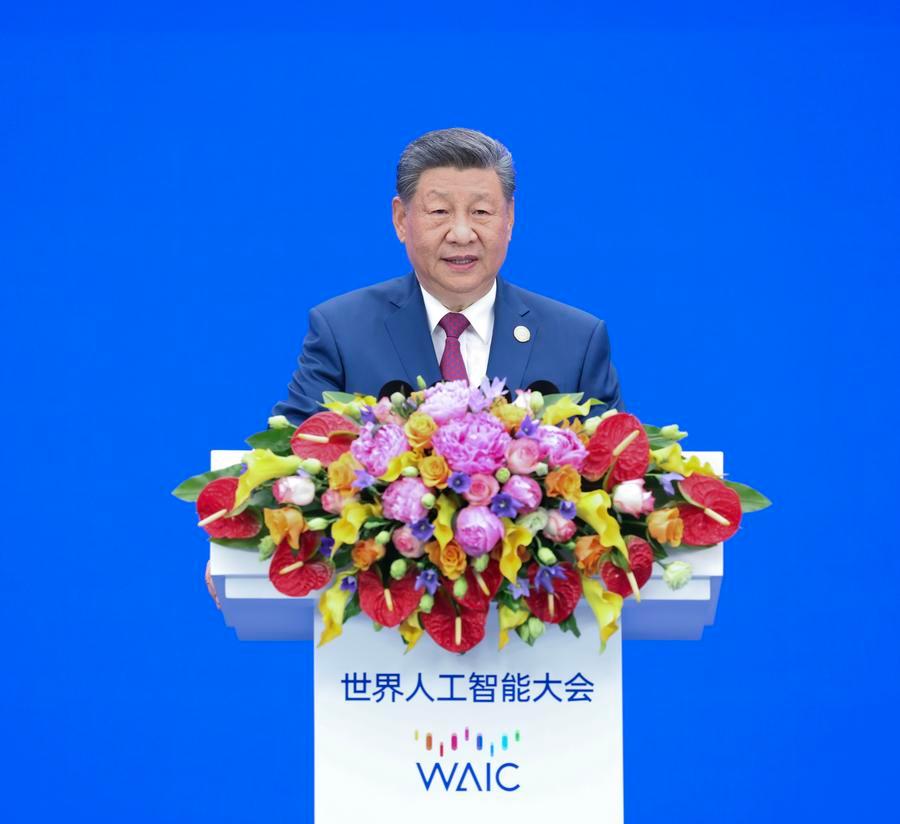
Chinese President Xi Jinping's advocacy for a people-centred approach to artificial intelligence (AI) – emphasizing that AI should be a trusted, human-controlled tool for the positive, for good and for all – has won broad international support and acclaim.

In his keynote speech at the opening ceremony of the 2026 World AI Conference and High-Level Meeting on Global AI Governance, Xi put forward a fundamental and vital concept that establishes a philosophical anchor for AI development and governance, according to Katleho Moloi, a professor at the University of South Africa.

"Ultimately, we don't want a system that will replace humanity, but we want a system that will improve the quality of life of humanity," Moloi said of the AI technology in an interview with China Media Group (CMG).

In a nod to the Chinese president's stress that AI's development is to be a trustworthy tool for humanity, he said, "The theme that we believe in is how we can make people's life better, not only by producing techniques that will replace them, but produce techniques that will make whatever they do to be more profitable, and more efficient."

Xi on Friday announced the creation of the World Artificial Intelligence Cooperation Organization (WAICO), a Shanghai-headquartered body that aims to ensure that AI is beneficial, safe, fair and serves the benefit of all humanity.

"I fully support President Xi's initiative, and this will augur well for the world," said Liow Tiong Lai, chairman of the ASEAN-China Association for the Promotion of Industrial Cooperation and Development and a former Malaysian transport minister, since the world needs "a body that will be able to promote accessibility and equality."

WAICO "will be able to ensure that we train the necessary talent, we provide the necessary infrastructure. We also share our values so that whatever regulations and whatever AI initiative, it is more humane and it is for the humanity," Liow said.

Public goods that answer the needs of the Global South

Analysts have welcomed Xi's pledge that China, as a responsible major country, is always committed to providing international public goods relating to AI.

"We must carry out extensive international cooperation and help Global South countries with capacity building to bridge the AI and digital divides, promote sustainable development, and prevent creating new historical injustice in AI," Xi said on Friday.

President Xi's emphasis on China as a provider of AI public goods is significant, said Haris Bilal Malik, a researcher at the Institute of Strategic Studies Islamabad, a think tank in Pakistan.

"It carries a broader meaning that the artificial intelligence is no more an issue of rich countries, or developed countries, or the great powers. It should serve the humanity across the board, across the globe, for every country, especially for the Global South," Malik said.

Donald Ramotar, former president of Guyana, also commended China's key proposals on AI and its push for a governance framework that leaves no nation behind.

China is advocating that the United Nations play a central role in forming "a global AI governance system with broad consensus to benefit all humanity," Ramotar wrote in a recent opinion piece. "This is to ensure that no country is left behind."

An open approach that builds global capacity, not walls

The international community has also applauded and embraced China's public pledge to roll out a range of practical measures for global AI capacity building over the next five years.

Xi announced at Friday's gathering that China will provide developing countries with 5,000 opportunities in AI training and seminar programs, and enable 30 countries to use the AI-powered meteorological warning system MAZU, to safeguard homes around the world.

China will also develop international AI application cooperation centers with the Association of Southeast Asian Nations, the League of Arab States, the African Union, the Community of Latin American and Caribbean States, the Shanghai Cooperation Organization, and BRICS.

Blade Nzimande, Minister of Science, Technology and Innovation of South Africa, hailed the significance of the Chinese concept of building a community with a shared future for humanity and advocating universal participation by all nations in AI development and governance.

African nations lack AI infrastructure, and China has proactively created favorable conditions to enable developing countries to genuinely share in the dividends of AI development, Nzimande said.

Nikki Gastinel, head of the California Software Association, hailed China's approach to AI development as one rooted in openness and the goal of benefiting all.

In expressing her appreciation, Gastinel called on all other nations to build more bridges for communication and cooperation rather than erecting walls that breed division and confrontation.

Xue Lan, dean of the Institute for AI International Governance at Tsinghua University, dismissed the narrative promoted by some in Europe and the United States that frames China and the US as rivals locked in head-to-head AI competition.

Xue said the Chinese president has made it crystal-clear in his speech that China develops AI for the positive, for good and for all humanity, thus spelling out the core purpose of China's AI strategy.

Thursday, 6 August 2026

A Mexican surveillance giant you’ve never heard of is now watching the US border

A Mexican surveillance giant you’ve never heard of is now watching the US border - Rest of World


A Mexican surveillance giant you’ve never heard of is now watching the U.S. border

Grupo Seguritech quietly built a $1.27 billion surveillance empire. Now it’s expanding into the U.S. and across Latin America.

Adriana Zehbrauskas for Rest of World
By JOSÉ OLIVARES
8 APRIL 2026 • CIUDAD JUÁREZ, MEXICO
TRANSLATE


This article was produced in partnership with Type Investigations.

Inside a law enforcement command center in Ciudad Juárez, a police officer scrolled across a map on her touch-screen computer. As she used her fingers to navigate through the Mexican state of Chihuahua, where Juárez is located, different colored bubbles lit up. “That one is a camera,” the analyst explained, pointing at a circle. “We can just click it and see the live view.”


Listen to story30 MINUTESLearn more


0:00/30:491X

“Look,” an analyst next to her said, demonstrating how the technology works. They zoomed in on a camera feed inside the women’s unit of a state prison. On screen, the camera focused on a group of women sitting around a table — the details of their playing cards clearly visible.

For decades, Juárez, which sits just across the border from El Paso, Texas, has been considered one of the most dangerous cities in the world. For years, rival gangs and drug cartels have battled for control of the city. To combat the violence, Mexican authorities have engaged in an ongoing fight against criminal groups in the area using surveillance technology.

This command center is key to Chihuahua’s growing surveillance network, Gilberto Loya Chávez, the state’s square-jawed and charismatic secretary of public security, said during a tour of the facility last October. Behind him, large screens blasted live camera feeds from throughout the state, as more than a dozen analysts typed away on computers.

Wednesday, 5 August 2026

CXMT’s founder is giving 40% of his new fortune to his workers

CXMT’s founder is giving 40% of his new fortune to his workers

Zhu Yiming became one of China's richest men on Monday, when the memory chipmaker he runs closed its Shanghai debut up 466%. He has promised to hand 40% of that fortune to his staff. The pledge is real, it is written into the prospectus, and it starts paying out in three years.

July 27, 2026 - 12:17 pm


Image by: CXMT


Zhu Yiming got about $10bn richer on Monday. He has promised to give roughly $5.6bn of it away, and not to charity.

The chairman of CXMT saw his fortune climb nearly 300% to $13.9bn when the memory chipmaker closed its Shanghai debut up 466%, according to the Bloomberg Billionaires Index. About 40% of that is earmarked for his employees, Bloomberg reported.

The promise is not new. It is the price tag that is.
What he actually pledged

Zhu committed the shares in CXMT’s IPO prospectus in May, well before anyone knew what Monday would do. He promised to transfer 767.9 million shares into employee incentive programmes.


The 💜 of EU tech

The latest rumblings from the EU tech scene, a story from our wise ol' founder Boris, and some questionable AI art. It's free, every week, in your inbox. Sign up now!


At the debut close of 49 yuan, those shares are worth about $5.6bn. Had the stock merely held its 8.66 yuan sale price, the same pledge would have been worth under $1bn.

He also agreed to restrictions on selling his own stock for 10 years. Bloomberg notes that both commitments are unusual in the history of mainland-listed Chinese companies.
The catch, and there are several

Nobody is getting paid soon. The bonus only begins paying out in three years, and payments are then phased across a decade.

CXMT also has not said who qualifies. The prospectus does not specify whether some or all staff benefit, and the company did not respond to Bloomberg’s request for comment.

The headcount gives a sense of scale. CXMT had 19,298 employees at the end of 2025. Split evenly, which the company has not said it will be, $5.6bn is roughly $290,000 a head.

That figure is not far off what the competition already pays. Samsung chip workers received an average bonus of about $340,000 this year, and SK Hynix has made comparable payouts.
This is a talent war, not a gift

Chinese founders now have to satisfy the state and hold on to engineers at the same time. The second problem is the one money can solve.

“This is very much a newly emerging phenomenon,” said Meng Shen, director at investment bank Chanson & Co. “Talent retention is definitely a key factor.”

Shen added that no single founder can drive success alone in high-growth tech, and that it takes a large influx of top talent.

The argument is familiar from the other side of the same industry. Jensen Huang recently said companies should pay workers as much as possible. In Korea, the same logic has produced its own problems, from appliance staff rallying over bonuses that went to chip divisions, to warnings that the payouts are an inflation risk.
He has done this before

Zhu has form on symbolic sacrifice. In 2018 he stepped back from GigaDevice Semiconductor, his first successful public venture, to run CXMT in partnership with the Hefei municipal government.

At the time he pledged not to draw a single yuan in salary until the project turned a profit. It was a multibillion-dollar bet on a company with no product.

That bet worked. CXMT is now China’s largest maker of DRAM, the memory that feeds server databases and AI workloads, and the fourth largest in the world.

He is also not alone. Yan Junjie of MiniMax has pledged to take no salary until his firm hits an AI milestone, while handing his own shares to long-serving staff.
Who actually owns CXMT

There is a larger shareholder in this story than Zhu, and it is the state.

Before the IPO, the Hefei municipal government held more than 30% through local state vehicles. China’s Big Fund II held over 8%. The Big Fund, formally the China Integrated Circuit Industry Investment Fund, exists to buy the country semiconductor self-sufficiency.

Set against what Zhu and the state made on Monday, $5.6bn is a modest slice. The generosity is real, and it is also affordable.
Whether it happens

A pledge that starts in three years and runs for ten is a long promise. Shen, who called the trend genuinely new, was also the one to say so.

“Whether these promises will actually be fulfilled, and to what extent, depends entirely on how binding the commitments really are,” he said.

He put the founder’s side of it more bluntly. “For founders at this stage, wealth eventually becomes nothing more than a number,” he said, adding that it can be a number with negative side effects.

Zhu spent seven years not taking a salary to build this company. He has now committed to a decade of not selling it, and to giving away a share of it beginning three years from now. On Monday the market decided what that share is worth. It picked $5.6bn.

Tuesday, 4 August 2026

EU: Meta’s apps are so addictive they violate the law


EU: Meta’s apps are so addictive they violate the law

Row of teen boys using their phones

Matt Cardy/Getty Images

A European Union investigation has determined that Meta’s Facebook and Instagram apps are too addictive, presumably after regulators lost half a day watching cooking reels and clips of 20-year-old TV shows. Now, the European Commission wants Zuck and company to make some changes, or face massive fines.

What happened? EU investigators announced yesterday that Meta is currently in breach of the bloc’s Digital Services Act. Regulators said Meta didn’t fully consider how some of its app features fuel compulsive use by sending users, especially younger ones, into a zombified “autopilot mode.” Meta will now have time to propose remedies before a final judgment—and fines—are handed down. The European Commission has some suggestions:

  • Disable autoplay and infinite scroll.
  • Implement screen time breaks.
  • Make its recommendation algorithm less “engagement-oriented.”

Fine line: If the preliminary findings are upheld, Meta could get fined up to 6% of its annual global revenue. The company said it disagrees with the report, pointing to its recent efforts to strengthen parental controls, but that it will “continue to engage constructively” with regulators.

And elsewhere in the Meta-verse…the company removed its controversial new Muse Image feature from Instagram, following days of complaints from users and Hollywood agencies and unions over how all IG accounts were opted in for their images to be used in the tool.

Monday, 3 August 2026

Private spreadsheets for sensitive work - Proton


Interactive Communications

Interactive Communications
Interactive Communications VOIP and VPN

eComTechnology RG Richardson Communications

eComTechnology since 2003. I am a business economist with interests in international trade worldwide through politics, money, banking and secure VOIP and Mail Communications. The author of RG Richardson City Guides has over 300 guides, including restaurants and finance. RG Richardson City author has over 300 travel guides. Let our interactive search city guides do the searching, no more typing, and they never go out of date. With over 13,900 preset searches, you only have to click on the preset icon. Search for restaurants, hotels, hostels, Airbnb, pubs, clubs, fast food, coffee shops, real estate, historical sites and facts all just by clicking on the icon. Even how to pack is all there. Finance, Money, Banking, and Economics definitions interactive dictionary.

Google will pay £260m to settle a UK class action over Play Store fees

Google will pay £260m to settle a UK class action over Play Store fees Google has agreed to pay £260m to settle a class action brought for U...