A Vancouver Company’s Role in the Race to Mine the Seabed | The Tyee
A Vancouver Company’s Role in the Race to Mine the Seabed
The US has set out to allow companies to bypass UN protections against risks in international waters.
 Cara B.G. James
 TodayThe Conversation
Cara B.G. James is a PhD candidate in geophysics at the University of British Columbia. This article was
originally published by the Conversation.
Our journalism is supported by readers like you. Click here to support The Tyee.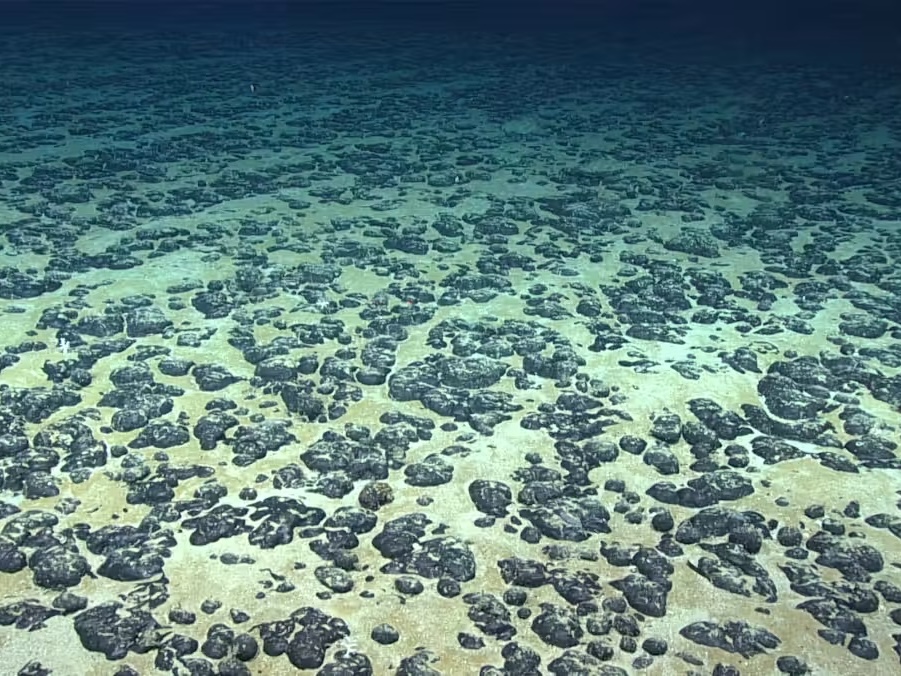
For mining companies, these polymetallic nodules four to six kilometres under the ocean surface are prized because they’re rich in cobalt, nickel and rare earth elements. Photo via NOAA.
Listen to this article
7 min
A Canadian deep-sea mining company may become the first to commercially mine the international seabed under a controversial U.S. executive order that bypasses United Nations regulations. A recent
legal analysis suggests that this could place Canada in violation of international law.
Announcements, Events & more from Tyee and select partners
At Knowledge Network, Indigenous Brilliance Shines On
The BC-based public broadcaster delivers 12 powerful films and original series to mark Indigenous History Month.
The U.S. National Oceanic and Atmospheric Administration, or NOAA, recently announced that an application made by Vancouver-based The Metals Company (via their U.S. subsidiary, TMC USA) is fully compliant with NOAA regulations. The next steps include publication of a draft environmental impact statement for public comment, which TMC expects will lead to a permit to mine the seabed
by the first quarter of 2027.
As demand for
critical minerals grows, governments worldwide are increasingly looking past their borders and coastlines towards the deep sea for mineral resources.
Of particular interest are the billions of tonnes of
polymetallic nodules rich in cobalt, nickel and rare earth elements that lie unattached on the sea floor, four to six kilometres below the water surface.
Modern engineering techniques are making polymetallic nodule mining more economically viable for mining companies. However, a complicating factor is that most polymetallic nodules lie in international waters, outside any single country’s territory.
Around 90 per cent of UN member states have ratified the
United Nations Convention on the Law of the Sea, or UNCLOS, which asserts that the deep sea is the “common heritage of mankind” and its resources are “vested in mankind as a whole.” The United States never ratified the treaty.
US moves to mine the international seabed
In April 2025, U.S. President Donald Trump signed an
executive order that aims to fast-track mining permits for seabed minerals in areas beyond U.S. national jurisdiction.
Put simply, the U.S. wants to start issuing permits to mine areas of the seabed that are not owned by the U.S. or any other country, outside of the UN’s International Seabed Authority regulations.
The same month, TMC USA
applied for a first commercial recovery permit to mine approximately 25,000 square kilometres of seabed in the Pacific Ocean. This application was later amended to 65,000 square kilometres, an area more than twice the size of Vancouver Island.
Negative reception of the US executive order
In response to Trump’s executive order, International Seabed Authority Secretary-General Leticia Carvalho
asserted that “no state has the right to unilaterally exploit the mineral resources of the [deep sea] outside the legal framework established by UNCLOS.”
UN member states have been working towards a regulatory framework for commercial mining of deep-sea minerals since 2014, under the guidance of the International Seabed Authority. However, as of June 2026, the regulations remain unfinished.
Representatives from the U.S. argue that their country neither signed nor ratified the UN Convention on the Law of the Sea and therefore has no obligation to adhere to the International Seabed Authority permitting process,
stating “the United States is not bound by the Convention rules dealing with seabed mining through the International Seabed Authority.”
They instead cite the U.S.
Deep Seabed Hard Mineral Resources Act, a little-used legislative pathway through which some exploration permits were handed out in the early 1980s but that has since lain dormant.
Potential legal ramifications for Canada
Whether or not the U.S. actions are legal remains to be seen. However, this issue raises a second question. Will Canada, a state party to the UN Convention on the Law of the Sea, face any legal ramifications if the American subsidiary of a Canadian company begins mining international waters under U.S. permits?
This question is the focus of recent legal analyses of UNCLOS articles 137 to 139 from
independent lawyers and a recent
report by Greenpeace.
For UNCLOS member states, their obligations under the treaty are very clear: these states are not allowed to mine independently, and they are also bound not to recognize or participate with any unilateral mining.
Crucially, member states also have a “responsibility to ensure” that no enterprise or person under their jurisdiction is involved with any of these unilateral mining activities.
If Canada is found to have breached any of these rules, this would leave the country vulnerable to being brought to disciplinary hearings at the
Seabed Disputes Chamber. As an UNCLOS state party, Canada would be legally obligated to comply with a disputes hearing and ruling, and to pay any damages ordered.
The Metals Company is pursuing the U.S. regulatory pathway through its U.S.-based subsidiary company. However, TMC USA has existed by that name only
since January 2025, meaning that critical data, funds and proprietary designs used for mining are likely carried over from the Canadian parent company TMC, or other TMC subsidiaries.
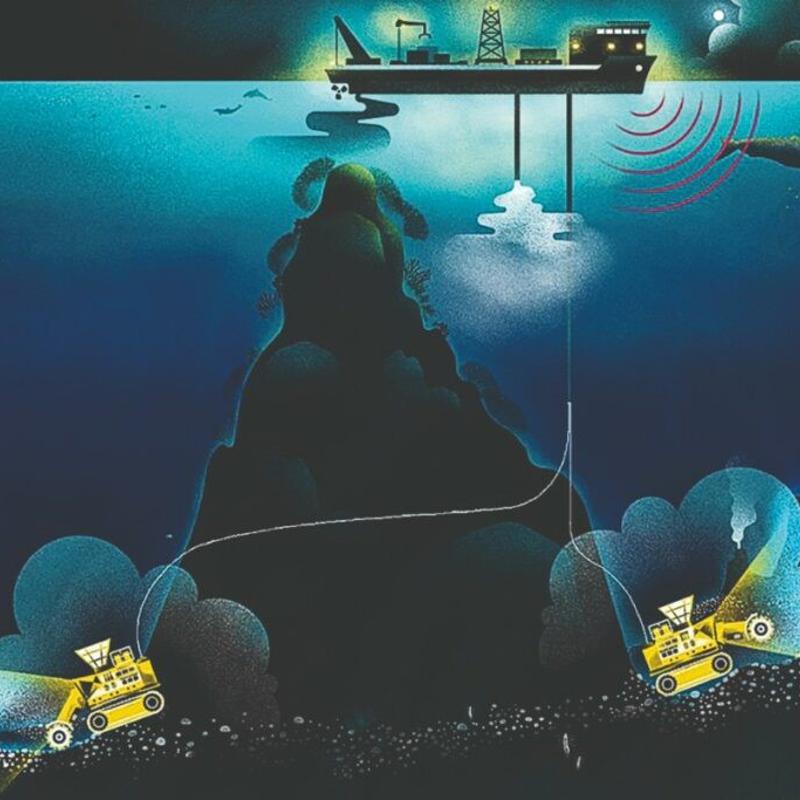
The Fight Over Seabed Mining Comes to Vancouver
read moreIf an American subsidiary has arguably no functional independence from its Canadian parent company, Canada could have an obligation and responsibility under the UN convention to ensure the company is not participating in mining activities that potentially violate UN regulations.
The Canadian government’s position
In 2023, the Canadian government announced its
support for a moratorium on commercial seabed mining in international waters. However, since then the government has remained silent on the issue of deep-sea mining.
In a
recent public letter, environmental and social justice organizations and community groups called on the government to “publicly denounce efforts by a Canadian company to engage in unilateral deep-sea mining,” as well as to reaffirm its commitment to UNCLOS and to a moratorium on deep-seabed minerals.
With the upcoming International Seabed Authority assembly meeting scheduled in July, all eyes will be on Canada to see if the government recognizes a responsibility to challenge TMC and the U.S. government’s actions, or if it continues to remain silent.


Read more:
EnvironmentIndependent journalism thrives when readers choose to support it
Nearly every week, I see newspapers and magazines that seemed fine suddenly going out of business. Or a private equity fund buying up a chain of newspapers that had been serving communities for decades and stripping them for parts. And now, the thing that’s making all publishers wring their hands is AI – publishers are seeing massive drops to their web visits as AI scrapes their content and delivers it up to people in chatbots, with the journalists who did the original work not even credited with the work.
Despite this, I have hope for journalism because of what’s happening at The Tyee.
Years ago, we made a strategic bet that support from our readers was going to drive our whole future. And thankfully, that is working for us.
Over the past decade, we’ve more than doubled our journalism team and are publishing more work than ever. More people read The Tyee now than at any point in our 23-year history.
This is only possible because we regularly ask our readers to sign up as paying Tyee Builder members. Roughly half of our entire budget is made up of contributions from over 10,000 readers.
We’ve been doing more as our resources have grown. A weekend culture section filled with original essays. Hard-hitting investigative journalism in Alberta. A brand new biodiversity beat. A reporting project called Reality Check, focusing on misinformation and online radicalization. A flagship podcast.
Our model is simple: if more of our readers sign up to support The Tyee, we can keep up with rising costs and keep adding more talented journalists to our roster and set them loose on uncovering truths that would otherwise not see the light of day.
Please help us prove that Independent Journalism Thrives with reader support.— Jeanette Ageson, Publisher

 OpenAI CEO Sam Altman speaks at a summit © Anna Moneymaker/Getty Images


 Getty / Futurism