Wednesday, 3 June 2026

Meta workers are straight up not having a good time

  Meta workers are straight up not having a good time

Meta HQ sign

Josh Edelson/Getty Images

The vibes at Meta headquarters right now aren’t just bad, they are downright rancid. Starting this morning, waves of emails will start arriving in nearly 8,000 employees’ personal inboxes, informing them that their jobs are terminated. Workers had been dreading the mass culling since it was first leaked by The Information in March, but Meta didn’t address the layoffs with staff until last month.

What’s the damage? The layoffs affect about 10% of the ~78,000 workforce. Earlier this week, the company said in a memo that it would also move 7,000 employees to AI-related initiatives and close 6,000 open roles.

Morale at the Facebook parent company is reportedly at an all-time low:

  • Things have gotten so bad that some employees are begging for the virtual pink slip and the 16 weeks minimum of severance, Wired reported.
  • An employee who worked at the company for over a decade told the San Francisco Standard, “I tend to cry in the shower.”
  • Another worker said large empty boxes began arriving at a few of the Menlo Park offices before today’s layoffs, and no one could give employees an answer as to why.

Layoffs are just the tip of the AIceberg

CEO Mark Zuckerberg said in 2022 that the layoffs were a correction to Covid-era overhiring, but the recent rounds are meant to free up funds for AI spending. The tech giant has pledged to spend as much as $145 billion this year on artificial intelligence.

In April, Meta rolled out a new program internally that tracks employees’ every move on their computers. The company said it would use the data to train AI models on “how people actually complete everyday tasks using computers.”

Big picture: Many Meta workers have pushed back, with some launching a petition urging execs to end the tracking program, and UK workers attempting to unionize. Meta, meanwhile, is reporting record profits.

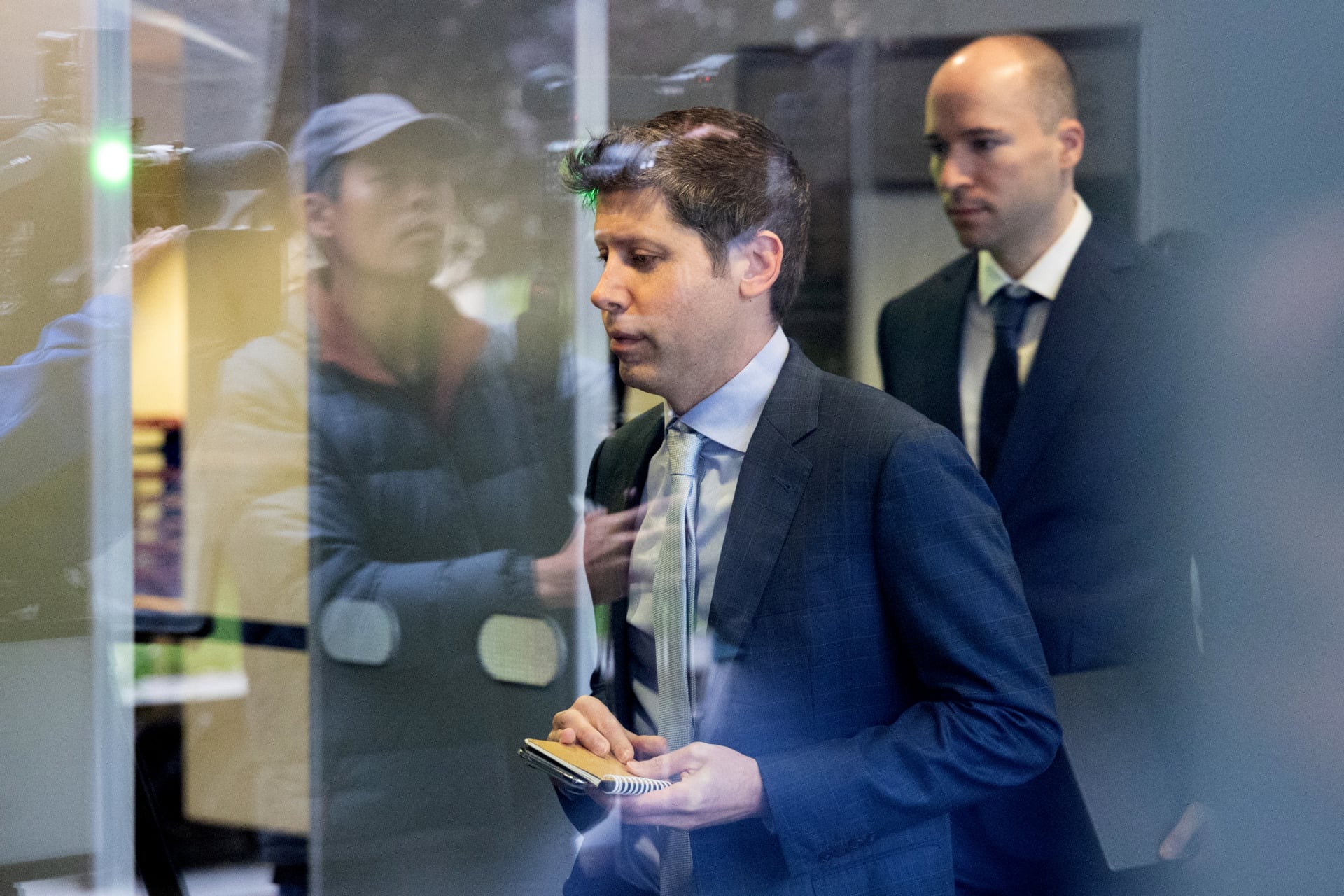
Sam Altman Sued by Florida AG Over Alleged Exploitation of ChatGPT Users for Profit

Sam Altman Sued by Florida AG Over Alleged Exploitation of ChatGPT Users for Profit

Sam Altman Sued by Florida AG Over Alleged Exploitation of ChatGPT Users for Profit
ChatGPT's dangers "outweigh any benefit" and its multibillion dollar valuation "has not been earned," the attorney general claims.
BY ECE YILDIRIMPUBLISHED JUNE 1, 2026, 4:00 PM ET

READING TIME 3 MINUTES

OpenAI CEO Sam Altman Benjamin Fanjoy
READ LATER COMMENTS (0)


OpenAI’s legal headaches are growing.

On Monday, Florida Attorney General James Uthmeier sued OpenAI and its CEO Sam Altman, claiming that the AI giant’s success and $852 billion valuation “has not been earned.”

“The rise of OpenAI is attributable to a web of deceit and the exploitation of users (including Floridians), leveraging their data and safety to boost OpenAI’s market value at unacceptable costs,” Uthemeir claims in the civil action complaint.

The lawsuit has been described by the AG’s office as a “first-in-the-nation state-led lawsuit” to take on OpenAI and Altman, claiming that the company knowingly put forth a dangerous and “shockingly unreliable” product with ChatGPT. The complaint accuses the company of falsely marketing ChatGPT as safe in pursuit of monetary gains, which has manifested numerous dangerous outcomes that “outweigh any benefit of using ChatGPT.”

“Because of Defendants’ misrepresentations about ChatGPT and their careless introduction of ChatGPT to Florida and the world, mass shooters have been aided and abetted in deadly rampages, vulnerable people have been encouraged into suicide, professionals have suffered public humiliation, users have lost critical thinking skills, and minors have become addicted to a tool that feigns human compassion to collect their data with no parental oversight,” the complaint says. “These harms cannot reasonably be avoided by the public, whether consumers or innocent bystanders, because Defendants take no effort to make the public aware of them.”

The lawsuit comes after the Office of Statewide Prosecution, also under Florida AG Uthmeier’s leadership, launched a separate, ongoing criminal investigation into the alleged role ChatGPT played in a 2025 mass shooting at Florida State University that took the lives of two people.

The mass shooting at FSU was far from the first time ChatGPT was accused of facilitating a violent attack. Earlier this year, mourning family members in the Tumbler Ridge district in British Columbia, Canada, sued OpenAI, alleging that the perpetrator of a mass shooting at the local high school had conversations with the company’s controversially sycophantic GPT-4o model months before the attack. The shooter, who later committed what has tragically been named one of the deadliest mass shootings in Canadian history, had his account flagged for “gun violence activity and planning” by OpenAI’s internal systems months before the shooting took place, but authorities were not notified. Altman has since issued an apology, admitting that the company should have alerted law enforcement.

The complaint also alleges that a deliberate lack of safeguards for vulnerable users, like minors, has led to AI chatbot addictions and a consequent host of mental health problems. The chatbot, and yet again specifically its GPT-4o model, was also the subject of a wrongful death lawsuit filed last year by the parents of a teenager who allegedly committed suicide after months of back-and-forth planning conversations with ChatGPT. While ChatGPT is arguably the most well-known AI chatbot, other AI chatbot proprietors have also been implicated with similar claims. Two separate Florida families have sued Character.AI and Google’s Gemini each for allegedly encouraging their sons to kill themselves.

In making the case that Altman has knowingly concealed these harms to profit from the unsafe ChatGPT models, the complaint also makes references to a New Yorker investigation published in April, quoting reports of Altman’s alleged penchant for lying and “sociopathic” tendencies.

The Florida AG’s legal challenge and request for a trial by jury comes freshly after OpenAI made it out of a lengthy legal battle with Elon Musk, one that yet again alleged deceitful practices by OpenAI. Though the jury ultimately ruled against Musk, the trial brought the AI company considerable negative press and unearthed some ugly truths regarding the former non-profit’s transition to a for-profit structure, at a time when OpenAI is trying to navigate the path forward for an incredibly consequential IPO, the SEC filing for which is reportedly set to hit pretty much any time now.

Tuesday, 2 June 2026

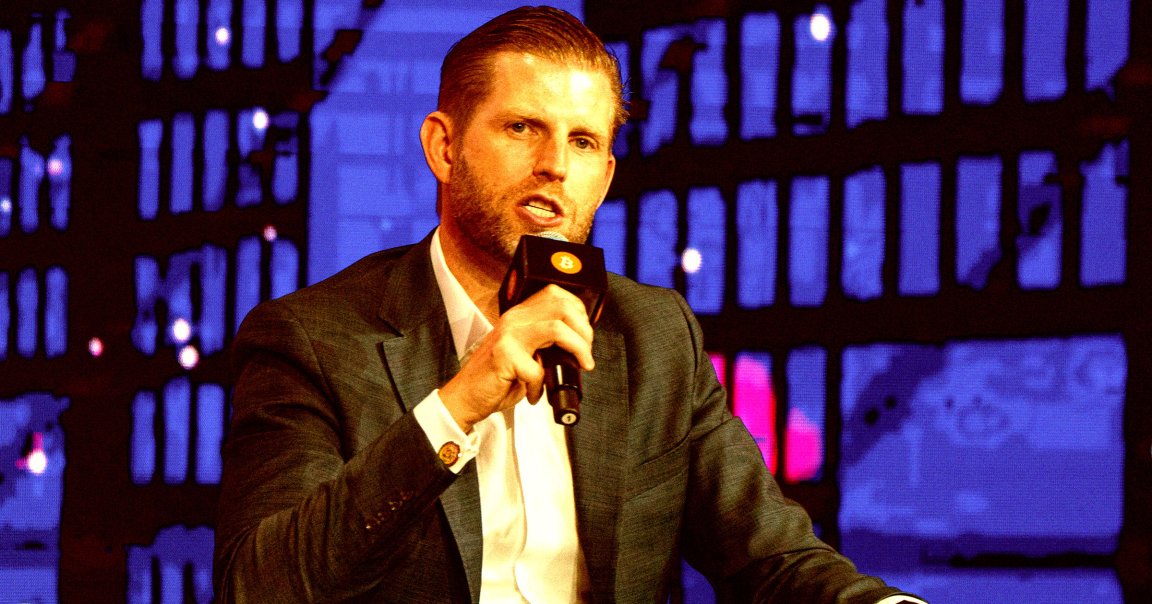
Eric Trump's Crypto Company Is Falling Into Total Disaster

Eric Trump's Crypto Company Is Falling Into Total Disaster

Eric Trump’s Crypto Company Is Falling Into Total Disaster

The grift is in danger.
A shady crypto company quietly scrubbed Eric Trump's name from its public leadership following major legal and financial turmoil.
VERNON YUEN/AFP via Getty Images

President Donald Trump and his spawn have reaped billions of dollars worth of crypto during his second term in office, a highly questionable portfolio considering his ability to regulate the very market that’s made him obscenely rich.

But the Trump crypto empire isn’t looking nearly as hot these days. A shady Las Vegas-based financial firm called Alt5 Sigma Corp, which has been stockpiling tokens from the Trump family’s World Liberty Financial venture, has quietly scrubbed Eric Trump’s name from its public leadership following major legal and financial turmoil, as the Daily Beast reports.

The news comes after major World Liberty Financial investor and crypto billionaire Justin Sun filed a lawsuit against the company earlier this month, accusing it of illegally freezing his tokens and profiting off fraud. (Eric Trump downplayed Sun’s legal threat as “ridiculous.”)

The lawsuit couldn’t have come at a worse time for Alt5. Since it announced it was stockpiling World Liberty tokens in August, its shares have lost around 90 percent of their value, trading at a measly 74 cents at press time.

The president’s son was originally envisioned to become a board director of Alt5, but was quickly downgraded to “board observer,” a far more hands-off role.

To call Alt5 a car wreck of a company would be a vast understatement. The company of just 16 employees burned through a staggering $341 million in its latest fiscal year, warning investors it had “substantial doubts” about its ability to keep going for another year, per the Beast.

Before its questionable crypto deal, it was an appliance recycling business, which then pivoted to biotech, and eventually fintech.

Several former executives have been found “criminally liable for offenses including illicit enrichment and money laundering” in Rwanda last year, according to 2025 Securities and Exchange Commission filings. Alt5 has also cycled through three CEOs in just six weeks late last year.

The decision to scrub Eric Trump from its leadership highlights only the latest highly questionable crypto venture tied to the Trump clan. Donald Trump’s crypto token, $TRUMP, which launched ahead of his second inauguration in January last year, has turned out to be a spectacular failure. Its value has lost a staggering percentage of its value over the last year, circling the drain at just over $2.30.

Trump’s disastrous Truth Social company, Trump Media & Technology Group, which similarly stockpiled a Bitcoin reserve, has seen its shares plummet to record lows earlier this year amid hundreds of millions in losses.

Last month, even CEO Devin Nunes, a longtime Trump loyalist and advisor, saw the writing on the wall, and ended up walking away.

Monday, 1 June 2026

End-to-end encrypted video conferencing


Sunday, 31 May 2026

Carney Breaks Down Plans to Spend $51B on Local Infrastructure Over a Decade

 Carney Breaks Down Plans to Spend $51B on Local Infrastructure Over a Decade


Carney Breaks Down Plans to Spend $51B on Local Infrastructure Over a Decade
April 7, 2026
Reading time: 3 minutes

Full Story: The Canadian Press with file from The Energy Mix
Author: Craig Lord


Mark Carney/Facebook


The federal government will address infrastructure gaps across Canada with billions of dollars in funding over the coming decade, Prime Minister Mark Carney said on Tuesday at a news conference in Brampton, Ontario.

Carney used the event to break down how his government plans to distribute $51 billion in its Build Communities Strong Fund. The new pot of money was first announced in the 2025 budget, which became law last month.

Ottawa plans to nearly double the rate of infrastructure investment in Canada over the next eight years compared with the previous eight, Carney said.

He teased that future announcements are coming on initiatives for skills training and apprenticeships, and urged youth to consider a career to support the infrastructure agenda.

“The next 25, 30 years is going to be a great time to be in the trades, to be an electrician, to be a pipefitter, to be a welder, to a plumber, a carpenter, and beyond, because we are literally going to build this country,” Carney said.

The Build Communities Strong Fund includes $27.8 billion over the next 10 years for infrastructure such as roads, bridges, and water and sewer systems, and $6 billion for other major local projects like building retrofits and community centres.

Carney’s first announcement under this local stream was $64 million for a new recreation centre and park in Brampton. The federal government announced $300 million in funding for 13 projects later in the day, more than a third of which will go toward water and wastewater systems underpinning new housing developments in Iqaluit.

“Iqaluit, Hay River, and Whitehorse all received federal support for key infrastructure from the Build Communities Strong Fund,” CBC North reports. In Iqaluit, “Tuesday’s announcement will fund utilidor improvements and trucked water services needed to add up to 2,500 new housing units in the Nunavut capital.”

The federal government also launched a website allowing municipalities and other organizations to apply for new project funding under this stream.

The remaining $17.2 billion in the fund is to be matched by provinces and territories and used to reduce the cost of building new infrastructure and housing. That includes $5 billion over three years to build out health care facilities such as new emergency departments.

The federal government announced last week that Ontario will use $4.4 billion of its allotment to waive sales taxes on eligible new homes for the next year.

With $6 billion set aside for the province, Ontario will receive the biggest share from the provincial and territorial stream. Quebec will receive $3.6 billion, British Columbia will get $2.2 billion, and Alberta will receive $1.9 billion, with hundreds of millions set aside for the remaining provinces and territories.

Provinces and territories are required to allocate 20% of their funding to rural, northern, and Indigenous communities. Ten per cent of funding through the $6-billion “direct delivery” stream must go to Indigenous-led projects.

British Columbia MP Dan Albas, the Conservative shadow minister for transport, criticized the infrastructure fund rollout as “another reannouncement.”

“Conservatives want our infrastructure, homes, and health to grow and improve, but the Carney Liberals need to get out of the way and scrap their anti-development laws and unaffordable taxes,” Albas said in a statement.

The main body of this story was first published by The Canadian Press on April 7, 2026.

Saturday, 30 May 2026

Meta Is Upgrading One of the Worst Parts of Its Smart Glasses

 Meta Is Upgrading One of the Worst Parts of Its Smart Glasses


Meta Is Upgrading One of the Worst Parts of Its Smart Glasses
And no, it's not privacy.
BY JAMES PEROPUBLISHED APRIL 10, 2026, 11:10 AM ET

READING TIME 2 MINUTES

© Raymond Wong / Gizmodo
READ LATER COMMENTS (11)


Computer vision might be one of the defining features of Meta’s smart glasses, but that doesn’t mean it works like one. Having used Meta’s Ray-Ban AI glasses at length, I can say with certainty that the ability to use the camera for identifying stuff in your surroundings is very hit or miss—sometimes it gets things right, but just as often it falls flat. According to Meta, an upgrade to that tumultuous experience may be on the way thanks to a new AI model.

Muse Spark, which Meta officially unveiled this week, is what the company is calling the “first in a series” of large language models built by Meta’s Superintelligence Labs. Though it’s not out yet, Meta says it plans to integrate Muse Spark into quite a few of its products, including AI glasses, in the coming weeks. What exactly will it be doing there? Seeing stuff better, apparently.


“When Meta AI powered by Muse Spark comes to our AI glasses, the assistant will be able to better see and understand the world around you,” says Meta in a blog post.

Lots of Muse Sparks’ strengths, in fact, appear to be centered on “multimodal perception,” which is shorthand for seeing stuff in your environment and being able to understand it. According to Meta, one of Muse Spark’s strengths is health. “Meta AI is now able to help you navigate health questions with more detailed responses, including some questions involving images and charts,” according to the company. It also says that Muse Spark excels at “visual coding,” which allows people to “create custom websites and mini-games straight from a prompt.”Meta notably shows nutrition features on a phone, though that doesn’t mean its AI glasses aren’t also capable of doing the same thing. © Meta

While it doesn’t say either of those abilities is coming to AI glasses necessarily, it’s worth noting that Meta has leaned into health recently, expanding the nutrition coaching capabilities on its AI glasses. Computer vision and AI are still two of the core pillars of Meta’s smart glasses, so I’m going to assume that any way Meta can squeeze Muse Spark into the equation, it’ll try.

How impactful Muse Spark is on the experience of using Ray-Ban Meta AI glasses is still an open question, but even if it makes computer vision less prone to mistakes and hallucinations, it could be a significant improvement. Now, if they could just spend a little time getting their abysmal privacy standards in order…

Friday, 29 May 2026

Kids are chatting old school

 Kids are chatting old school

Child using Tin Can phone

Tin Can

The next generation will be expert prank callers: There’s a monthslong waitlist for a screenless, landline-inspired device for kids called Tin Can. The pared-down phone has only been on the market for a year and has already sold hundreds of thousands of units, the startup that sells it told Bloomberg yesterday.

Tech that parents actually like? The wi-fi-enabled phone costs $100, and offers free calls between Tin Cans and to emergency services. Its most popular plan, according to the company, is an extra $10/month that lets users call non-Tin Can phones:

  • The phone was created by Chet Kittleson, a father of three, who says he felt exhausted by the choice between letting his kids get a smartphone or managing all their playdates with friends.
  • His company has since raised an initial $3.5 million, followed by a $12 million seed round in December led by Greylock Partners.

Tin Can says its fastest-growing market segment is bulk orders from schools. This month, the Nativity Parish school in Kansas delivered free Tin Cans to 200+ families of elementary school students.

Big picture: The retro device has attracted parents as lawmakers around the world pitch social media bans for kids. Just last month, Meta and YouTube lost a huge social media addiction trial a day after Meta lost a different child safety case.


Thursday, 28 May 2026

Amazon chased Musk into space and landed a golden Apple


Wednesday, 27 May 2026

Shell Puts Canada at Heart of Growth Plans in $13.6 Billion Deal

 Shell Puts Canada at Heart of Growth Plans in $13.6 Billion Deal


Shell Puts Canada at Heart of Growth Plans in $13.6 Billion Deal · Bloomberg
Mitchell Ferman and Robert Tuttle
Mon, April 27, 2026 at 9:20 AM PDT 3 min read

(Bloomberg) -- Shell Plc agreed to buy Canadian oil and gas producer ARC Resources Ltd. for $13.6 billion, its biggest deal in more than a decade as it seeks to sustain output in the long term.

It’s the first major acquisition in the three-year tenure of Chief Executive Officer Wael Sawan, who has been pressed recently to bolster the company’s fossil fuel reserves. In the absence of major discoveries, and with Shell saying last year it won’t bid for troubled rival BP Plc, a smaller deal has been the likeliest path to growth.

ARC’s low-cost shale gas and liquid hydrocarbon production complements Shell’s existing operations in Canada, which include a stake in a major liquefied natural gas export facility on the west coast. The country, which under Prime Minister Mark Carney has accelerated approval of energy projects, is now core to Shell’s ambitions, Sawan said.

“This establishes Canada as a heartland for Shell,” Sawan said in a statement announcing the transaction on Monday. The deal “strengthens our resource base for decades to come.”

The deal reinforces the London-based company’s move to refocus on its core oil and gas business in a drive to boost returns to investors. ARC’s assets will raise the compound annual growth rates of Shell’s production between 2025 and 2030 to 4%, up from 1% previously. It will help sustain liquids production toward 2030 and beyond at about 1.4 million barrels a day.


ARC’s shares jumped as much as 24% to the highest in more than 10 years. Shell dropped 1.7% to 3,252.5 pence in London.

LNG Canada

The transaction will help support output from LNG Canada, an important export project that gives access to Asian markets to the country’s natural gas resources. A second phase of expansion is possible at the project, in which Shell has a 40% stake, although Sawan told reporters acquiring ARC doesn’t mean a final investment decision is imminent until at least the end of the year.

ARC’s operations are situated in the same region as Shell’s Groundbirch asset in British Columbia, which supplies LNG Canada, and the Gold Creek project in neighboring Alberta, according to the statement. The acquisition also gives Shell exposure to another export project with ARC’s supply deal into Cedar LNG, a smaller facility under construction nearby.
Story Continues

Tuesday, 26 May 2026

New $100 Fitbit is just a band, and that’s the point

 New $100 Fitbit is just a band, and that’s the point

Side-by-side view of the Fitbit Air and Whoop wearable devices, both screenless health trackers.

Google, Whoop

Screenless health trackers are having a moment, and Google wants in. Yesterday, the tech giant unveiled the first display-free Fitbit, the Fitbit Air. The $100 device will compete directly with smart band-maker Whoop at a time when more people want wearable health monitoring, but nobody wants to look at another screen.

The new Fitbit launches on May 26 with the typical slate of new-age health features, including sleep tracking, blood-oxygen monitoring, and irregular heart-rate detection. Users can also pay $100/year to access a Gemini-powered health coach within the new Google Health app (rebranded yesterday from the Fitbit app).

Google saw an opportunity. In the overall wearables market, Apple Watch still dominates, and Google’s Pixel smart watches barely make a dent. Meanwhile, Whoop and Oura took a different track, offering minimalist designs—which save screen time and battery life—that have helped propel both companies’ valuations beyond $10 billion.

Fitbit Air could undercut those popular screenless wearables:

  • Whoop charges at least $200/year to use its wristbands, which have no upfront cost.
  • Oura Rings start at $349, and a subscription that unlocks all its tracking features will run you another $70/year.

Zoom out: In the US, purchases of fitness trackers jumped 88% from 2024 to 2025, while purchases of smart rings spiked 195%.

Interactive Communications

Interactive Communications
Interactive Communications VOIP and VPN

eComTechnology RG Richardson Communications

eComTechnology since 2003. I am a business economist with interests in international trade worldwide through politics, money, banking and secure VOIP and Mail Communications. The author of RG Richardson City Guides has over 300 guides, including restaurants and finance. RG Richardson City author has over 300 travel guides. Let our interactive search city guides do the searching, no more typing, and they never go out of date. With over 13,900 preset searches, you only have to click on the preset icon. Search for restaurants, hotels, hostels, Airbnb, pubs, clubs, fast food, coffee shops, real estate, historical sites and facts all just by clicking on the icon. Even how to pack is all there. Finance, Money, Banking, and Economics definitions interactive dictionary.

You might buy SpaceX stock without even realizing it

  You might buy SpaceX stock without even realizing it Niv Bavarsky On Tuesdays, the Brew’s Matty Merritt brings you the news you need to ...