Oracle Forced to Cancel Incredibly Polluting Natural Gas Plant to Power AI Data Center
Futurism · a day ago
by Joe Wilkins · Science & Energy
The tech industry has done a poor job of hiding the environmental footprint of AI data centers, which hoover up electrons like nobody’s business. With America’s crumbling energy grid struggling to keep up, billionaire tech industrialists are increasingly financing their own energy solutions.
This has had predictable consequences Elon Musk’s xAI data center in south Memphis, for example, is choking residents with its slapdash fleet of portable methane generators, courting a clean air lawsuit from the NAACP.
Now Oracle, the AI company helmed by tech billionaire Larry Ellison, announced it’s cancelling a major natural gas plant meant to power its “Project Jupiter” facility in New Mexico. According to Business Insider, the cancellation comes after both the Federal Energy Regulatory Commission and the New Mexico State Land Office denied Oracle’s requests to build a new natural gas pipeline to deliver fuel to the facility.
Instead, the company is partnering with Bloom Energy, a company which produces solid oxide fuel cells, which convert chemical energy directly into electricity without combustion.
Estimates previously pegged Project Jupiter’s on-site greenhouse gas emissions at over 14 million tons per year, more than the cities of Albuquerque and Las Cruces combined. Though the pivot to fuel cells will theoretically be better than straight natural gas, it only reduces the damage — with new estimates suggesting a 30 percent reduction to around 10 million tons of pollution emitted per year instead.
“I don’t know that this is the clean energy solution that they’re saying it’s going to be,” Kacey Hovden, a staff attorney with the New Mexico Environmental Law Center told News From the States.
Ultimately, it might be best to think of these data centers like cigarettes. Sure, there are ways to cut down on the damage they cause to your lungs with filters and such, but no cigarette is ever going to be good for you — and no data center is ever going to come without some kind of consequence to the environment it inhabits.
More on data centers: Almost Half of US Data Centers That Were Supposed to Open This Year Slated to Be Canceled or Delayed
The post Oracle Forced to Cancel Incredibly Polluting Natural Gas Plant to Power AI Data Center appeared first on Futurism.
eComTechnology

Interactive services
Sunday, 5 July 2026
Saturday, 4 July 2026
AI centers being imposed from above by tech billionaires and their political allies
Residents Furious After Their Town Board Rejected an OpenAI Data Center, But a Billionaire Developer Forced It Through Anyway
Futurism · 21 hours ago
by Joe Wilkins · Artificial Intelligence
Across the United States, the fight over data center construction has largely pitted stamp-happy municipal governments against their own residents. As these battles multiply, local officials are increasingly pressured to approve projects their constituents oppose, while more and more voters take their struggles to the ballot box.
Residents in Saline Township, Michigan, however, thought they had avoided the drama after their township board and planning commission both voted to decline a 21 million square foot data center in their backyard. It was exactly what Saline’s 2,883-some residents wanted. Unfortunately for them, the data center developer soon sued the tiny township, Fortune reported, which was ultimately bullied into accepting the $16 billion development.
Back in September, Saline’s planning commission rejected the request to rezone 575 acres of farmland for the data center, proposed by the company Related Digital, a subsidiary of a real estate conglomerate owned by billionaire Steven Roth (who’s been in the news lately for other reasons.)
Two days later, Related Digital filed suit, alleging the township had practice “exclusionary zoning.” The local officials were up against the wall: a lengthy legal battle risked depleting the township’s coffers, and even if they won in court — an unlikely proposition — Related Digital could have forced the data center anyway by partnering with the University of Michigan, which can bypass local zoning laws.
The township soon settled, signing an agreement allowing the project to proceed. Later in October, it was revealed that the data center would be primarily leased to Sam Altman’s OpenAI and Larry Ellison’s Oracle, as part of Donald Trump’s $500 billion AI infrastructure initiative, dubbed “Stargate.”
“I’m not sure there were any good solutions,” Fred Lucas, the township’s attorney told Fortune. “If you polled everyone on the township board, they would have said the same thing: they didn’t want a data center there. We didn’t invite them, we didn’t encourage them.”
The legal strong-arming in Saline exposes a fundamental contradiction in America’s AI infrastructure boom: it’s being imposed from above by tech billionaires and their political allies, not chosen by the communities forced to live with it. Town after town has been compelled to absorb the environmental and social costs of an industry obsessed with expansion — making it clear that when capital and democracy collide, capital wins.
Kathryn Haushalter, a local mother who lives near the data center site told Fortune that “it feels like I’m playing by a different rule book. Like I’m playing baseball and they’re playing football.”
Futurism · 21 hours ago
by Joe Wilkins · Artificial Intelligence
Across the United States, the fight over data center construction has largely pitted stamp-happy municipal governments against their own residents. As these battles multiply, local officials are increasingly pressured to approve projects their constituents oppose, while more and more voters take their struggles to the ballot box.
Residents in Saline Township, Michigan, however, thought they had avoided the drama after their township board and planning commission both voted to decline a 21 million square foot data center in their backyard. It was exactly what Saline’s 2,883-some residents wanted. Unfortunately for them, the data center developer soon sued the tiny township, Fortune reported, which was ultimately bullied into accepting the $16 billion development.
Back in September, Saline’s planning commission rejected the request to rezone 575 acres of farmland for the data center, proposed by the company Related Digital, a subsidiary of a real estate conglomerate owned by billionaire Steven Roth (who’s been in the news lately for other reasons.)
Two days later, Related Digital filed suit, alleging the township had practice “exclusionary zoning.” The local officials were up against the wall: a lengthy legal battle risked depleting the township’s coffers, and even if they won in court — an unlikely proposition — Related Digital could have forced the data center anyway by partnering with the University of Michigan, which can bypass local zoning laws.
The township soon settled, signing an agreement allowing the project to proceed. Later in October, it was revealed that the data center would be primarily leased to Sam Altman’s OpenAI and Larry Ellison’s Oracle, as part of Donald Trump’s $500 billion AI infrastructure initiative, dubbed “Stargate.”
“I’m not sure there were any good solutions,” Fred Lucas, the township’s attorney told Fortune. “If you polled everyone on the township board, they would have said the same thing: they didn’t want a data center there. We didn’t invite them, we didn’t encourage them.”
The legal strong-arming in Saline exposes a fundamental contradiction in America’s AI infrastructure boom: it’s being imposed from above by tech billionaires and their political allies, not chosen by the communities forced to live with it. Town after town has been compelled to absorb the environmental and social costs of an industry obsessed with expansion — making it clear that when capital and democracy collide, capital wins.
Kathryn Haushalter, a local mother who lives near the data center site told Fortune that “it feels like I’m playing by a different rule book. Like I’m playing baseball and they’re playing football.”
Friday, 3 July 2026
Kindle users get crafty as old models stop working
Kindle users get crafty as old models stop working

Niv Bavarsky
Paperback diehards who claim to love lugging around Ron Chernow doorstoppers are getting vindicated. Today, Amazon is ending support for Kindle e-readers released before 2013—which prompted some users to load up on books or alter their devices. While the titles already loaded on the gadget your parents gifted you in 2010 aren’t going anywhere, the owners of the ~2 million older Kindles still in use won’t be able to acquire new books from the Kindle Store.
But some aren’t rushing to Amazon.comMany scrappy bookworms are now sidestepping the Amazon ecosystem by sideloading titles onto their vintage Kindles from designated apps on their computer. Others are altering their Kindle’s software—a more technically involved process known as jailbreaking that may violate Amazon’s terms of service (though not always the law). This allows them to install alternative reading apps with more features and download books in formats that aren’t compatible with ordinary Kindles. You can see how people are doing it here. Many users are angry…accusing Amazon of practicing planned obsolescence and exacerbating the issue of e-waste, with some saying they’ll switch to competing e-readers. Amazon currently controls 72% of the e-reader market. |
Thursday, 2 July 2026
You’ll Never Guess Trade Unions’ Position on AI Data Centers
You’ll Never Guess Trade Unions’ Position on AI Data Centers
Futurism · an hour ago
by Joe Wilkins · Artificial Intelligence
Trade unions have a centuries-long history of squaring up against the might of industrial capitalists to fight for rights that workers now often take for granted, from the eight-hour work day to the federal minimum wage to workplace safety laws.
If you were to imagine how unions are responding to the tech industry’s massive push to build AI data centers across the country — an issue that’s currently uniting the grassroots left and right to an almost unprecedented degree in opposition — you might reasonably assume they’re staunch foes of the projects.
But in the topsy-turvy world of AI, where alliances often seem to contradict traditional political categorization, you’d be dead wrong. Instead, unions are playing a pivotal role in the tech industry’s push to ram data centers through local opposition. According to the Associated Press, they’ve become a publicly visible force alongside pro-business Republicans and big tech corporations — two famously anti-labor cohorts, ironically.
The core factor underscoring this contradictory stance is construction employment. When data center developers approach communities in search of land to erect their computational complexes, one of the main carrots they wave around are jobs, both temporary construction labor and permanent full-time labor.
At this point, we know that data centers aren’t a major source for quality, full-time jobs after they’re built. They do require tons of contract construction gigs, however, which generates short-term work for building trades workers, and growth for their craft unions.
“When people say, you know, ‘data centers are the root of all evil,’ we’re just saying, ‘look, they do create a hell of a lot of construction jobs, which we live and work in your communities,'” president of the Pennsylvania Building and Construction Trades Council Rob Bair told the AP.
In effect, these unions are abandoning their communities in favor of narrow self-interest — prioritizing immediate, short-term gains while ignoring the material harm data centers inflict on their communities.
It’s not a new phenomenon, but one which has become increasingly common as trade unions have been defanged. For example, the AFL-CIO, the largest federation of trade unions in the US, infamously supported the US war on Vietnam for its stimulating effect on industry, siding with conservative and military industrial complex forces over the progressive anti-war movement.
The real tragedy here isn’t that unions have forgotten how to fight — but that increasingly, they seem to have forgotten who it is they’re fighting for in the first place.
Wednesday, 1 July 2026
NOAA Issues Stark Warning About Upcoming El Niño
NOAA Issues Stark Warning About Upcoming El Niño
Beware.By Frank Landymore
Published May 20, 2026 1:22 PM EDT
Add Futurism(opens in a new tab)More information
 Getty / Futurism
Sign up to see the future, today
Can’t-miss innovations from the bleeding edge of science and tech
Email addressSign Up
It’s never a good sign when meteorologists start throwing around phrases like “double whammy.” But that’s what scientists at the National Oceanic and Atmospheric Association say we’re in for with the return of El Niño, the fearsome tropical climate pattern.
In a new announcement, NOAA’s National Weather Service said that it was predicting El Niño will likely emerge in July and last through the winter, bringing high-tide flooding with it. These floods can happen without storms or heavy rainfall; as El Niño causes flux in the jet streams above the ocean, these can elevate local sea levels along the coasts and spill over onto land.
William Sweet, a NOAA oceanographer and high tide flooding expert, warns that these events often end up being a “double whammy,” amid a backdrop of climate change.
“The first punch is decades of sea level rise, which has waters close to the brim in many coastal communities,” Sweet explained in a statement. “And now with this second punch — a strong El Niño — coastal communities face more frequent, deeper and widespread high tide flooding along both the West and East Coasts.”
El Niño is part of a cyclical climate phenomenon caused by shifting winds and surface temperatures over the ocean. In the phenomenon’s warm phase, the planet’s easterly winds along the equator, called trade winds, weaken and migrate upward, warming the northern oceans. In its cool phase, El Niña, the opposite happens: the trade winds get stronger and cool the Pacific off the western Americas and drive warmer waters towards Asia. It swings between warm and cool phases every two to seven years on an irregular schedule, wreaking varying degrees of devastation.
This year, unfortunately, is anticipated to be historically disastrous. Scientists are projecting that El Niño will heat sea surface temperatures in the eastern tropical Pacific by 5.4 degrees Fahrenheit. Experts say a similar shift happened during the strongest El Niño on record in 1877 to 1878, which drove a global famine that killed more than 50 million people worldwide.
While the food supply chains are more robust than it was 150 years ago — or so you’d hope — that figure gives you an idea of how disruptive a few degrees’ difference in ocean temperatures can be. Batten down the hatches, folks.
More on the climate: The Upcoming El Niño Is About to Unleash Devastation, Experts Warn

Frank Landymore
Contributing Writer
I’m a tech and science correspondent for Futurism, where I’m particularly interested in astrophysics, the business and ethics of artificial intelligence and automation, and the environment.
People They Pay to Improve Their Chatbots Are Just Feeding AI Slop Into Them
Futurism · 3 days ago
by Joe Wilkins · Artificial Intelligence
For tech companies racing to be the king of the AI hill, there are few things more precious than raw, original data.
To keep the large language models underlying our favorite AI chatbots up to date, tech companies have to feed them reams of fresh inputs. As one study found, the amount of data being used to train AI has doubled every nine months since 2010 — exponential growth which may soon hit a wall as stores of clean data run critically low.
When there’s no more original content to pilfer, companies have started paying workers to generate fresh training data, offering them low-quality contracts to train AI in hyper-specific tasks like running weekly payroll for Broadway musicians. Others have been hired for to film themselves doing degrading or menial chores like folding laundry or distinctly adult activities.
Predictably, this growing workforce behind the AI boom has started cutting corners en masse, turning to other AI chatbots to supply the data meant to feed AI chatbots. Talking to New Scientist, numerous insiders said this practice of AI cannibalism — a method experts have long warned can destabilize LLMs — is shockingly commonplace.
“It’s very widespread,” a worker identified as Alice told NewSci. “Every company I’ve worked for has had explicit guidelines around it and they clearly do try to catch people out, so I think they do care. But I don’t think they can stop it.”
In other words, AI companies are learning an ironic lesson: after purloining everybody else’s content without permission to create a product that threatens employment across the economy, the new precariat they’ve created are using the same tech to do the few human tasks they still need in as lazy a fashion as possible.
Though workers have to be careful not to be too obvious, Alice says it isn’t hard to pass AI-generated data off as her own, provided she scrubs the obnoxious linguistic tics of chatbots like ChatGPT before she submits it. “It’s only the sloppiest of users that get caught,” the AI contractor told NewSci. “Anyone with a modicum of awareness around AI hallmarks can tell their output not to use them, and at that point what are you going to do?”
“If these companies want quality data, then they should offer quality contracts,” Alice continued. “Instead they’re low-balling struggling people, employing them for the barest possible amount of time and tossing them aside as projects are finished with no warning.”
Other contractors told NewSci they use LLMs in order to avoid making mistakes and losing their gig entirely.
“I was terrified of not having an income source, and then after that, it just became easier to run everything through LLMs,” one explained. “For a lot of the projects that I do now, it’s creating scenarios, so I will use one LLM to help me create the scenario and then I’ll use a different LLM to help me create the files that go along with the scenario. I do feel guilty but like I said, in the beginning it was more about trying to make sure I wasn’t making any errors.”
Whatever the reason, it’s clear workers aren’t above feeding AI companies a taste of their own slop — a situation which could have drastic consequences for the AI race as a whole.
More on AI: Cop Accused of Using AI to Fake Evidence
The post AI Companies Are Learning an Ironic Lesson as the People They Pay to Improve Their Chatbots Are Just Feeding AI Slop Into Them appeared first on Futurism.

Tuesday, 30 June 2026
A Vancouver Company’s Role in the Race to Mine the Seabed | The Tyee
A Vancouver Company’s Role in the Race to Mine the Seabed | The Tyee
A Vancouver Company’s Role in the Race to Mine the Seabed
The US has set out to allow companies to bypass UN protections against risks in international waters.

Cara B.G. James TodayThe Conversation
Cara B.G. James is a PhD candidate in geophysics at the University of British Columbia. This article was originally published by the Conversation.Our journalism is supported by readers like you. Click here to support The Tyee.
 For mining companies, these polymetallic nodules four to six kilometres under the ocean surface are prized because they’re rich in cobalt, nickel and rare earth elements. Photo via NOAA.
Listen to this article
7 min
A Canadian deep-sea mining company may become the first to commercially mine the international seabed under a controversial U.S. executive order that bypasses United Nations regulations. A recent legal analysis suggests that this could place Canada in violation of international law.
Announcements, Events & more from Tyee and select partners
At Knowledge Network, Indigenous Brilliance Shines On

The BC-based public broadcaster delivers 12 powerful films and original series to mark Indigenous History Month.
The U.S. National Oceanic and Atmospheric Administration, or NOAA, recently announced that an application made by Vancouver-based The Metals Company (via their U.S. subsidiary, TMC USA) is fully compliant with NOAA regulations. The next steps include publication of a draft environmental impact statement for public comment, which TMC expects will lead to a permit to mine the seabed by the first quarter of 2027.
As demand for critical minerals grows, governments worldwide are increasingly looking past their borders and coastlines towards the deep sea for mineral resources.
Of particular interest are the billions of tonnes of polymetallic nodules rich in cobalt, nickel and rare earth elements that lie unattached on the sea floor, four to six kilometres below the water surface.
Modern engineering techniques are making polymetallic nodule mining more economically viable for mining companies. However, a complicating factor is that most polymetallic nodules lie in international waters, outside any single country’s territory.
Around 90 per cent of UN member states have ratified the United Nations Convention on the Law of the Sea, or UNCLOS, which asserts that the deep sea is the “common heritage of mankind” and its resources are “vested in mankind as a whole.” The United States never ratified the treaty.
US moves to mine the international seabed
In April 2025, U.S. President Donald Trump signed an executive order that aims to fast-track mining permits for seabed minerals in areas beyond U.S. national jurisdiction.
Put simply, the U.S. wants to start issuing permits to mine areas of the seabed that are not owned by the U.S. or any other country, outside of the UN’s International Seabed Authority regulations.
The same month, TMC USA applied for a first commercial recovery permit to mine approximately 25,000 square kilometres of seabed in the Pacific Ocean. This application was later amended to 65,000 square kilometres, an area more than twice the size of Vancouver Island.
Negative reception of the US executive order
In response to Trump’s executive order, International Seabed Authority Secretary-General Leticia Carvalho asserted that “no state has the right to unilaterally exploit the mineral resources of the [deep sea] outside the legal framework established by UNCLOS.”
UN member states have been working towards a regulatory framework for commercial mining of deep-sea minerals since 2014, under the guidance of the International Seabed Authority. However, as of June 2026, the regulations remain unfinished.
Representatives from the U.S. argue that their country neither signed nor ratified the UN Convention on the Law of the Sea and therefore has no obligation to adhere to the International Seabed Authority permitting process, stating “the United States is not bound by the Convention rules dealing with seabed mining through the International Seabed Authority.”
They instead cite the U.S. Deep Seabed Hard Mineral Resources Act, a little-used legislative pathway through which some exploration permits were handed out in the early 1980s but that has since lain dormant.
Potential legal ramifications for Canada
Whether or not the U.S. actions are legal remains to be seen. However, this issue raises a second question. Will Canada, a state party to the UN Convention on the Law of the Sea, face any legal ramifications if the American subsidiary of a Canadian company begins mining international waters under U.S. permits?
This question is the focus of recent legal analyses of UNCLOS articles 137 to 139 from independent lawyers and a recent report by Greenpeace.
For UNCLOS member states, their obligations under the treaty are very clear: these states are not allowed to mine independently, and they are also bound not to recognize or participate with any unilateral mining.
Crucially, member states also have a “responsibility to ensure” that no enterprise or person under their jurisdiction is involved with any of these unilateral mining activities.
If Canada is found to have breached any of these rules, this would leave the country vulnerable to being brought to disciplinary hearings at the Seabed Disputes Chamber. As an UNCLOS state party, Canada would be legally obligated to comply with a disputes hearing and ruling, and to pay any damages ordered.
The Metals Company is pursuing the U.S. regulatory pathway through its U.S.-based subsidiary company. However, TMC USA has existed by that name only since January 2025, meaning that critical data, funds and proprietary designs used for mining are likely carried over from the Canadian parent company TMC, or other TMC subsidiaries.

The Fight Over Seabed Mining Comes to Vancouverread more
If an American subsidiary has arguably no functional independence from its Canadian parent company, Canada could have an obligation and responsibility under the UN convention to ensure the company is not participating in mining activities that potentially violate UN regulations.
The Canadian government’s position
In 2023, the Canadian government announced its support for a moratorium on commercial seabed mining in international waters. However, since then the government has remained silent on the issue of deep-sea mining.
In a recent public letter, environmental and social justice organizations and community groups called on the government to “publicly denounce efforts by a Canadian company to engage in unilateral deep-sea mining,” as well as to reaffirm its commitment to UNCLOS and to a moratorium on deep-seabed minerals.
With the upcoming International Seabed Authority assembly meeting scheduled in July, all eyes will be on Canada to see if the government recognizes a responsibility to challenge TMC and the U.S. government’s actions, or if it continues to remain silent.


Read more: Environment
Independent journalism thrives when readers choose to support it

Nearly every week, I see newspapers and magazines that seemed fine suddenly going out of business. Or a private equity fund buying up a chain of newspapers that had been serving communities for decades and stripping them for parts. And now, the thing that’s making all publishers wring their hands is AI – publishers are seeing massive drops to their web visits as AI scrapes their content and delivers it up to people in chatbots, with the journalists who did the original work not even credited with the work.
Despite this, I have hope for journalism because of what’s happening at The Tyee.
Years ago, we made a strategic bet that support from our readers was going to drive our whole future. And thankfully, that is working for us.
Over the past decade, we’ve more than doubled our journalism team and are publishing more work than ever. More people read The Tyee now than at any point in our 23-year history.
This is only possible because we regularly ask our readers to sign up as paying Tyee Builder members. Roughly half of our entire budget is made up of contributions from over 10,000 readers.
We’ve been doing more as our resources have grown. A weekend culture section filled with original essays. Hard-hitting investigative journalism in Alberta. A brand new biodiversity beat. A reporting project called Reality Check, focusing on misinformation and online radicalization. A flagship podcast.
Our model is simple: if more of our readers sign up to support The Tyee, we can keep up with rising costs and keep adding more talented journalists to our roster and set them loose on uncovering truths that would otherwise not see the light of day.
Please help us prove that Independent Journalism Thrives with reader support.
— Jeanette Ageson, Publisher
Monday, 29 June 2026
Fox to buy Roku for $22 billion to reach streaming customers
Fox to buy Roku for $22 billion to reach streaming customers. Roku City will soon have a new sheriff in town: Fox Corp. has agreed to purchase Roku in a cash-and-stock deal for $160 per share that would give it access to the 100 million global households with purple buttons on their remotes. The deal, expected to close next year, combines Fox’s sports, news, and entertainment content (and the streaming company it already bought, Tubi) with Roku’s popular platform, marking a big move into streaming for Fox as traditional TV’s popularity wanes. “This is a defining moment for Fox,” Fox CEO Lachlan Murdoch said, calling it a “natural extension” of the company’s strategy.
Sunday, 28 June 2026
China builds a rival satellite constellation as SpaceX goes public
China builds a rival satellite constellation as SpaceX goes public
A Chinese state-backed satellite company is signing the partners and governments Starlink has pushed aside, days before SpaceX’s record listing.

Rest of World/iStock
By INDRANIL GHOSH
+
11 JUNE 2026
TRANSLATE

Chinese upstart Spacesail is trying to steal SpaceX’s thunder.
State-backed Spacesail launched two satellites on a reusable rocket on June 1, just days before SpaceX’s $1.8 trillion listing on June 12, the largest public offering to date. Much of SpaceX’s valuation rests on Starlink, the satellite internet service, which has over 10 million customers across 100 countries.
Spacesail appears to be deliberately targeting countries where Starlink has faced issues.”Blaine Curcio, founder of Orbital Gateway Consulting
Starlink’s 7,000 satellites dominate internet service in virtually every market where they are present. User growth slowed in the first quarter of this year as sign-ups tapered in established markets, and rapid expansion left a trail of disgruntled partners and regulators.
Meanwhile, Spacesail launched three batches of satellites in five days, reaching 200 in orbit on June 5. The company has moved into markets where Starlink’s complacency had created openings.
“Spacesail appears to be deliberately targeting countries where Starlink has faced political or regulatory issues, or other market issues,” Blaine Curcio, founder of Orbital Gateway Consulting, a Hong Kong-based firm tracking the Chinese space industry, told Rest of World.

Tech reporting from beyond Silicon ValleySee the full picture of how technology is shaping the world. Twice a week, straight to your inbox.
Email
SpaceX and Spacesail had not responded to Rest of World’s queries by the time of publication.
Going head-to-head
For governments that previously had no alternative to Starlink, Spacesail’s arrival changed the negotiating dynamic. A second provider, backed by Chinese state financing and willing to work on their terms, gave them the leverage they did not have before.
Starlink had signed a reseller agreement with state-linked satellite operator Measat in Malaysia years before Spacesail arrived. Measat then undercut its own partner by bringing in competing resellers, Curcio said. Spacesail signed its first international partnership with Measat early last year.
Starlink’s dominance led to similar friction in Africa, where users in several cities had no alternative provider as service quality declined. Spacesail last year registered trademarks in South Africa.
Governments across Africa have welcomed the prospect of a new entrant, Temidayo Oniosun, CEO of Space in Africa, a Lagos-based firm tracking Africa’s satellite industry, told Rest of World.
“After gaining market share, Starlink has done several price increases because the competition isn’t there,” Oniosun said. “People in those cities may be looking for alternatives.”
In 2024, SpaceX CEO Elon Musk refused to comply with a Brazilian court’s orders to moderate content on his social media platform X — leading to a five-week ban, and an opening for Spacesail. After Chinese President Xi Jinping visited Brazil for the G20 summit in November that year, a Spacesail deal with Brazil’s state telecom followed, and the telecom regulator granted Spacesail an operating licence in February, Curcio said.
In Kazakhstan, Starlink’s project to connect 2,000 schools stalled in 2024 after the company refused to meet the government’s data security requirements, he said. Spacesail registered a subsidiary in the country in January 2025.
Airbus agreed in December to include Spacesail’s network on its in-flight Wi-Fi platform, a deal that took Spacesail’s reach beyond individual country markets. Thailand’s state telecom signed a partnership in April, and Spacesail is reportedly negotiating with roughly 30 other countries.
Spacesail raised over $1 billion in 2024, and is seeking fresh capital to expand its constellation to 15,000 satellites by 2030. The June 1 launch used a new Chinese reusable rocket, similar to the technology that had allowed SpaceX to build Starlink affordably.
With 200 satellites now in orbit, Spacesail said it has enough capacity to support its first commercial application: tracking maritime vessels at sea. The company aims to begin broader commercial services by the end of 2026.
The U.S. is watching
Spacesail’s expansion into Starlink’s growth markets carries direct implications for U.S. companies that rely on satellite connectivity abroad, and for investors in the SpaceX IPO.
The growing dependence of countries on Chinese space infrastructure should alarm U.S. policymakers, said Ellis Scherer, a space policy analyst at the Information Technology and Innovation Foundation, a Washington-based think tank that tracks Chinese space capabilities.
China still lacks a mission-ready, fully reusable rocket like SpaceX’s Falcon 9.” Ellis Scherer, space policy analyst, Information Technology and Innovation Foundation
“China still lacks a mission-ready, fully reusable rocket like SpaceX’s Falcon 9,” Scherer told Rest of World. “Until such a rocket is successfully developed by a Chinese company, Spacesail’s launch cadence will continue to lag significantly behind SpaceX’s, limiting Spacesail’s competitive edge.”
Even where Spacesail gains a foothold, replacing Starlink will take time, Oniosun said. Users who have invested in Starlink may be reluctant to pay again for Spacesail hardware — although in cities where Starlink’s quality has dropped because of overloaded capacity, users may be more open to a new provider, he said.
The IPO also reflects SpaceX’s expansion into AI computing. After merging with Musk’s company xAI in February, SpaceX now operates data centers in Memphis, Tennessee. In its regulatory filing, the company has disclosed a deal under which Google will pay approximately $920 million a month for computing capacity at those facilities through June 2029.
Spacesail’s playbook of state backing, non-Western markets, and government-level deals resembles that of BYD, the Chinese electric car maker that grew with billions in subsidies and overtook Tesla in global sales, Curcio said.
The parallel holds in strategy, but satellite internet has a grim track record: Iridium, Spacesail’s best-known predecessor, had failed before it found a viable business, Curcio said. Spacesail also has a rival at home in China — state-owned company SatNet — with which it competes for rockets and government support, he said.
“Other than Starlink, effectively no other satellite constellations have been very successful, at least before declaring bankruptcy first,” Curcio said.
Indranil Ghosh
+ is the Middle East and Africa Editor at Rest of World, based in Abu Dhabi.
A Chinese state-backed satellite company is signing the partners and governments Starlink has pushed aside, days before SpaceX’s record listing.
Rest of World/iStock
By INDRANIL GHOSH
+
11 JUNE 2026
TRANSLATE
Chinese upstart Spacesail is trying to steal SpaceX’s thunder.
State-backed Spacesail launched two satellites on a reusable rocket on June 1, just days before SpaceX’s $1.8 trillion listing on June 12, the largest public offering to date. Much of SpaceX’s valuation rests on Starlink, the satellite internet service, which has over 10 million customers across 100 countries.
Spacesail appears to be deliberately targeting countries where Starlink has faced issues.”Blaine Curcio, founder of Orbital Gateway Consulting
Starlink’s 7,000 satellites dominate internet service in virtually every market where they are present. User growth slowed in the first quarter of this year as sign-ups tapered in established markets, and rapid expansion left a trail of disgruntled partners and regulators.
Meanwhile, Spacesail launched three batches of satellites in five days, reaching 200 in orbit on June 5. The company has moved into markets where Starlink’s complacency had created openings.
“Spacesail appears to be deliberately targeting countries where Starlink has faced political or regulatory issues, or other market issues,” Blaine Curcio, founder of Orbital Gateway Consulting, a Hong Kong-based firm tracking the Chinese space industry, told Rest of World.
Tech reporting from beyond Silicon ValleySee the full picture of how technology is shaping the world. Twice a week, straight to your inbox.
SpaceX and Spacesail had not responded to Rest of World’s queries by the time of publication.
Going head-to-head
For governments that previously had no alternative to Starlink, Spacesail’s arrival changed the negotiating dynamic. A second provider, backed by Chinese state financing and willing to work on their terms, gave them the leverage they did not have before.
Starlink had signed a reseller agreement with state-linked satellite operator Measat in Malaysia years before Spacesail arrived. Measat then undercut its own partner by bringing in competing resellers, Curcio said. Spacesail signed its first international partnership with Measat early last year.
Starlink’s dominance led to similar friction in Africa, where users in several cities had no alternative provider as service quality declined. Spacesail last year registered trademarks in South Africa.
Governments across Africa have welcomed the prospect of a new entrant, Temidayo Oniosun, CEO of Space in Africa, a Lagos-based firm tracking Africa’s satellite industry, told Rest of World.
“After gaining market share, Starlink has done several price increases because the competition isn’t there,” Oniosun said. “People in those cities may be looking for alternatives.”
In 2024, SpaceX CEO Elon Musk refused to comply with a Brazilian court’s orders to moderate content on his social media platform X — leading to a five-week ban, and an opening for Spacesail. After Chinese President Xi Jinping visited Brazil for the G20 summit in November that year, a Spacesail deal with Brazil’s state telecom followed, and the telecom regulator granted Spacesail an operating licence in February, Curcio said.
In Kazakhstan, Starlink’s project to connect 2,000 schools stalled in 2024 after the company refused to meet the government’s data security requirements, he said. Spacesail registered a subsidiary in the country in January 2025.
Airbus agreed in December to include Spacesail’s network on its in-flight Wi-Fi platform, a deal that took Spacesail’s reach beyond individual country markets. Thailand’s state telecom signed a partnership in April, and Spacesail is reportedly negotiating with roughly 30 other countries.
Spacesail raised over $1 billion in 2024, and is seeking fresh capital to expand its constellation to 15,000 satellites by 2030. The June 1 launch used a new Chinese reusable rocket, similar to the technology that had allowed SpaceX to build Starlink affordably.
With 200 satellites now in orbit, Spacesail said it has enough capacity to support its first commercial application: tracking maritime vessels at sea. The company aims to begin broader commercial services by the end of 2026.
The U.S. is watching
Spacesail’s expansion into Starlink’s growth markets carries direct implications for U.S. companies that rely on satellite connectivity abroad, and for investors in the SpaceX IPO.
The growing dependence of countries on Chinese space infrastructure should alarm U.S. policymakers, said Ellis Scherer, a space policy analyst at the Information Technology and Innovation Foundation, a Washington-based think tank that tracks Chinese space capabilities.
China still lacks a mission-ready, fully reusable rocket like SpaceX’s Falcon 9.” Ellis Scherer, space policy analyst, Information Technology and Innovation Foundation
“China still lacks a mission-ready, fully reusable rocket like SpaceX’s Falcon 9,” Scherer told Rest of World. “Until such a rocket is successfully developed by a Chinese company, Spacesail’s launch cadence will continue to lag significantly behind SpaceX’s, limiting Spacesail’s competitive edge.”
Even where Spacesail gains a foothold, replacing Starlink will take time, Oniosun said. Users who have invested in Starlink may be reluctant to pay again for Spacesail hardware — although in cities where Starlink’s quality has dropped because of overloaded capacity, users may be more open to a new provider, he said.
The IPO also reflects SpaceX’s expansion into AI computing. After merging with Musk’s company xAI in February, SpaceX now operates data centers in Memphis, Tennessee. In its regulatory filing, the company has disclosed a deal under which Google will pay approximately $920 million a month for computing capacity at those facilities through June 2029.
Spacesail’s playbook of state backing, non-Western markets, and government-level deals resembles that of BYD, the Chinese electric car maker that grew with billions in subsidies and overtook Tesla in global sales, Curcio said.
The parallel holds in strategy, but satellite internet has a grim track record: Iridium, Spacesail’s best-known predecessor, had failed before it found a viable business, Curcio said. Spacesail also has a rival at home in China — state-owned company SatNet — with which it competes for rockets and government support, he said.
“Other than Starlink, effectively no other satellite constellations have been very successful, at least before declaring bankruptcy first,” Curcio said.
Indranil Ghosh
+ is the Middle East and Africa Editor at Rest of World, based in Abu Dhabi.
Saturday, 27 June 2026
US bans Anthropic from letting any foreigner access its “too powerful” AI
US bans Anthropic from letting any foreigner access its “too powerful” AI
========================================================================= Anthropic hyped its Claude Mythos AI as too powerful for public release. The announcement sent waves through multiple industries. The AI company then offered extremely selective access to a few companies in a handful of countries for the sake of research, especially for finance. A few days ago, Anthropic released a watered-down version of Mythos called Claude Fable 5. Now, Anthropic has pulled access to Fable, following an order from the US government, which blocks access for “any foreign national, whether inside or outside the United States, including foreign national Anthropic employees.” Access to Claude Fable 5 and Mythos 5 has now been disabled for all customers. Anthropic says it’s a misunderstanding and that it’s working with the US government to restore access. For the rest of the world, it’s a stark warning of how AI is now being seen as an asset, more so than ever before. Read More

========================================================================= Anthropic hyped its Claude Mythos AI as too powerful for public release. The announcement sent waves through multiple industries. The AI company then offered extremely selective access to a few companies in a handful of countries for the sake of research, especially for finance. A few days ago, Anthropic released a watered-down version of Mythos called Claude Fable 5. Now, Anthropic has pulled access to Fable, following an order from the US government, which blocks access for “any foreign national, whether inside or outside the United States, including foreign national Anthropic employees.” Access to Claude Fable 5 and Mythos 5 has now been disabled for all customers. Anthropic says it’s a misunderstanding and that it’s working with the US government to restore access. For the rest of the world, it’s a stark warning of how AI is now being seen as an asset, more so than ever before. Read More
Friday, 26 June 2026
The most AI-obsessed companies spend $7,500 per employee per month
The most AI-obsessed companies spend $7,500 per employee per month. The median spends $11.
The Next Web · 18 hours ago
by Cristian Dina · Artificial Intelligence

The top 1% of US companies by AI adoption spend $7,500 per employee per month on AI tools and compute. The median firm spends $11.38. That 680x gap, drawn from the Ramp AI Index, is the clearest picture yet of how unevenly AI spending is distributed across American business. Ramp describes the top 1% as […]
This story continues at The Next Web
Thursday, 25 June 2026
Judge blocks Trump’s $100,000 H-1B visa fee
Judge blocks Trump’s $100,000 H-1B visa fee
Published Mon, Jun 8 20261:34 PM EDTUpdated Tue, Jun 9 20261:29 AM EDT

Kevin Breuninger@KevinWilliamB
ShareShare Article via FacebookShare Article via TwitterShare Article via LinkedInShare Article via Email
Key Points
A federal judge vacated President Donald Trump’s policy imposing a $100,000 fee for employers’ H-1B visa applications.
The policy violated the federal Administrative Procedure Act and the Constitution, Judge Leo Sorokin declared in the ruling.
The judge found that the payment is a tax that Congress had not delegated to the executive branch.
The Trump administration said it would appeal the ruling.

President Donald Trump speaks before signing executive orders in the Oval Office at the White House on September 19, 2025 in Washington, DC.
Andrew Harnik | Getty Images
A federal judge on Monday vacated President Donald Trump’s $100,000 fee for employers’ H-1B visa applications for highly-skilled foreign workers.
The policy implementing the high fee on the visas for workers in a specialty occupation violated the federal Administrative Procedure Act and the Constitution, Judge Leo Sorokin declared in the ruling in U.S. District Court in Boston.
The Trump administration plans to appeal the decision.
“Every day, thousands of people with H-1B visas serve New Yorkers as doctors, teachers, and other skilled workers,” said New York Attorney General Letitia James, whose state is one of 20 states that sued to block the fee.
“Today a court put an end to this administration’s illegal attempt to destroy this critical program and the many jobs it makes possible,” James said.
Sorokin agreed with the states in finding “the substance and application of the $100,000 payment reveal that it is a tax,” and that Congress had not delegated that power to the executive branch.
The judge cited the Supreme Court’s opinion in February striking down Trump’s “reciprocal” tariffs on imports from most of the world’s countries because he lacked the legal authority to unilaterally impose them.
In that case, the high court ruled that tariffs assessed by the Department of Homeland Security “amount to taxes for the purposes of the Constitution’s Taxing Clause,” Sorokin noted. The Homeland Security Department is a defendant in the H-1B case.
Trump blasted Sorokin’s decision when he was later asked by a reporter in New York if he would try to have Congress approve the fee.
“These federal judges are really giving us a hard time,” said Trump, who in recent weeks has seen federal judges order the removal of his name from the Kennedy Center in Washington, D.C., block a Department of Justice “Anti-Weaponization” fund set up to settle a lawsuit he filed against the IRS, and deliver other setbacks to his administration.
“It’s really crazy what’s going on with the court system,” he said. “They’re hurting our country very badly.”
The H-1B policy was created in 1990 and is heavily used by U.S. tech giants to bring in highly skilled workers from overseas.
The program allows U.S. employers to seek government permission to hire nonimmigrant workers in specialty occupations for up to six years.
Trump implemented the $100,000 fee in a presidential proclamation last September. He argued that the H-1B visa program was being misused and undermining U.S. economic and national security through the “large-scale replacement of American workers.”
Before his proclamation, H-1B visa fees had ranged from $2,000 to $5,000 per application.
Several companies, including Walmart, said that they would pause their participation in the H-1B program as a result of Trump’s proclamation.
The program is capped at 65,000 visas annually, plus an additional 20,000 for those with a master’s degree or doctorate from a U.S. institution.
But just 85 payments of the $100,000 fee had been made as of February 15, the Trump administration said in a March filing, Reuters reported.
White House spokeswoman Taylor Rogers told CNBC in a statement after Monday’s ruling, “President Trump has clear legal authority to restrict entry of any class of aliens he determines is not in America’s best interests, and that is exactly what he did.”
“The H-1B program has been abused for decades, and President Trump finally took action to fix it. A federal judge in Washington already upheld a nearly identical order, and the Administration is confident this order will be reversed on appeal,” Rogers said.
The lawsuit was filed in December against the Trump administration and a number of top officials. The U.S. Chamber of Commerce in October filed its own lawsuit challenging the $100,000 H-1B visa policy.
Published Mon, Jun 8 20261:34 PM EDTUpdated Tue, Jun 9 20261:29 AM EDT
Kevin Breuninger@KevinWilliamB
ShareShare Article via FacebookShare Article via TwitterShare Article via LinkedInShare Article via Email
Key Points
A federal judge vacated President Donald Trump’s policy imposing a $100,000 fee for employers’ H-1B visa applications.
The policy violated the federal Administrative Procedure Act and the Constitution, Judge Leo Sorokin declared in the ruling.
The judge found that the payment is a tax that Congress had not delegated to the executive branch.
The Trump administration said it would appeal the ruling.
President Donald Trump speaks before signing executive orders in the Oval Office at the White House on September 19, 2025 in Washington, DC.
Andrew Harnik | Getty Images
A federal judge on Monday vacated President Donald Trump’s $100,000 fee for employers’ H-1B visa applications for highly-skilled foreign workers.
The policy implementing the high fee on the visas for workers in a specialty occupation violated the federal Administrative Procedure Act and the Constitution, Judge Leo Sorokin declared in the ruling in U.S. District Court in Boston.
The Trump administration plans to appeal the decision.
“Every day, thousands of people with H-1B visas serve New Yorkers as doctors, teachers, and other skilled workers,” said New York Attorney General Letitia James, whose state is one of 20 states that sued to block the fee.
“Today a court put an end to this administration’s illegal attempt to destroy this critical program and the many jobs it makes possible,” James said.
Sorokin agreed with the states in finding “the substance and application of the $100,000 payment reveal that it is a tax,” and that Congress had not delegated that power to the executive branch.
The judge cited the Supreme Court’s opinion in February striking down Trump’s “reciprocal” tariffs on imports from most of the world’s countries because he lacked the legal authority to unilaterally impose them.
In that case, the high court ruled that tariffs assessed by the Department of Homeland Security “amount to taxes for the purposes of the Constitution’s Taxing Clause,” Sorokin noted. The Homeland Security Department is a defendant in the H-1B case.
Trump blasted Sorokin’s decision when he was later asked by a reporter in New York if he would try to have Congress approve the fee.
“These federal judges are really giving us a hard time,” said Trump, who in recent weeks has seen federal judges order the removal of his name from the Kennedy Center in Washington, D.C., block a Department of Justice “Anti-Weaponization” fund set up to settle a lawsuit he filed against the IRS, and deliver other setbacks to his administration.
“It’s really crazy what’s going on with the court system,” he said. “They’re hurting our country very badly.”
The H-1B policy was created in 1990 and is heavily used by U.S. tech giants to bring in highly skilled workers from overseas.
The program allows U.S. employers to seek government permission to hire nonimmigrant workers in specialty occupations for up to six years.
Trump implemented the $100,000 fee in a presidential proclamation last September. He argued that the H-1B visa program was being misused and undermining U.S. economic and national security through the “large-scale replacement of American workers.”
Before his proclamation, H-1B visa fees had ranged from $2,000 to $5,000 per application.
Several companies, including Walmart, said that they would pause their participation in the H-1B program as a result of Trump’s proclamation.
The program is capped at 65,000 visas annually, plus an additional 20,000 for those with a master’s degree or doctorate from a U.S. institution.
But just 85 payments of the $100,000 fee had been made as of February 15, the Trump administration said in a March filing, Reuters reported.
White House spokeswoman Taylor Rogers told CNBC in a statement after Monday’s ruling, “President Trump has clear legal authority to restrict entry of any class of aliens he determines is not in America’s best interests, and that is exactly what he did.”
“The H-1B program has been abused for decades, and President Trump finally took action to fix it. A federal judge in Washington already upheld a nearly identical order, and the Administration is confident this order will be reversed on appeal,” Rogers said.
The lawsuit was filed in December against the Trump administration and a number of top officials. The U.S. Chamber of Commerce in October filed its own lawsuit challenging the $100,000 H-1B visa policy.
Wednesday, 24 June 2026
Dispute could rock the America’s Cup
Dispute could rock the America’s Cup
The America’s Cup has had its share of land-based drama, but a legal row may top the charts between British Olympic champion Ben Ainslie and chemicals billionaire Jim Ratcliffe and his company INEOS that sponsored Ainslie’s America’s Cup challenge in 2021 and 2024.
According to reports from the court proceedings, Ainslie alleged that senior INEOS Sport executives warned him that Ratcliffe would effectively “burn your house down” if he did not agree to INEOS’s position in their dispute over the British America’s Cup team and its assets.
Ainslie said the remark was conveyed during a meeting by executives, including Jean-Claude Blanc and Rob Nevin, the chief executive and chairman of Ineos Sport.
The disagreement stems from the collapse of the partnership between Ratcliffe’s INEOS group and Ainslie’s sailing organization, now known as Athena Racing. After their split in 2025, both sides claimed ownership rights over key America’s Cup assets, especially the AC75 yacht that raced as INEOS Britannia in the 2024 America’s Cup.
INEOS argues that, having invested roughly £174–180 million in the project, it is entitled to ownership of the yacht and other assets under the parties’ agreements. Athena Racing argues that interpretation and maintains the assets belong to the team.
The case could have major consequences for Britain’s challenge in the 38th America’s Cup in Naples. Ainslie has warned that if INEOS succeeds in taking possession of the AC75 yacht, it could seriously disrupt or even jeopardize Britain’s campaign.
As the Challenger of Record, this is the boat Ainslie’s team needs to compete in 2027.
The reported threat is part of Ainslie’s account presented in court. INEOS’s legal position centers on ownership of the yacht and related assets rather than public allegations of personal intimidation. Court proceedings are ongoing, and the allegations remain contested.
In short, the case is one of the biggest off-the-water disputes in modern America’s Cup history: a fight between former partners over control of a British sailing team, a highly valuable racing yacht, and the future of Britain’s bid to win sailing’s oldest trophy.
Tuesday, 23 June 2026
Meta building “Data Centers” that Are Just Tents Filled With AI Chips
Meta So Desperate for Compute That It’s Building “Data Centers” That Are Just Tents Filled With AI Chips
Futurism · a day ago
by Joe Wilkins · Artificial Intelligence
It’s a desperate time for tech companies trying to assert dominance in the AI boom. Back in April, we found out that nearly half of the data centers that were supposed to open this year had been cancelled or significantly delayed — putting a bottleneck on an industry which will live or die by its ability to access AI chips.
The situation has grown so frantic that Mark Zuckerberg’s Meta has even started building tent-pole data centers with portable gas turbines, Michael Thomas, founder of data center tracking company Cleanview, explained in a recent social media post.
As part of its “Prometheus” project, a gigawatt-scale data center campus in an exurb of Columbus, Ohio, Meta has erected six massive weatherproof tents to speed up the deployment of its precious AI chips. Per Thomas, each so-called “rapid deployment structure” is 125,000 square feet in size, all powered by a 200-megawatt generator facility nearby.
Lined up in a row on a dirt construction site, the buildings look more like industrial chicken farms than traditional data centers.
Meta is building dozens of massive tents at campuses across the US, sticking billions of dollars of chips inside, and powering them with off-grid turbines.
The AI race has officially entered its Mad Max phase.
Over the last month, I reviewed hundreds of documents and satellite… pic.twitter.com/U8yDZUlEO0— Michael Thomas (@curious_founder) June 4, 2026
The use of these canvas structures has helped Meta cut down the time it takes to deploy a barrage of AI chips from years to months, Thomas explains. The first five actual buildings at the Prometheus campus took around two to three years to build, for example, whereas the six canvas structures are already up despite beginning construction between April and June of this year.
To be fair, Meta hasn’t exactly tried to hide any of this. In a blog post from 2025, Meta wrote that “we needed to find innovative ways to scale” their AI compute.
“We accomplished this by building this cluster across several of our traditional data center buildings as well as several weatherproof tents, and adjacent co-location facilities,” the explainer reads.
The revelation has garnered some understandable comparisons to the early days of Tesla, when Elon Musk used canvas structures to house his assembly lines in a similarly desperate scramble to get a product to market.
As more and more communities across the United States successfully shut down years-long data center construction projects, it’s not unthinkable that more data center developers turn to tents to plug their chips into the grid as soon as possible. These six chicken huts, in other words, could just be the beginning.
More on data centers: Data Centers Have Become Shockingly Unpopular, Poll Finds
The post Meta So Desperate for Compute That It’s Building “Data Centers” That Are Just Tents Filled With AI Chips appeared first on Futurism.

Futurism · a day ago
by Joe Wilkins · Artificial Intelligence
It’s a desperate time for tech companies trying to assert dominance in the AI boom. Back in April, we found out that nearly half of the data centers that were supposed to open this year had been cancelled or significantly delayed — putting a bottleneck on an industry which will live or die by its ability to access AI chips.
The situation has grown so frantic that Mark Zuckerberg’s Meta has even started building tent-pole data centers with portable gas turbines, Michael Thomas, founder of data center tracking company Cleanview, explained in a recent social media post.
As part of its “Prometheus” project, a gigawatt-scale data center campus in an exurb of Columbus, Ohio, Meta has erected six massive weatherproof tents to speed up the deployment of its precious AI chips. Per Thomas, each so-called “rapid deployment structure” is 125,000 square feet in size, all powered by a 200-megawatt generator facility nearby.
Lined up in a row on a dirt construction site, the buildings look more like industrial chicken farms than traditional data centers.
Meta is building dozens of massive tents at campuses across the US, sticking billions of dollars of chips inside, and powering them with off-grid turbines.
The AI race has officially entered its Mad Max phase.
Over the last month, I reviewed hundreds of documents and satellite… pic.twitter.com/U8yDZUlEO0— Michael Thomas (@curious_founder) June 4, 2026
The use of these canvas structures has helped Meta cut down the time it takes to deploy a barrage of AI chips from years to months, Thomas explains. The first five actual buildings at the Prometheus campus took around two to three years to build, for example, whereas the six canvas structures are already up despite beginning construction between April and June of this year.
To be fair, Meta hasn’t exactly tried to hide any of this. In a blog post from 2025, Meta wrote that “we needed to find innovative ways to scale” their AI compute.
“We accomplished this by building this cluster across several of our traditional data center buildings as well as several weatherproof tents, and adjacent co-location facilities,” the explainer reads.
The revelation has garnered some understandable comparisons to the early days of Tesla, when Elon Musk used canvas structures to house his assembly lines in a similarly desperate scramble to get a product to market.
As more and more communities across the United States successfully shut down years-long data center construction projects, it’s not unthinkable that more data center developers turn to tents to plug their chips into the grid as soon as possible. These six chicken huts, in other words, could just be the beginning.
More on data centers: Data Centers Have Become Shockingly Unpopular, Poll Finds
The post Meta So Desperate for Compute That It’s Building “Data Centers” That Are Just Tents Filled With AI Chips appeared first on Futurism.
Monday, 22 June 2026
Florida becomes first state to sue OpenAI
Florida becomes first state to sue OpenAI

Morning Brew Inc
Florida Man is taking on Sam Altman. Florida Attorney General James Uthmeier filed an 83-page lawsuit against OpenAI and its CEO, Sam Altman, yesterday, accusing the company of releasing ChatGPT despite knowing its safety flaws. How is this case different from others? OpenAI is wrapped up in so much litigation, its in-house legal department is running out of timecards. The company has been at the center of high-profile copyright and privacy litigation, and is also being sued by seven people claiming that ChatGPT drove individuals to suicide and other delusions. But Florida is the first state to sue the company:
In the civil suit, Uthmeier references a criminal investigation he opened earlier this year against the company for its alleged role in helping an individual plan a mass shooting at Florida State University. It remains ongoing. OpenAI and Altman haven’t responded directly to the new lawsuit, but the company has previously denied similar claims and has said it’s working on bettering safety protocols within ChatGPT. Big picture: Uthmeier and Florida Governor Ron DeSantis, both Republicans, have broken with President Trump’s policy of deregulating AI. Public backlash against the tech has intensified—and even the Pope called on lawmakers to regulate it |
Sunday, 21 June 2026
There’s a growing chance a Super El Niño is coming
There’s a growing chance a Super El Niño is coming

Dasril Roszandi/Getty Images
Is it hot in here or is it just the weakening trade winds over the Pacific? El Niño, a naturally occurring weather pattern, now has an 80% chance of developing by the end of August, according to the UN’s World Meteorological Organization. The phenomenon could have wide-ranging effects on the global economy, hitting everything from trade to agriculture to energy. What is El Niño? We’ll never be able to harness Bill Nye’s raw passion for meteorological phenomena, but we can try. Every two to seven years, trade winds that normally blow from east to west weaken or reverse course over the Pacific Ocean, pushing warm waters usually headed toward Asia back to the Americas. No one is totally sure why this happens, just that when it does, it stirs up a whole bunch of weather and storm drama around the globe:
Now put a “Super” in front of itThe odds of a “Super El Niño,” which occurs when the water in a specific area of the Pacific rises above two degrees celsius, have also jumped from 25% to 37%, according to the National Weather Service. A normal El Niño is classified by only a half a degree celsius temperature increase. Some data suggests that a deep wave of abnormally warm water could push Pacific Ocean temps higher than they’ve been in a decade, resulting in a record-setting year for global temperatures in 2027. Big picture: Scientists have warned that this El Niño could be supercharged by the warming climate, exacerbating already strained supply chains for everything from fertilizer to fuel. One study from Dartmouth estimated that in the five-year fallout from the 1997–1998 El Niño, there was a $5.7 trillion drop in global GDP. |
Saturday, 20 June 2026
Nvidia’s new PC chips represent CEO Huang’s bid to win at every layer of AI stack - Not good?
Nvidia’s new PC chips represent CEO Huang’s bid to win at every layer of AI stack
Published Tue, Jun 2 20268:00 AM EDT
Katie Tarasov@KatieTarasov

Kif Leswing@kifleswingWATCH LIVE
All MAGA?
Key Points
Nvidia’s announced entry into the PC chip market sent shares of AMD, Intel and Qualcomm lower on Monday as Wall Street recognized the threat.
Jensen Huang, Nvidia’s CEO, signaled his intent to “reinvent the PC.”
Analysts see Nvidia moving beyond the data center and to the so-called edge, as smaller devices become capable of running AI workloads without tapping the cloud.
In this articleNVDA-0.23 (-0.10%)

Jensen Huang, chief executive officer of Nvidia Corp., presents the RTX Spark Superchip at the Nvidia GTC conference on the sidelines of Computex 2026 in Taipei, Taiwan, on Monday, June 1, 2026.
Lam Yik Fei | Bloomberg | Getty Images
As important as Nvidia has become to the tech industry, its entire run-up in recent years has been tied to the data center. Now the chipmaker is going after the PC market, and Wall Street is recognizing the threat it poses.
During a keynote address at Taiwan’s Computex conference on Monday, Nvidia CEO Jensen Huang said his company, along with Microsoft, is going to “reinvent the PC.” Nvidia’s plan to build system-on-chips, or SoCs, for PCs sent shares of Advanced Micro Devices, Intel and Qualcomm downward.
It’s the latest sign of Nvidia moving beyond the data center for artificial intelligence and to the so-called edge, where smaller devices like phones or computers run advanced AI models on their installed chips without tapping the cloud.
“Nvidia getting into the space is Jensen recognizing that he wants to own every bit of the AI stack in some shape,” said IDC analyst Tom Mainelli.
While makers of PC central processing units, or CPUs, and mobile phone chips sank on Monday, Nvidia’s stock popped more than 6%. With a market cap of about $5.4 trillion, Nvidia is worth more than any company on the planet, and is almost $1 trillion above its closest U.S. peer.
Nvidia is officially entering the PC market with a chip called RTX Spark, which is a joint effort with Taiwan’s MediaTek. The RTX Spark, which Huang also referred to as the N1X, debuts later this year on a fresh line of Windows PCs from Microsoft, Dell, HP, ASUS, Lenovo and MSI.
“This reinvention of the computer is as big of a deal as the reinvention of the phone into what we now know as the smartphone,” Huang said, pointing to the fact agentic AI will run across all new computers.

watch now
VIDEO02:46
D.A. Davidson’s Gil Luria says Nvidia’s push into PC chips is ‘a very big deal’
Nvidia has a major balance sheet advantage and has all the momentum in the world. But that doesn’t mean it’s going to be easy to crack a market that has historically been controlled by the duopoly of Intel and AMD. Additionally, Qualcomm has introduced new SoCs for Windows laptops in the past two years, and Apple, which has about 9% of the PC market, started making its own processors in 2020.
Nvidia’s rise has been fueled by selling systems based around the data center graphics processing unit, or GPU, which is better suited for running cutting-edge AI models with unlimited power, cooling and space. As chips become powerful enough to perform AI at the edge, Nvidia is racing to get there.
“All AI computing, regardless where it is, that’s the prize,” said chip analyst Patrick Moorhead. “Jensen is not going to be happy if they just get data center or data center and auto. They want everything on the edge.”
Second chance for AI PCs
Financially, the PC is just a blip for Nvidia, at least in the near term.
Creative Strategies analyst Ben Bajarin estimated on Monday that Nvidia’s networking business alone — which reported about $15 billion in sales in the most recent quarter — will be at least 20 times the size of Nvidia’s PC business. Total data center revenue in the latest quarter topped $75 billion.
Intel’s client computing group, mostly comprised of PC chip sales, reported $32.2 billion in revenue for all of 2025.
“PC for Nvidia is highly underpenetrated, so this is the start of an attempt to gain share for an edge story,” Bajarin said.
Jay Goldberg, an analyst at Seaport Research Partners, wrote in a note he doesn’t expect material numbers from Nvidia’s PC chips “any time soon.” He has a sell rating on the stock.
It’s also far from the high-growth market that Nvidia’s been leading since generative AI took off in late 2022. Market researcher IDC estimates that 296 million PC chips were shipped in 2025, increasing for the first time in three years, but still well below the pandemic-era peak of 361 million in 2021. Nvidia could sell 10 million PC chips over the next two years, Moorhead said.
The “AI PC,” a concept introduced by Microsoft and its PC partners in 2024, hasn’t sparked much of a revival, due to a lack of new software and Microsoft’s challenges with its Copilot technology.
But some analysts say Nvidia’s prowess in AI could bring a different level of enthusiasm and credibility.
“Nvidia’s not the first to do it,” Mainelli said. “But because they bring the GPU chops and because so much of AI in the cloud is built on Nvidia, the fact they’re pushing this out to the device is pretty interesting.”
Nvidia’s RTX Spark chips will pair the company’s cutting-edge Blackwell GPU with a MediaTek CPU on the same SoC. It will also have a feature called unified memory, which allows the CPU and GPU to access the same memory on a single SoC, eliminating a major AI bottleneck and allowing the chip to run bigger and more capable AI models.
In revealing the chip, Huang connected the technology to one of the hottest trends in Silicon Valley: AI agents. Every developer is seemingly obsessed with their ability to run agents like OpenClaw or Hermes Agent in the background to become much more productive.
Huang suggested that those kinds of agents might run perfectly well locally, where they’ll be cheaper than in the cloud.
“Look how beautiful it is — this agent could run 24/7, meter free,” Huang said, holding up a small Nvidia-based computer from MSI. “No meter anxiety.”

Nvidia CEO Jensen Huang introduces the RTX Spark during his keynote speech at Computex 2026 in Taipei on June 1, 2026. Nvidia unveiled a powerful laptop chip for Windows machines on June 1, staking its claim in the market for next-generation consumer PCs integrated with artificial intelligence.
Photo by I-Hwa Cheng / AFP via Getty Images
Another chip in the x86 wall
Nvidia’s announcement is also the latest sign of the power of Arm.
For decades, CPUs have been built on the x86 instruction sets pioneered by Intel in the 1970s and AMD a couple decades later.
Arm’s alternative power-efficient architecture went mainstream when Apple adopted it for the first iPhone in 2007. Then Amazon popularized Arm-based chips for data centers when it announced its in-house Graviton processor in 2018. Nvidia tried to buy Arm for $40 billion in 2020 in a preview of its SoC ambitions. The deal was spiked by regulators.
Cloud rivals Google and Microsoft followed Amazon with their own custom Arm CPUs for data centers. Now the entire CPU market is having a resurgence as mass AI adoption shifts from call-and-answer chatbots to task-oriented agentic apps. The overall market for CPUs is exploding into what Huang says will be a $200 billion industry.
Within the CPU renaissance, a flurry of companies have been switching from x86 to Arm.
Apple ended a 15-year reliance on Intel x86 chips in 2023, and now uses its own Arm-based processors for its computers. The latest MacBooks released in March come with a higher price tag and Apple’s latest M5 CPU.
Arm unveiled its first in-house CPU in March, with Meta, OpenAI, Cloudflare and SAP as early customers. AMD is also reportedly working toward an Arm-based PC chip.
Nvidia’s RTX Spark chips are likely to show up first in pricey computers, with budget options coming down the road. Nvidia-powered computers with AI features from companies like Adobe and Microsoft could be the first laptops in years to give Apple’s MacBooks significant competition in the premium category.
“This is the closest thing to take on the MacBook Pro for the Windows ecosystem,” Moorhead said.
Friday, 19 June 2026
Canada’s Stablecoin Framework
Canada’s Stablecoin Framework
1. Introduction
A stablecoin is a digital asset designed to maintain a stable value relative to an underlying asset. A fiat-backed stablecoin is a particular type of stablecoin that is pegged to one fiat currency of reference (e.g., CAD or USD).
There is currently no comprehensive regulation of the issuance of fiat-backed stablecoins in Canada, and that is the focus of the new federal framework. This framework, proposed through Budget 2025 with the legislation introduced in Bill C-15, will make stablecoins safer to hold and use in Canada, ensuring that issuers maintain proper reserves, offer redemption at par in the referenced fiat currency, maintain appropriate data security practices, and have sound corporate and financial governance.
The framework will complement existing federal and provincial regimes, including the Retail Payment Activities Act.
1.1 What will Canada's Stablecoin Framework do?
The goal of the proposed stablecoin framework is to promote safe innovation and competition in the financial sector through regulations for Canadian financial technology companies to innovate and issue stablecoins, while ensuring that consumers are protected. The framework will apply to domestic and foreign issuers.
The proposed framework follows recent developments of legislative and regulatory frameworks for stablecoins in other jurisdictions, such as the United States and European Union. In August 2025, the United States enacted the Guiding and Establishing National Innovation for US Stablecoins (GENIUS) Act, following the full adoption of the Markets in Crypto Assets regulations in the European Union in 2024. Canada's stablecoin framework is designed to be compatible with these frameworks, with key elements consistent with recommendations of the Financial Stability Board.
| Individuals | Issuers |
|---|---|
| Confidence that fiat-backed stablecoin issued to Canadians are safe and subject to comprehensive oversight by the Bank of Canada | Consistent and appropriate regulatory framework that applies across the country |
| Redemption at par in the underlying fiat currency, with transparency in published redemption policies | International recognition and potential for interoperability/reciprocity agreements |
| Disclosures from issuers | Unlocking new business opportunities |
Canadians currently primarily use fiat-backed stablecoins as a store of value when trading other cryptocurrencies, and as a bridge between the traditional fiat currency/financial system and the digital asset space. However, with Canada's stablecoin framework, Canadians will be able to feel more confident in using fiat-backed stablecoins for payment purposes, such as for sending money abroad.
1.2 Policy Objectives for Canada's Stablecoin Framework
Competition is central to productivity, innovation, and affordability. Developing regulations for fiat-backed stablecoins will respond to the government's commitment to increase innovation and competition in the financial sector by helping to provide Canadians with options for digital payments, international money transfers, and more.
The development of Canada's stablecoin framework was guided by four public policy objectives:
- Enabling innovation and competition: Creating a regulated, safe, and predictable environment for issuers of stablecoins to operate in Canada.
- Consumer protection: Ensuring timely redemption, appropriate management of reserve assets, and requiring disclosure of information so Canadian consumers can feel confident holding and using stablecoins.
- International alignment: Ensuring that Canada's framework is consistent with the Financial Stability Board recommendations for stablecoin regulation, and preparing for potential future interoperability with the United States, European Union, and other jurisdictions.
- Safeguarding financial stability: Ensuring that stablecoins retain their peg to the referenced fiat currency and maintain sufficient reserve assets, and in sufficient composition, to enable timely redemption.
2. Course of Action
The government has introduced legislation through the 2025 Budget Implementation Act that will require issuers to, among other requirements:
- register with the Bank of Canada, provide necessary information on an ongoing basis and as requested, and be subject to prudential requirements overseen by the Bank of Canada;
- maintain a 1:1 reserve of high-quality liquid assets, in the reference currency of the stablecoins;
- create and adhere to a redemption policy for stablecoin holders, and offer at-par redemption; and,
- create and adhere to policies around corporate governance, risk management, data security, and recovery and resolution.
The Department of Finance Canada, working closely with the Bank of Canada, will begin regulatory development once the legislation has received Royal Assent. Once completed, draft regulations will be published in the Canada Gazette for consultations before being finalized. It is expected that this work will continue over 12-18 months from early 2026, with the stablecoin framework coming into force in 2027.
2.1 Governance
The Bank of Canada will administer the framework and supervise stablecoin issuers, building on their expertise in payment service provider supervision under the Retail Payment Activities Act and their responsibility for supervising financial market infrastructure, including systemically important and prominent payment systems under the Payment, Clearing and Settlement Act. The Department of Finance will continue its role in respect of policy and legislative/regulatory development.
Canada's stablecoin framework includes safeguards to protect the public interest and national security. The Stablecoin Act provides the Minister of Finance with the authority to address risks related to national security. The Minister's exercise of the national security authorities will be supported by security and intelligence agencies.
2.2 Scope
Visual overlay of the stablecoin regulatory landscape in Canada
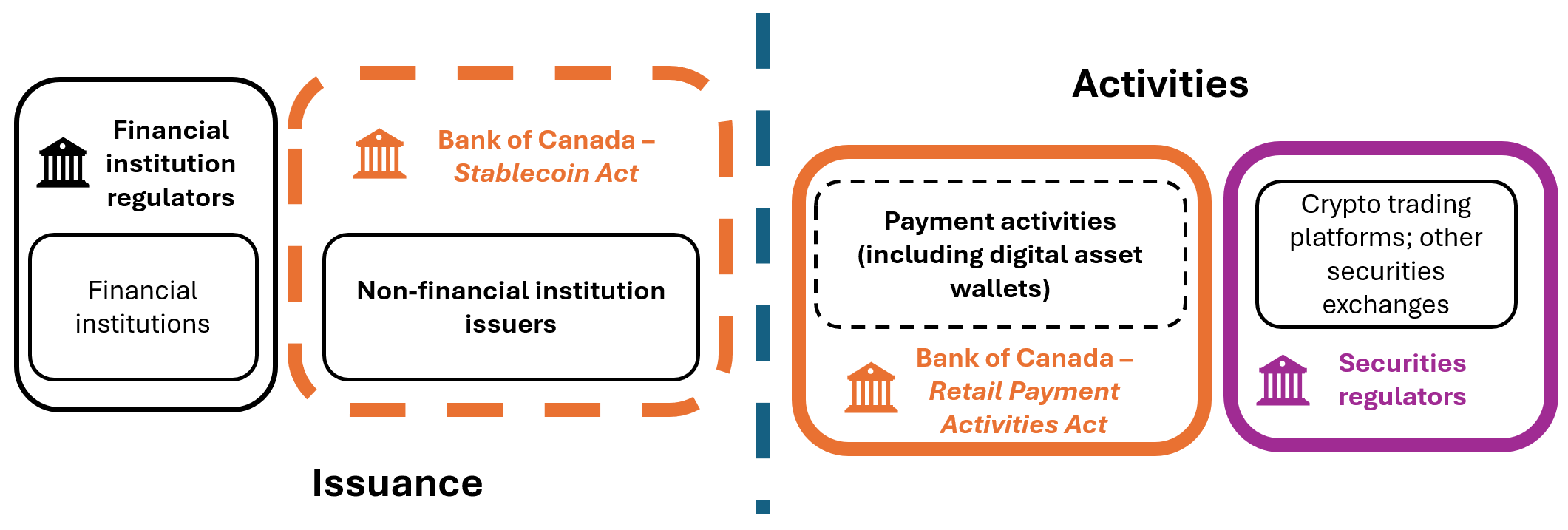
Canada's stablecoin framework will only regulate the issuance of fiat-backed stablecoins by non-financial institutions. All non-financial institution issuers of fiat-backed stablecoins in Canada will be subject to the framework and supervision by the Bank of Canada. Federal, provincial and foreign financial institutions that are prudentially regulated, such as banks or credit unions, are already subject to comprehensive regulation of their business activities. Other types of stablecoins (non-fiat-backed) will continue to be regulated by their respective provincial or territorial securities regulator.
The framework will apply to domestic and foreign issuers who make fiat-backed stablecoins available to Canadians, directly or indirectly. It does not distinguish between CAD-denominated vs foreign-currency-denominated stablecoins.
The use and exchange of fiat-backed stablecoins will continue to be regulated according to how they are used. Securities regulators will regulate the exchange and trading of fiat-backed stablecoins on securities exchanges and crypto-trading platforms. The Bank of Canada, under the Retail Payment Activities Act, will supervise payment service providers that perform payment functions in a fiat-backed stablecoin, subject to that stablecoin being prescribed in regulation.
2.3 Registration
Non-financial institution issuers will need to apply for registration with the Bank of Canada. As part of this application, issuers will need to provide:
- information on corporate ownership, structure and financial health;
- technology information related to the stablecoin that is planned to be issued; and,
- compliance information related to the Stablecoin Act (the Act).
Registration will be an ongoing obligation, with various requirements for issuers to provide updated information to the Bank of Canada within the time and in the manner to be specified in the regulations and when significant changes occur. Issuers will also need to provide to the Bank of Canada reports containing compliance-related information certified by a chartered accountant and supported by an opinion from a legal practitioner.
2.4 Reserves
Issuers will need to maintain a reserve of assets of equal or greater value than the value of stablecoins that have been minted. The assets must be held in cash or high-quality cash-like assets at a qualified custodian and must be segregated from the other assets of the issuer and the qualified custodian. Issuers must ensure that, in the event of their insolvency, the reserve assets are not accessible to creditors other than the holders of the outstanding stablecoins.
2.5 Redemption
Issuers will need to establish, publish, and follow a redemption policy that spells out how a stablecoin holder can redeem their stablecoin in the referenced currency. This will include the timing and manner of redemption, any fees that may be charged, and a description of the role of third parties.
2.6 Other provisions
Issuers will need to:
- establish, publish, and follow policies on corporate governance, data security, risk management, and recovery and resolution;
- not offer interest or yield to stablecoin holders;
- not represent that their stablecoin is legal tender, a deposit, or insured under a public deposit insurance system;
- not communicate or provide false or misleading information, by the use of such terms, expressions, logos, symbols, or illustrations to be specified in the regulations; and,
- provide the Bank of Canada or the Minister of Finance with any information requested.
Issuers of stablecoins will also be subject to anti-money laundering and anti-terrorist financing (AML/ATF) requirements established under the Proceeds of Crime (Money Laundering) and Terrorist Financing Act as they are considered money services businesses (MSBs) that are dealing in virtual currencies.
2.7 Enforcement
Canada's stablecoin framework includes key protections to ensure that issuers respect their obligations under the Act. Non-compliance can be addressed by the Bank of Canada through compliance agreements and administrative monetary penalties.
The proposed framework provides authorities to the Minister of Finance that align with existing financial sector statutes, including the Retail Payment Activities Act and the Consumer-Driven Banking Act, to refuse access to the framework for national security-related reasons.The Minister can also prohibit an issuer from taking any measures related to issuing stablecoins to people in Canada if it serves the public interest or for reasons related to national security. Consistent with the federal legislation of financial institutions, the Act provides the Minister with the power to impose conditions or require undertakings, if the Minister is of the opinion that it is necessary for national security reasons.
3. Next Steps
With the legislation having received Royal Assent, the Department of Finance has begun the development of supporting regulations for the Stablecoin Act. Once completed, draft regulations will be published in the Canada Gazette.
The Department will continue to work with the Bank of Canada and other key partners to monitor ongoing domestic and international developments in this evolving market and ensure that Canada's stablecoin framework provides a safe environment for innovation and competition while protecting consumers and the stability of Canada's financial system.
Page details
Date modified: 2026-03-31
Subscribe to:
Posts (Atom)
Interactive Communications

Interactive Communications VOIP and VPN
A Chinese AI Model Just Shot to Number One on the Charts
A Chinese AI Model Just Shot to Number One on the Charts, Sending Shockwaves Through the American Tech Industry US tech execs are shaking i...
-
The EU launches its new satellite plan and challenges Starlink: “Reserve two-thirds of the bandwidth for domestic operators” The Commission’...
-
Anthropic Caught Secretly Spying on Users Anthropic's privacy claims are now "harder to believe." By Frank Landymore Published...

